70-462 Exam Details
-
Exam Code
:70-462 -
Exam Name
:Administering Microsoft SQL Server 2012/2014 Databases -
Certification
:Microsoft Certifications -
Vendor
:Microsoft -
Total Questions
:324 Q&As -
Last Updated
:Feb 06, 2022
Microsoft 70-462 Online Questions & Answers
-
Question 221:
DRAG DROP
Your company has a data warehouse that contains all of the sales data for your company. Several business applications read data from the data warehouse.
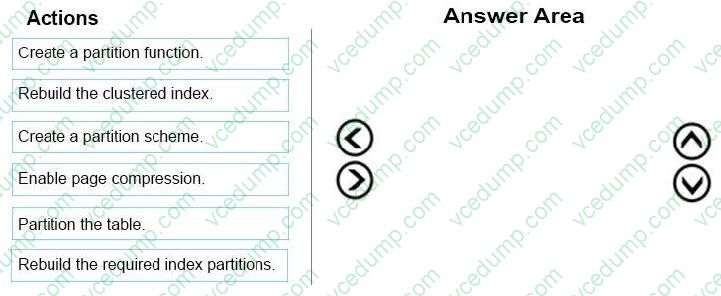
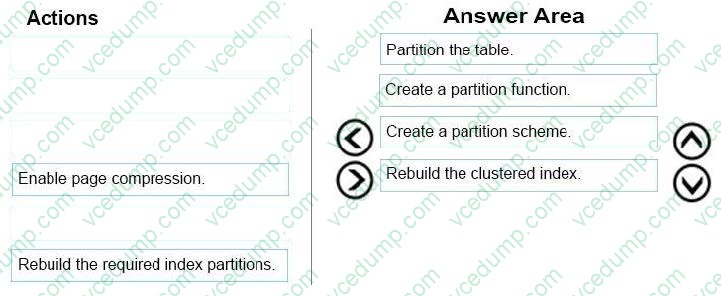
You plan to deploy an indexing strategy for a 2-TB table named FactSales contains a clustered index.
You need to recommend a solution for index maintenance that meets the following requirements:
Maintenance must be performed only when index fragmentation reaches 50 percent.
Maintenance must minimize the impact on the database reads from the business applications.
Which four actions should you perform in sequence? To answer, move the appropriate actions from the list of actions to the answer area and arrange them in the correct order.
Select and Place:
-
Question 222:
Note: This question is part of a series of questions that use the same set of answers choices. An answer choice may be correct for more than one question in the series.
You administer a Microsoft SQL Server database server that hosts a transactional database and a reporting database. The transactional database is updated through a web application and is operational throughout the day. The reporting
database is only updated from the transactional database.
The recovery model and backup schedule are configured as shown in the following table:
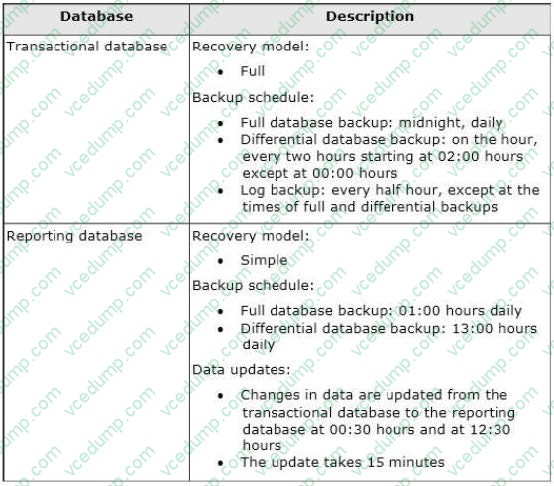
At 16:20 hours, you discover that pages 17, 137, and 205 on one of the database files are corrupted on the transactional database.
You need to ensure that the transactional database is restored.
You also need to ensure that data loss is minimal.
What should you do?
A. Perform a partial restore.
B. Restore the latest full backup, and restore the latest differential backup. Then, restore each log backup taken before the time of failure from the most recent differential backup.
C. Perform a point-in-time restore.
D. Restore the latest full backup.
E. Restore the latest full backup, and restore the latest differential backup. Then, restore the latest log backup.
F. Perform a page restore.
G. Restore the latest full backup. Then, restore each differential backup taken before the time of failure from the most recent full backup.
H. Restore the latest full backup. Then, restore the latest differential backup. -
Question 223:
You administer a Microsoft SQL Server database server. One of the databases on the server supports a highly active OLTP application.
Users report abnormally long wait times when they submit data into the application.
You need to gather blocking data over an extended period of time. You also need to ensure minimum impact to server performance.
What should you do?
A. Run the sp_who2 command from a query window and examine the BlkBy column.
B. Use the Job Activity monitor to review all processes that are actively running. Review the Job History to find out the duration of each step.
C. Use sp_configure to set a value for blocked process threshold. Create an extended event session.
D. Use SQL Profiler to trace all queries that are processing on the server. Filter queries that have a Duration value of more than 1,000 ms.
E. Run the DBCC TRACEON 1222 command from a query window and review the SQL Server event log. -
Question 224:
DRAG DROP
You administer a Microsoft SQL Server 2012 database.
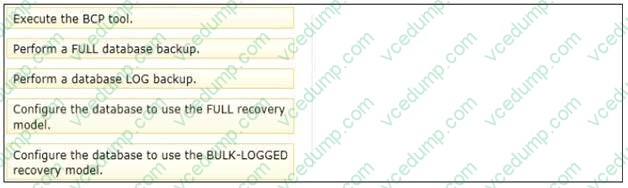
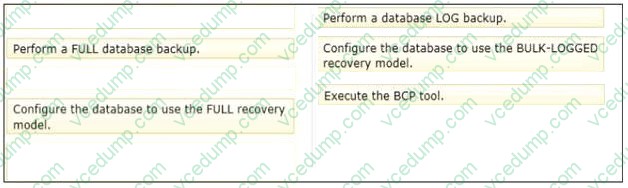
The database uses SQL Server Agent jobs to perform regular FULL and LOG backups. The database uses the FULL recovery model.
You plan to perform a bulk import of a very large text file.
You need to ensure that the following requirements are met during the bulk operation:
The database transaction log is minimally affected.
The database is online and all user transactions are recoverable.
All transactions are fully recoverable prior to the import.
Which three actions should you perform in sequence? (To answer, move the appropriate actions from the list of actions to the answer area and arrange them in the correct order.)
Select and Place:
-
Question 225:
You administer a Microsoft SQL Server 2012 Enterprise Edition server that uses 64 cores.
You discover performance issues when complex calculations are performed on large amounts of data under heavy system load.
You need to limit the number of cores that process the calculations.
What should you configure?
A. Max worker threads
B. Processor affinity
C. I/O affinity
D. Lightweight pooling -
Question 226:
You administer a Microsoft SQL Server database instance. You create a new user named UserA.
You need to ensure that UserA is able to create SQL Server Agent jobs and execute SQL Server Agent jobs owned by UserA
To which role should you add UserA?
A. RSExecRole
B. SQLAgentUserRole
C. serveradmin
D. DatabaseMailUserRole -
Question 227:
You administer several Microsoft SQL Server database servers. Merge replication has been configured for an application that is distributed across offices throughout a wide area network (WAN).
Many of the tables involved in replication use the XML and varchar (max) data types. Occasionally, merge replication fails due to timeout errors.
You need to reduce the occurrence of these timeout errors.
What should you do?
A. Set the Merge agent on the problem subscribers to use the slow link agent profile.
B. Create a snapshot publication, and reconfigure the problem subscribers to use the snapshot publication.
C. Change the Merge agent on the problem subscribers to run continuously.
D. Set the Remote Connection Timeout on the Publisher to 0. -
Question 228:
You administer a Microsoft SQL Server database that has multiple tables in the Sales schema.
Some users must be prevented from deleting records in any of the tables in the Sales schema.
You need to manage users who are prevented from deleting records in the Sales schema. You need to achieve this goal by using the minimum amount of administrative effort.
What should you do?
A. Create a custom database role that includes the users. Deny Delete permissions on the Sales schema for the custom database role.
B. Include the Sales schema as an owned schema for the db_denydatawriter role. Add the users to the db_denydatawriter role.
C. Deny Delete permissions on each table in the Sales schema for each user.
D. Create a custom database role that includes the users. Deny Delete permissions on each table in the Sales schema for the custom database role. -
Question 229:
DRAG DROP
You administer a Microsoft SQL Server database that is used by an application.
Users of the application report performance issues.
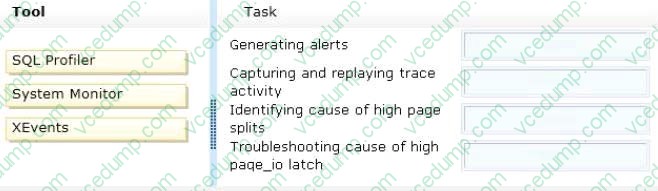
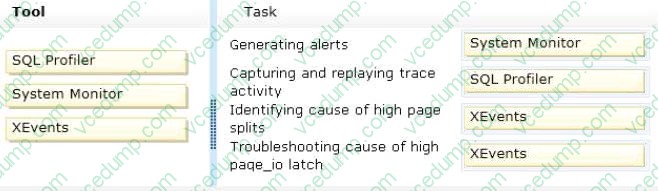
You need to choose the appropriate tool for performance-tuning of SQL Server databases.
Which tool or tools should you use? (To answer, drag the appropriate tool or tools to their corresponding task or tasks in the answer area. Each tool may be used once, more than once, or not at all. You may need to drag the split bar between
panes or scroll to view content.)
Select and Place:
-
Question 230:
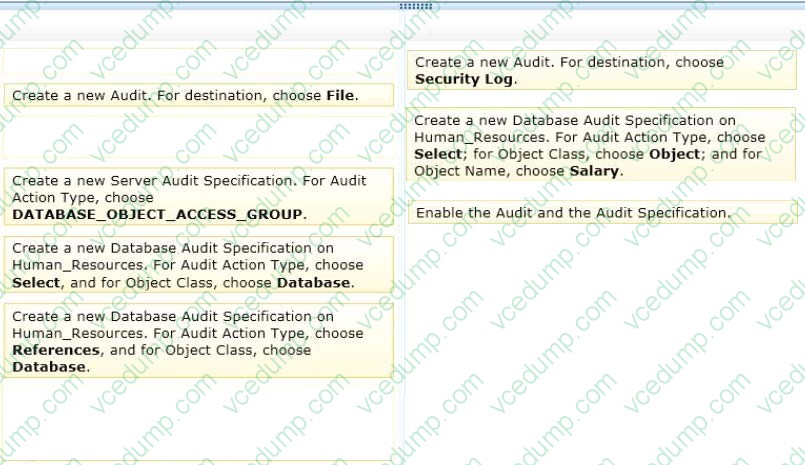
DRAG DROP
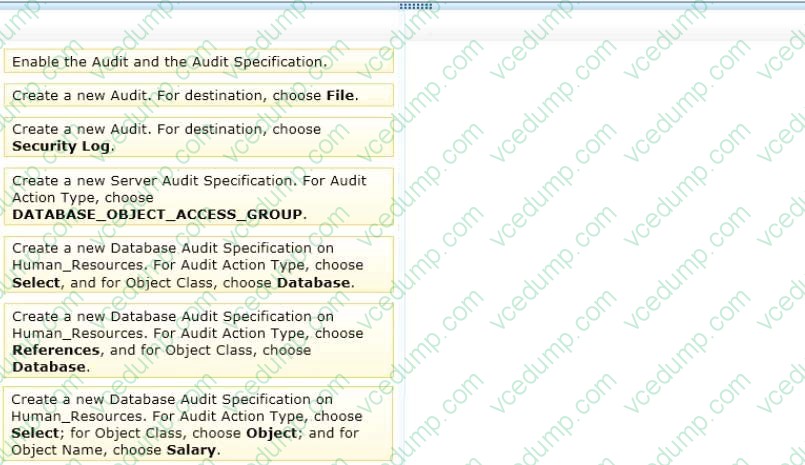
You administer a Microsoft SQL Server 2012 database called Human_Resources. The database contains a table named dbo.Salary.
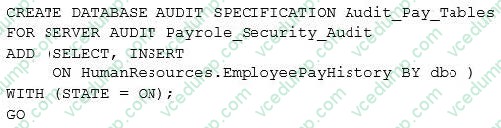
You need to ensure that all read activity against dbo.Salary is audited and written to the Windows Security Log.
What should you do? (To answer, move the three appropriate actions from the list of actions to the answer area and arrange them in the correct order.)
Select and Place:
Related Exams:
-
62-193
Technology Literacy for Educators -
70-243
Administering and Deploying System Center 2012 Configuration Manager -
70-355
Universal Windows Platform – App Data, Services, and Coding Patterns -
77-420
Excel 2013 -
77-427
Excel 2013 Expert Part One -
77-725
Word 2016 Core Document Creation, Collaboration and Communication -
77-726
Word 2016 Expert Creating Documents for Effective Communication -
77-727
Excel 2016 Core Data Analysis, Manipulation, and Presentation -
77-728
Excel 2016 Expert: Interpreting Data for Insights -
77-731
Outlook 2016 Core Communication, Collaboration and Email Skills
Tips on How to Prepare for the Exams
Nowadays, the certification exams become more and more important and required by more and more enterprises when applying for a job. But how to prepare for the exam effectively? How to prepare for the exam in a short time with less efforts? How to get a ideal result and how to find the most reliable resources? Here on Vcedump.com, you will find all the answers. Vcedump.com provide not only Microsoft exam questions, answers and explanations but also complete assistance on your exam preparation and certification application. If you are confused on your 70-462 exam preparations and Microsoft certification application, do not hesitate to visit our Vcedump.com to find your solutions here.