70-462 Exam Details
-
Exam Code
:70-462 -
Exam Name
:Administering Microsoft SQL Server 2012/2014 Databases -
Certification
:Microsoft Certifications -
Vendor
:Microsoft -
Total Questions
:324 Q&As -
Last Updated
:Feb 06, 2022
Microsoft 70-462 Online Questions & Answers
-
Question 1:
You administer a Microsoft SQL Server database.
You need to ensure that the size of the transaction log file does not exceed 2 GB.
What should you do?
A. Execute sp_configure 'max log size', 2G.
B. Use the ALTER DATABASE...MODIFY FILE command along with the name and maxsize parameters.
C. Use the ALTER DATABASE...MODIFY FILEGROUP command along with the name and maxsize parameters.
D. Use the ALTER DATABASE...AUTO_SHRINK command along with the On parameter. -
Question 2:
Note: This question is part of a series of questions that use the same set of answer choices. An answer choice may be correct for more than one question in the series.
You administer all the deployments of Microsoft SQL Server in your company.
You need to ensure that an OLTP database that uses a storage area network (SAN) remains available if any of the servers fail.
You also need to minimize the amount of storage used by the database.
Which configuration should you use?
A. Two servers configured in different data centers SQL Server Availability Group configured in Synchronous-Commit Availability Mode One server configured as an Active Secondary
B. SQL Server that includes an application database configured to perform transactional replication
C. Two servers configured in the same data center SQL Server Availability Group configured in Asynchronous-Commit Availability Mode One server configured as an Active Secondary
D. Two servers configured in different data centers SQL Server Availability Group configured in Asynchronous-Commit Availability Mode
E. Two servers configured in the same data center A primary server configured to perform log-shipping every 10 minutes A backup server configured as a warm standby
F. Two servers configured on the same subnet SQL Server Availability Group configured in Synchronous-Commit Availability Mode
G. SQL Server that includes an application database configured to perform snapshot replication
H. Two servers configured in a Windows Failover Cluster in the same data center SQL Server configured as a clustered instance -
Question 3:
You administer a SQL Server database instance.
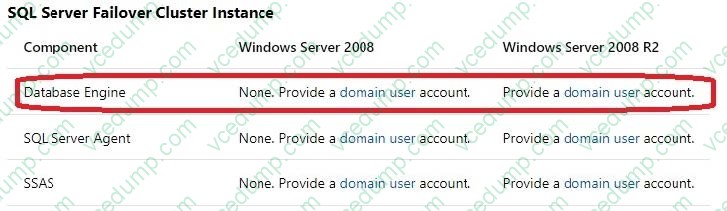
You need to configure the SQL Server Database Engine service on a failover cluster.
Which user account should you use?
A. The BUILTIN\LocalService account
B. A domain user
C. A local administrative user
D. The BUILTIN\NetworkService account -
Question 4:
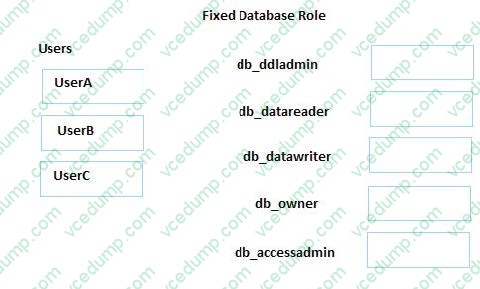
DRAG DROP
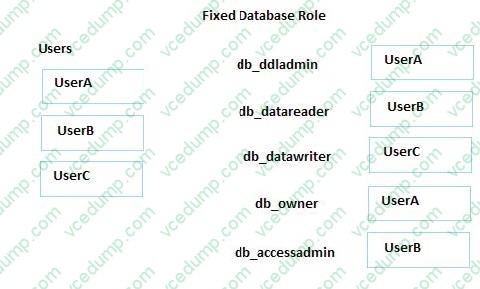
You administer a database named SalesDb that has users named UserA, UserB, and UserC. You need to ensure that the following requirements are met:
* UserA must be able to provide Windows login access to the database.
* UserB must be able to select, update, delete and insert data to the database tables.
* UserC must be able to create new tables and stores procedures
You need to achieve this goal by granting only the minimum permissions required.
To which fixed database role or roles should you add the users?
Select and Place:
-
Question 5:
You install SQL Server on a new server named SQL1 and create several databases.
Users report that they fail to connect to any of the databases on SQL1.
You discover that the TCP connections are disabled for the database engine on SQL1.
You need to ensure that the users can connect to the databases on SQL1.
What should you use?
A. the SQL Server Installation Center
B. the sp_configure stored procedure
C. SQL Server Configuration Manager
D. the ODBC Data Source Administrator -
Question 6:
You administer a single server that contains a Microsoft SQL Server 2012 default instance.
You plan to install a new application that requires the deployment of a database on the server. The application login requires sysadmin permissions.
You need to ensure that the application login is unable to access other production databases.
What should you do?
A. Use the SQL Server default instance and configure an affinity mask.
B. Install a new named SQL Server instance on the server.
C. Use the SQL Server default instance and enable Contained Databases.
D. Install a new default SQL Server instance on the server. -
Question 7:
You have a large partitioned fact table in a data warehouse. The table is stored as a clustered index.
You need to modify the indexing solution to minimize the amount of disk space required to store the table.
What should you do?
A. Enable row compression for the clustered index.
B. Enable page compression for the clustered index.
C. Implement a nonclustered columnstore index.
D. Implement a clustered columnstore index. -
Question 8:
You need to install SQL Server on a server. The server must meet the following requirements:
Include SQL Server Integration Services (SSIS)
Be able to run 32-bit SSIS legacy packages
You add the Integration Services shared feature to the installation.
Which other shared feature should you add to the installation?
A. Client Tools Connectivity
B. Master Data Services (MDS)
C. Management Tools - Complete
D. SQL Server Data Tools -
Question 9:
Which of the following transaction safety setting in SQL Server 2012 mirroring forces the mirror to be synchronized with the primary at all times?
A. SAFETY FULL
B. SAFETY OFF
C. MIRROR SYNC
D. MIRROR 100 -
Question 10:
You administer a Microsoft SQL Server 2012 database named Contoso on a server named Server01.
You need to diagnose deadlocks that happen when executing a specific set of stored procedures by recording events and playing them back on a different test server.
What should you create?
A. An Extended Event session
B. A Policy
C. A Database Audit Specification
D. An Alert
E. A Server Audit Specification
F. A SQL Profiler Trace
G. A Resource Pool
Related Exams:
-
62-193
Technology Literacy for Educators -
70-243
Administering and Deploying System Center 2012 Configuration Manager -
70-355
Universal Windows Platform – App Data, Services, and Coding Patterns -
77-420
Excel 2013 -
77-427
Excel 2013 Expert Part One -
77-725
Word 2016 Core Document Creation, Collaboration and Communication -
77-726
Word 2016 Expert Creating Documents for Effective Communication -
77-727
Excel 2016 Core Data Analysis, Manipulation, and Presentation -
77-728
Excel 2016 Expert: Interpreting Data for Insights -
77-731
Outlook 2016 Core Communication, Collaboration and Email Skills
Tips on How to Prepare for the Exams
Nowadays, the certification exams become more and more important and required by more and more enterprises when applying for a job. But how to prepare for the exam effectively? How to prepare for the exam in a short time with less efforts? How to get a ideal result and how to find the most reliable resources? Here on Vcedump.com, you will find all the answers. Vcedump.com provide not only Microsoft exam questions, answers and explanations but also complete assistance on your exam preparation and certification application. If you are confused on your 70-462 exam preparations and Microsoft certification application, do not hesitate to visit our Vcedump.com to find your solutions here.