70-462 Exam Details
-
Exam Code
:70-462 -
Exam Name
:Administering Microsoft SQL Server 2012/2014 Databases -
Certification
:Microsoft Certifications -
Vendor
:Microsoft -
Total Questions
:324 Q&As -
Last Updated
:Feb 06, 2022
Microsoft 70-462 Online Questions & Answers
-
Question 191:
HOTSPOT
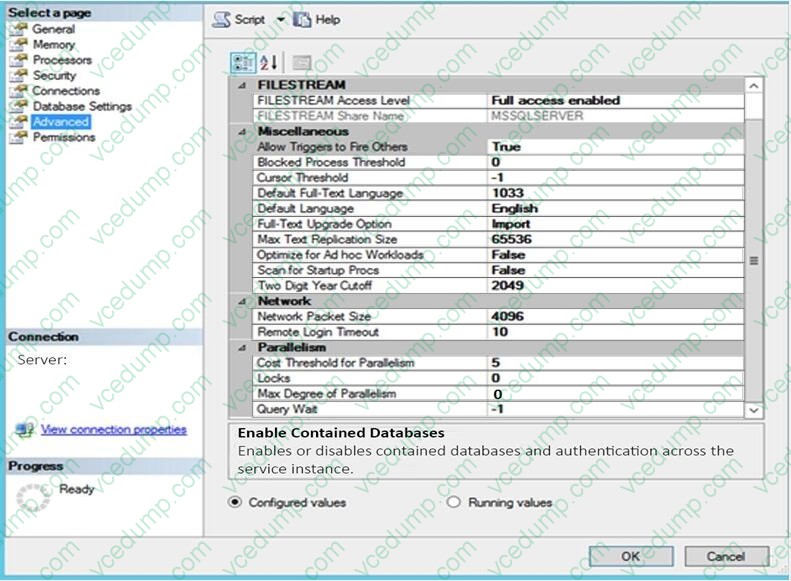
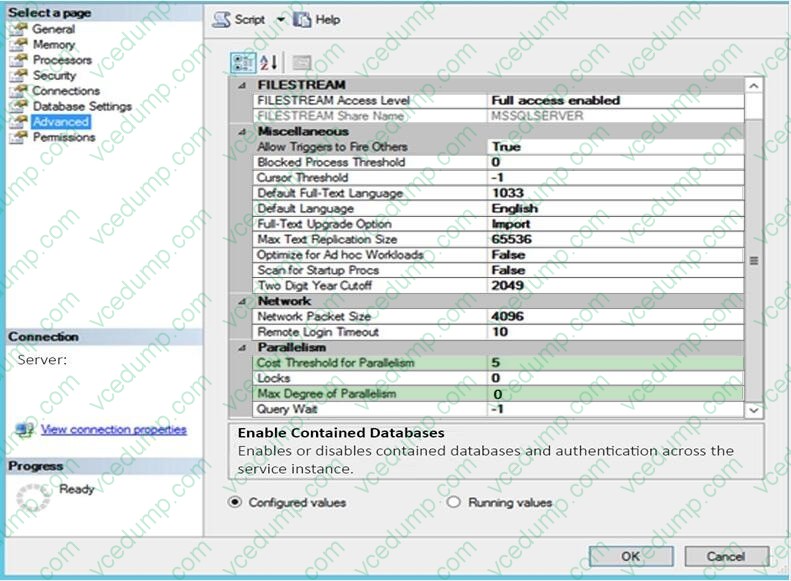
You have a server named SQL1 that has SQL Server 2014 installed. SQL1 has 32 processor cores and 64 GB of RAM.
SQL1 hosts a database used for a public-facing marketing website. SQL1 performs Online Transaction Processing (OLTP) operations only.
Several of the queries that run on SQL1 use the 32 processor cores and complete in 30 ms.
You need to reduce the number of queries that use multiple cores. The solution must also reduce the number of processor cores used by the queries that require multiple processor cores.
Which two database settings should you modify? To answer, select the appropriate settings in the answer area.
Hot Area:
-
Question 192:
You administer a Microsoft SQL Server database.
You need to ensure that the size of the transaction log file does not exceed 2 GB.
What should you do?
A. Execute sp_configure 'max log size', 2G.
B. Use the ALTER DATABASE...MODIFY FILEGROUP command along with the name and maxsize parameter.
C. In SQL Server Management Studio, right-click the database, select Properties, and then click Files. Open the Transaction log Autogrowth window and set the maximum size of the file.
D. Use the ALTER DATABASE...AUTO_SHRINK command along with the On parameter. -
Question 193:
DRAG DROP
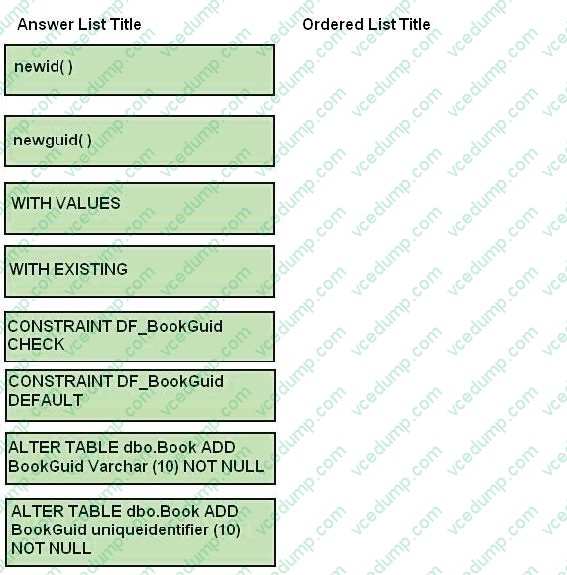
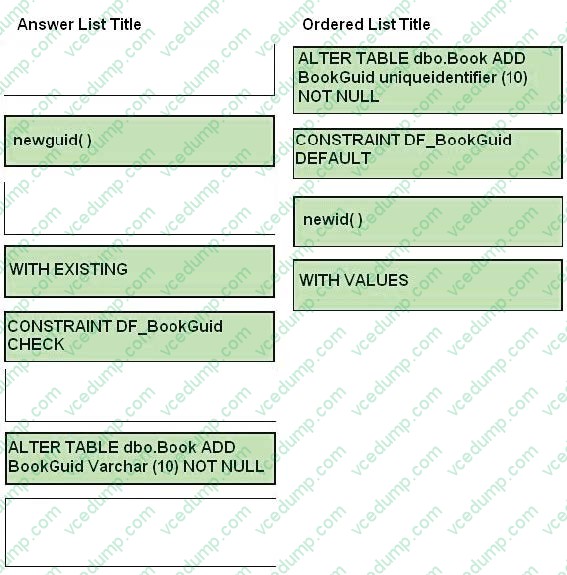
You want to add a new GUID column named BookGUID to a table named dbo.Book that already contains data.
BookGUID will have a constraint to ensure that it always has a value when new rows are inserted into dbo.Book. You need to ensure that the new column is assigned a GUID for existing rows. Which four Transact-SQL statements should you
use? (To answer, move the appropriate SQL statements from the list of statements to the answer area and arrange them in the correct order.)
Select and Place:
-
Question 194:
Which of the following will show you a history of job errors that have occurred in jobs scheduled to run in an SQL Server 2012 installation?
A. Look at the sys.all_job_hist table.
B. In Management Studio, navigate to SQL Server Agent -> Error Logs and look at the log for the corresponding date.
C. Open the c:\error\job.log file and search for the particular job and the errors you wish to view.
D. You must use T-SQL to write a job-logging procedure to monitor jobs. -
Question 195:
DRAG DROP
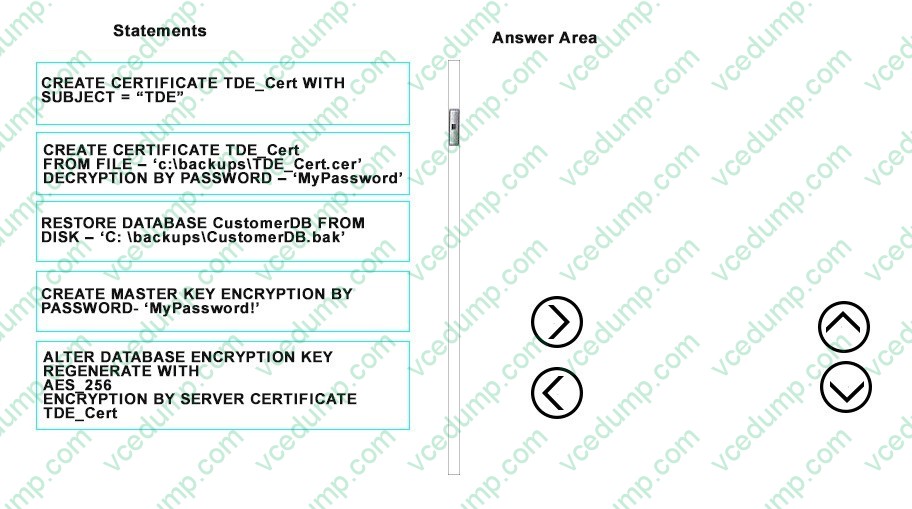
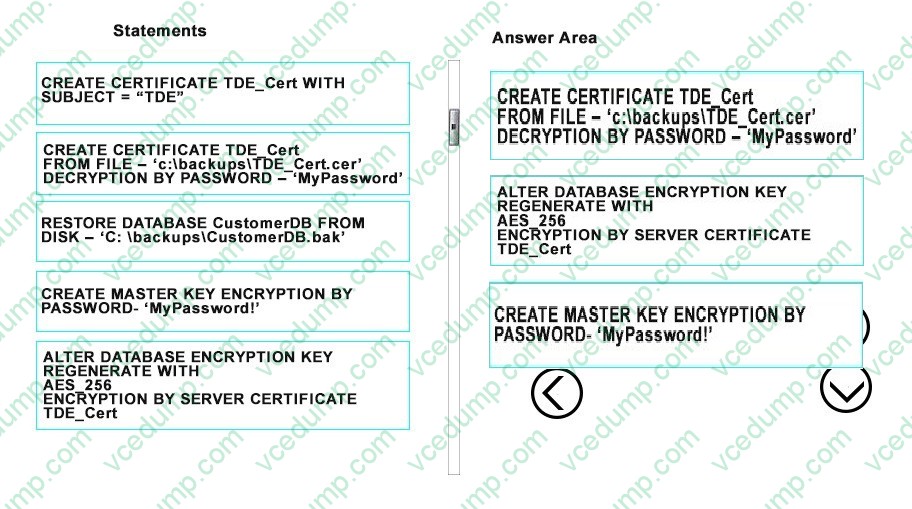
You have a SQL Server database server that contains a database named CustomerDB. CustomerDB is protected by using transparent data encryption (TDE) and a certificate named TDE_Cert.
The server fails.
You deploy a new server and restore all of the backups to a folder named C:\backups.
You need to restore the database to the new server.
Which three statements should you execute in sequence? To answer, move the appropriate statements from the list of statements to the answer area and arrange them in the correct order.
Select and Place:
-
Question 196:
You have configured Resource Governor with three resource pools.
You have assigned the first resource pool a minimum CPU and memory value of 20%.
You have assigned the second resource pool a minimum CPU and memory value of 30%.
You want to assign maximum CPU and memory values to the third resource pool.
What is the maximum CPU and memory value you can assign to this resource pool?
A. 30%
B. 50%
C. 70%
D. 100% -
Question 197:
You administer a Microsoft Azure SQL Database instance named Orders.
Users report that a query that filters on OrderDate is taking an exceptionally long time. You discover that an index named IX_OrderDate on the CustomerOrder table is disabled.
You need to ensure that the query can use the IX_OrderDate index.
Which Transact-SQL command should you use?
A. ALTER INDEX IX_OrderDate ON CustomerOrder DISABLE
B. ALTER INDEX IX_OrderDate ON CustomerOrder ENABLE
C. ALTER INDEX IX_OrderDate ON CustomerOrder REORGANIZE
D. ALTER INDEX IX_OrderDate ON CustomerOrder REBUILD -
Question 198:
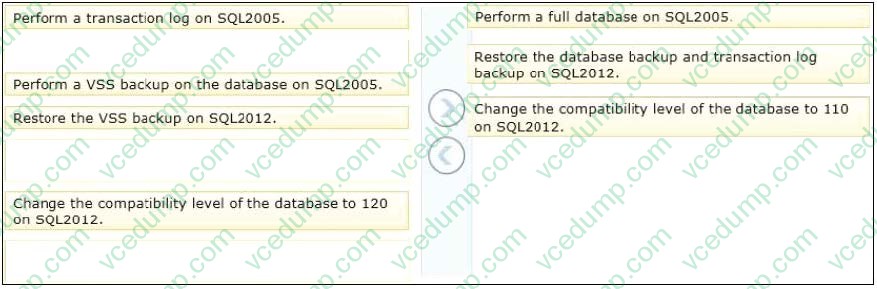
DRAG DROP
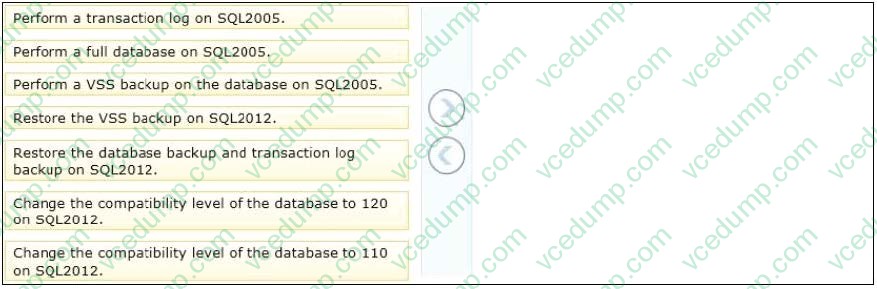
You administer a Microsoft SQL Server 2012 environment that contains a production SQL Server 2005 instance named SQL2005 and a development SQL Server 2012 instance named SQL2012.
The development team develops a new application that uses the SQL Server 2012 functionality. You are planning to migrate a database from SQL2005 to SQL2012 so that the development team can test their new application.
You need to migrate the database without affecting the production environment.
Which three actions should you perform in sequence? (To answer, move the appropriate actions from the list of actions to the answer area and arrange them in the correct order.)
Select and Place:
-
Question 199:
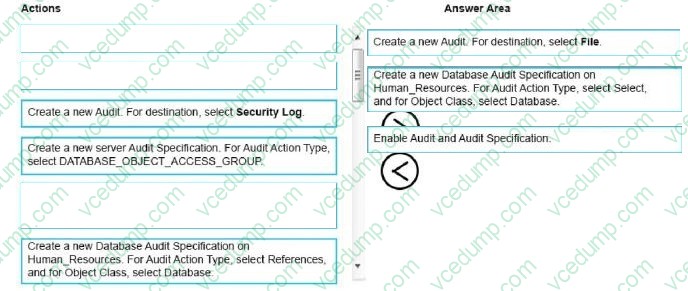
DRAG DROP
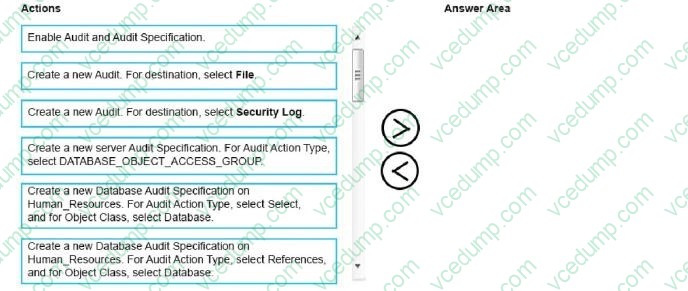
You administer a Microsoft SQL Server 2012 database named Human_Resources.
You need to ensure that all read activity against any object in the Human_Resources database is audited and written to a text file.
What should you do? (To answer, move the appropriate actions from the list of actions to the answer area and arrange them in the correct order.)
Select and Place:
-
Question 200:
You manage a server that has SQL Server installed and hosts databases for five applications. Each application has a different login to the SQL Server instance. You need to create a TCP endpoint to be used only by a login named Application3. The solution must ensure that Application3 only uses the new endpoint. Which three statements should you execute? Each correct answer presents part of the solution.
A. GRANT CONNECT ON ENDPOINT::[TSQL Default TCP] TO Application3
B. DENY CONNECT ON ENDPOINT::[TSQL Default TCP] TO Application3
C. CREATE ENDPOINT Application3_EndPoint STATE=STARTED AS TCP (LISTENER_PORT=1388)
D. GRANT .CONNECT ON ENDPOINT:: Application3_EndPoint TO Public
E. GRANT CONNECT ON ENDPOINT::[TSQL Default TCP] TO PUBLIC
F. REVOKE CONNECT ON ENDPOINT::[TSQL Default TCP] TO Application3
G. REVOKE CONNECT ON ENDPOINT::[TSQL Default TCP] TO PUBLIC
Related Exams:
-
62-193
Technology Literacy for Educators -
70-243
Administering and Deploying System Center 2012 Configuration Manager -
70-355
Universal Windows Platform – App Data, Services, and Coding Patterns -
77-420
Excel 2013 -
77-427
Excel 2013 Expert Part One -
77-725
Word 2016 Core Document Creation, Collaboration and Communication -
77-726
Word 2016 Expert Creating Documents for Effective Communication -
77-727
Excel 2016 Core Data Analysis, Manipulation, and Presentation -
77-728
Excel 2016 Expert: Interpreting Data for Insights -
77-731
Outlook 2016 Core Communication, Collaboration and Email Skills
Tips on How to Prepare for the Exams
Nowadays, the certification exams become more and more important and required by more and more enterprises when applying for a job. But how to prepare for the exam effectively? How to prepare for the exam in a short time with less efforts? How to get a ideal result and how to find the most reliable resources? Here on Vcedump.com, you will find all the answers. Vcedump.com provide not only Microsoft exam questions, answers and explanations but also complete assistance on your exam preparation and certification application. If you are confused on your 70-462 exam preparations and Microsoft certification application, do not hesitate to visit our Vcedump.com to find your solutions here.