400-051 Exam Details
-
Exam Code
:400-051 -
Exam Name
:CCIE Collaboration Written -
Certification
:Cisco Certifications -
Vendor
:Cisco -
Total Questions
:585 Q&As -
Last Updated
:Dec 15, 2021
Cisco 400-051 Online Questions & Answers
-
Question 311:
Company ABC is deploying Mobile and Remote Access (MRA) to allow employees to login Jabber clients from anywhere on the internet. Which HTTPS request does a Jabber client send after it successfully established a secured connection with a Cisco Expressway-E?
A. get_cucm_uds
B. get_services_config
C. get_user_config
D. get_edge_config
E. get_jabber_config -
Question 312:
Refer to the exhibit.
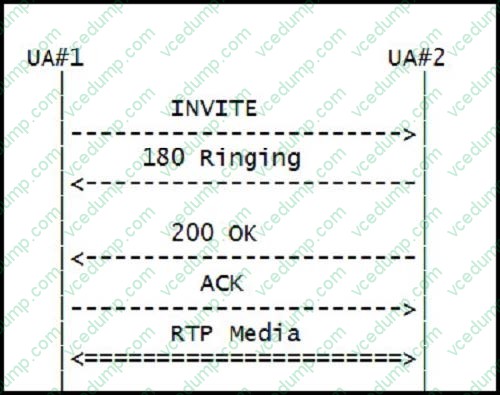
If this SIP call is initiated using early offer, which SIP message will UA#2 use to communicate its media capability to UA#1?
A. INVITE
B. 180 Ringing
C. 200 OK
D. ACK
E. RTP Media -
Question 313:
When using LDAP synchronization to automatically create and synchronize Cisco Unified Communications Manager end users, which two LDAP attributes can be synchronized to directory URI? (Choose two.)
A. emailaddress
B. msRTCSIPuseraddress
C. mail
D. msRTCSIPprimaryuseraddress
E. email -
Question 314:
Which system location is used for intercluster Enhanced Location CAC on Cisco Unified Communications Manager?
A. Hub_None
B. Default
C. Intercluster
D. Phantom
E. Shadow -
Question 315:
When multiple greetings are enabled on Cisco Unity Express, which greeting will take the highest precedence?
A. standard
B. meeting
C. busy
D. closed
E. internal -
Question 316:
What is the maximum length of any numeric geographic area address in ITU recommendation E.164?
A. 15
B. 18
C. 21
D. 22
E. 25 -
Question 317:
Refer to the exhibit.
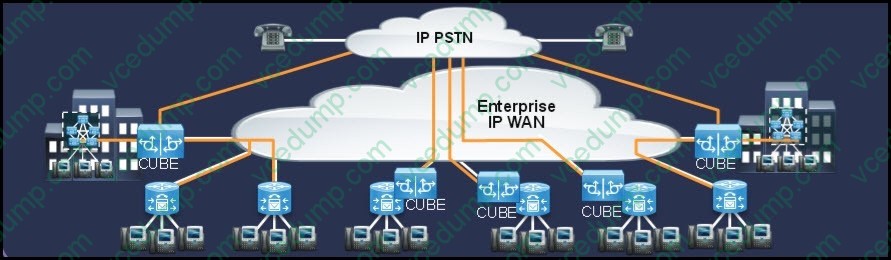
Which SIP trunk deployment model is shown in this enterprise VoIP topology?
A. mixed TDM and VoIP
B. centralized
C. hybrid
D. traditional TDM
E. distributed -
Question 318:
Which statement describes how much of the DSP resources are reserved for video conference when voice-service dsp-reservation 40 is configured on a Cisco Integrated Router Generation 2 with packet voice and video digital signal processor 3?
A. 60% of the total available DSP resources
B. 40% of the total available DSP resources
C. 50% of the total available DSP resources
D. Video conferencing resources are reserved dynamically by Cisco IOS and cannot be changed.
E. This command is used for voice resource reservation only. -
Question 319:
Refer to the exhibit.
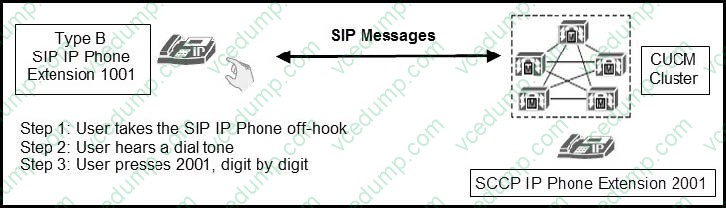
A user is going through a series of dialing steps on a SIP Type B IP phone (for example, a Cisco 7975) to call an SCCP IP phone. Both phones are registered to the same Cisco Unified Communications Manager cluster. Assuming the calling SIP phone is associated with a SIP dial rule with a pattern value of 2001, which statement about how digits are forwarded to Cisco Unified Communications Manager for further call processing is true?
A. As each digit is pressed on the SIP IP phone, it is sent to Cisco Unified Communications Manager in a SIP NOTIFY message as a KPML event.
B. The SIP IP phone will wait for the interdigit timer to expire, and then send each digit to Cisco Unified Communications Manager as a separate KPML event in a SIP NOTIFY message.
C. The SIP IP phone will wait for the interdigit timer to expire, or for the Dial softkey to be selected before sending all digits to Cisco Unified Communications Manager in a SIP INVITE message.
D. The SIP IP phone will wait for the interdigit timer to expire, or for the Dial softkey to be selected before sending the first digit in a SIP INVITE and the subsequent digits in SIP INFORMATION messages.
E. The SIP IP phone will wait for the interdigit timer to expire, and then send all digits to Cisco Unified Communications Manager in a SIP INVITE message. -
Question 320:
Refer the exhibit. Which description of the Cisco Unified Communication Manager cluster that produced these identify Trust List records is true?
A. IP phones registered to this cluster have ITL and CTL files installed.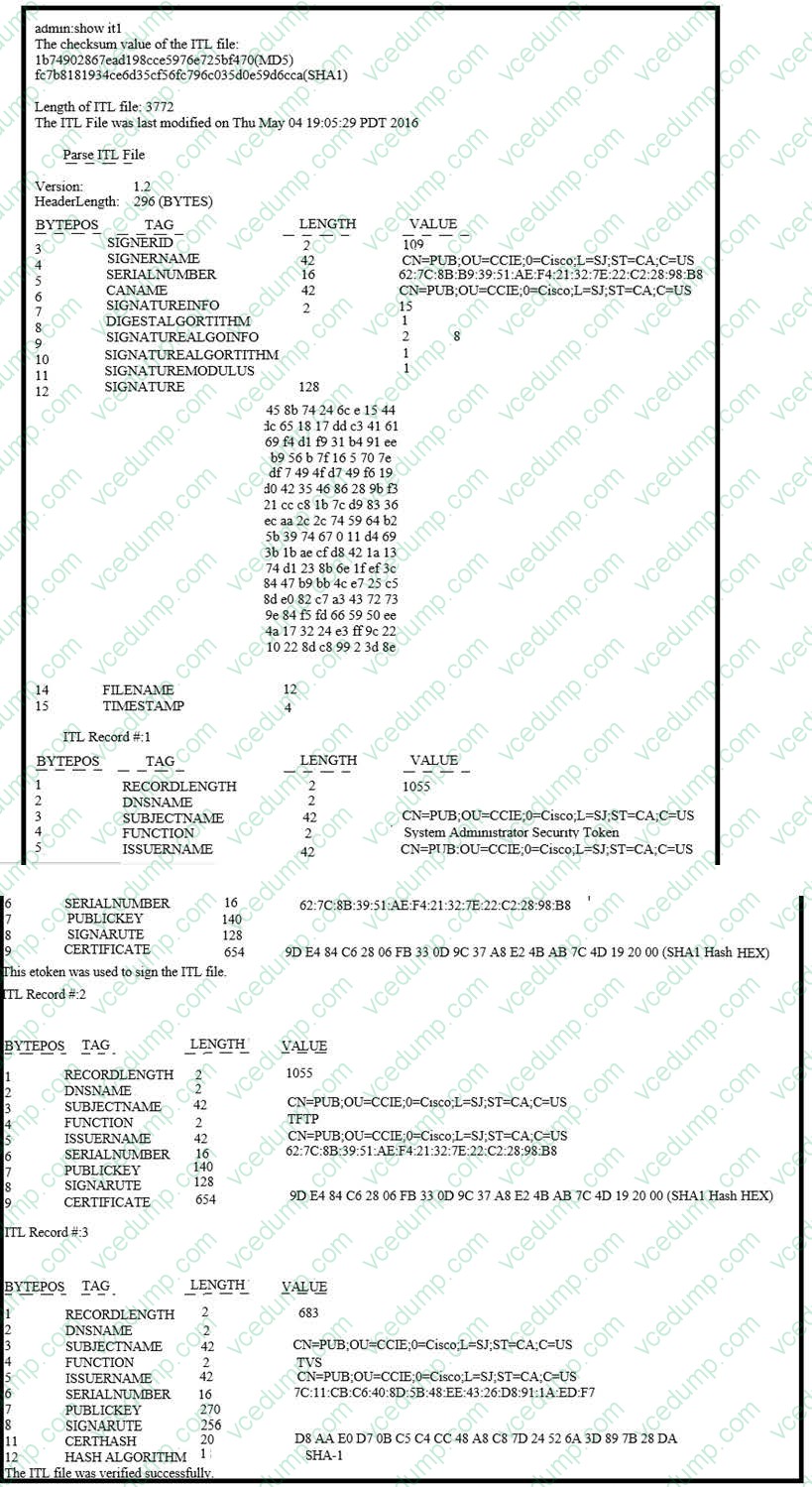
B. It is mixed-mode cluster that uses tokenless solution.
C. IP phones registered to this cluster have neither ITL nor CTL files installed.
D. It is mixed-mode cluster that uses hardware USB eToken.
E. IP phones registered to this cluster have only ITL file installed.
Related Exams:
-
300-745
Designing Cisco Security Infrastructure (300-745 SDSI) v1.0 -
350-101
Implementing and Operating Cisco Wireless Core Technologies (350-101 WLCOR)v1.0 -
352-011
Cisco Certified Design Expert Practical -
500-052
Cisco Unified Contact Center Express -
500-173
Designing the FlexPod Solution (FPDESIGN) -
500-201
Deploying Cisco Service Provider Mobile Backhaul Solutions -
500-210
SP Optical Technology Field Engineer Representative -
500-220
Engineering Cisco Meraki Solutions (ECMS) v2.2 -
500-230
Cisco Service Provider Routing Field Engineer -
500-240
Cisco Mobile Backhaul for Field Engineers
Tips on How to Prepare for the Exams
Nowadays, the certification exams become more and more important and required by more and more enterprises when applying for a job. But how to prepare for the exam effectively? How to prepare for the exam in a short time with less efforts? How to get a ideal result and how to find the most reliable resources? Here on Vcedump.com, you will find all the answers. Vcedump.com provide not only Cisco exam questions, answers and explanations but also complete assistance on your exam preparation and certification application. If you are confused on your 400-051 exam preparations and Cisco certification application, do not hesitate to visit our Vcedump.com to find your solutions here.