352-001 Exam Details
-
Exam Code
:352-001 -
Exam Name
:CCDE Written -
Certification
:Cisco Certifications -
Vendor
:Cisco -
Total Questions
:705 Q&As -
Last Updated
:Dec 07, 2025
Cisco 352-001 Online Questions & Answers
-
Question 611:
Refer to the exhibit.
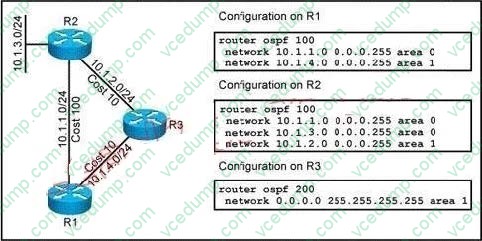
Traffic in this network that is destined for 10.1.3.1 arrives at R1. Which path will the traffic take from here and why?
A. through R3, because it is the lowest cost path
B. through R2, because it is an intra-area path
C. through R2, because R3 is in a different autonomous system
D. through R3, because R1 will only have a summary (type 3) LSA from R2 -
Question 612:
Refer to the exhibit.
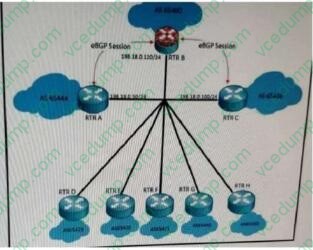
Transit traffic in this large enterprise campus network passes the eBGP core. Per security policy, traffic coming from AS 65444 destined for AS 65466 and vice-versa must pass through AS 65400. An audit discovers that traffic between 65444 and 65466 did not pass through 65400, instead it is communicating directly. How must you design BGP to ensure that the traffic from AS 65444 destined for AS 65466 passes through AS65400 on this broadcast network?
A. Apply an ACL on AS 65466 to drop the direct traffic between AS 65444 and AS 65466
B. Apply AS-path prepending on AS 65466 and AS 65444
C. Apply next-hop self on both BGP neighbors on AS 65400
D. Apply the MED attribute on the BGP session for AS 65444 -
Question 613:
Refer to the exhibit.
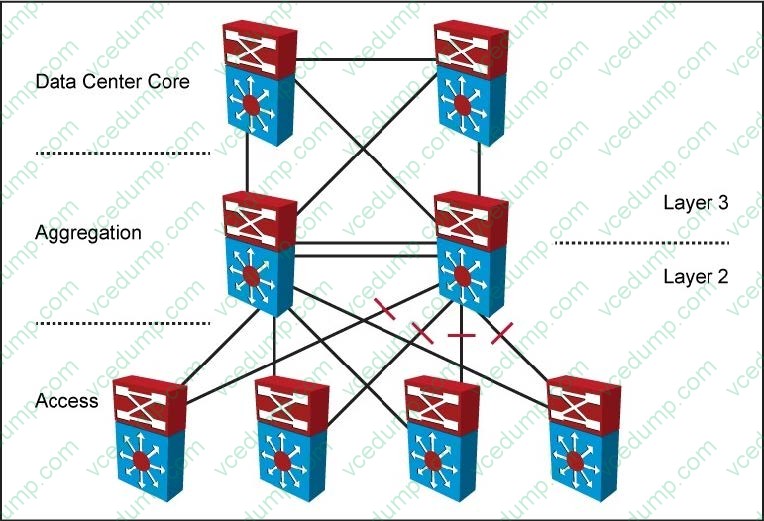
Your company designed a network to allow server VLANs to span all access switches in a data center. In the design, Layer 3 VLAN interfaces and HSRP are configured on the aggregation switches.
Which two features will improve STP stability within the network design? (Choose two.)
A. BPDU guard on access ports
B. Edge port on access ports
C. Root guard on access ports
D. BPDU guard on the aggregation switch downlinks toward access switches
E. Root guard on the aggregation switch downlinks toward access switches F. Access switch pairs are explicitly determined to be root and backup root bridges -
Question 614:
A mobile network operator is designing an NGN backhaul and plans to migrate their legacy SDH and SONET-based transport network to a packet-based transport network. The NGN network must achieve similar failover and failback times as the legacy network (50 milliseconds). Which method does allow for similar failover and failback times on the new packet-based network?
A. BFD
B. E-OAM
C. UDLC
D. BPDU -
Question 615:
Which mechanism prevents switched traffic from traversing suboptimal paths on the network?
A. PortFast
B. UDLD
C. root guard
D. Bridge Assurance
E. BPDU Filter -
Question 616:
Which network topology is characterized by a link fate-sharing situation?
A. B. C.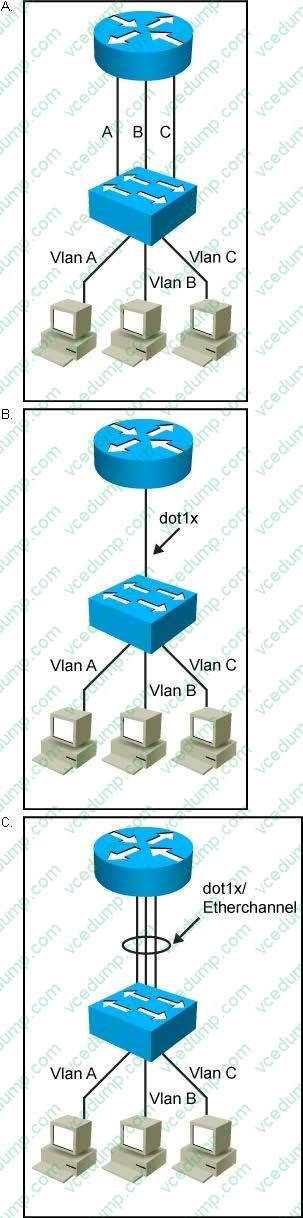
-
Question 617:
On this MPLS-based networking ring, links have failed between router A and router E. These failures formed microloops while the network converged, when A forwarded traffic to B, but B forwarded it back to A. Which technology is the simplest solution to avoid microloops without enabling a new protocol in the network?
A. Loop-Free Alternate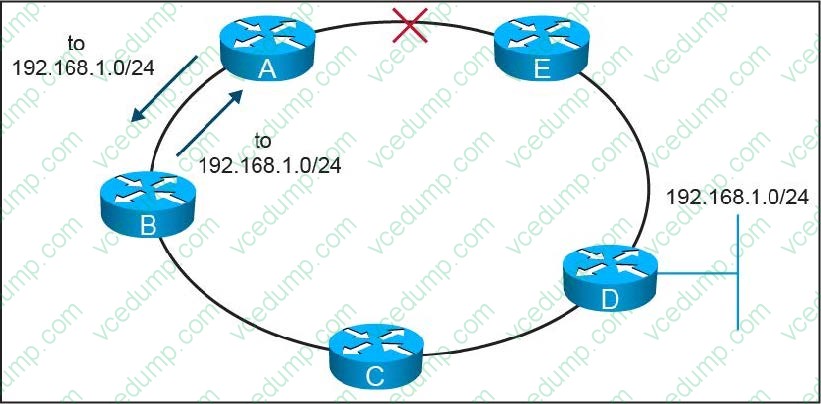
B. Remote Loop-Free Alternate
C. IP Fast ReRoute
D. TE Fast ReRoute -
Question 618:
What is downstream suppression?
A. the ability of a fault management tool to generate alerts for only an upstream device failure and to suppress the alarms related to all unreachable downstream sites
B. the ability of devices to exclusively send summary routes and suppress the sending of complete routing updates
C. the ability of a router to suppress downstream route fluctuations to avoid introducing instability into the network core
D. the ability of a network management station to perform root cause analysis on a network fault and remove duplicates of all other alarms resulting from fault symptoms
E. the ability of an element manager to restrict forwarding to critical performance alarms northbound to the Manager of Managers and suppress other alarms -
Question 619:
Two MPLS service providers (SP1 and SP2) are offering inter-provider RFC 2547/4364- based IP-VPN service to an enterprise customer. IP traffic among some of the customer's sites has to traverse both of the service providers. The service providers and the enterprise do not know what the minimum MTU is along the end-to-end path.
What could be done to guarantee that large packets are not dropped for MTU-related reasons?
A. enable Path MTU Discovery on all devices within SP1 and SP2
B. enable Path MTU Discovery on all devices within the enterprise
C. configure the IP sender or senders to set the DF flag in the IP header
D. configure the IP sender or senders to clear the DF flag in the IP header -
Question 620:
A data center provider has designed a network using these requirements:
-Two data center sites are connected to the public Internet.
-
Both data centers are connected to different Internet providers.
-
Both data centers are also directly connected with a private connection for the internal traffic, and public Internet traffic can also be routed at this direct connection.
-
The data center provider has only one /19 public IP address block.
Under normal conditions, Internet traffic should be routed directly to the data center where the services are located. When one Internet connection fails, the complete traffic for both data centers should be routed by using the remaining Internet connection. In which two ways can this routing be achieved? (Choose two.)
A. The data center provider must have an additional public IP address block for this routing.
B. One /20 block is used for the first data center and the second /20 block is used for the second data center. The /20 block from the local data center is sent out with a low BGP weight and the /20 block from the remote data center is sent out with a higher BGP weight at both sites.
C. One /20 block is used for the first data center and the second /20 block is used for the second data center. The /20 block from the local data center is sent out without path prepending and the /20 block from the remote data center is sent out with path prepending at both sites.
D. One /20 block is used for the first data center and the second /20 block is used for the second data center. Each /20 block is only sent out locally. The /19 block is sent out at both Internet connections for the backup case to reroute the traffic through the remaining Internet connection.
E. One /20 block is used for the first data center and the second /20 block is used for the second data center. The /20 block from the local data center is sent out with a low BGP local preference and the /20 block from the remote data center is sent out with a higher BGP local preference at both sites.
F. BGP will always load-balance the traffic to both data center sites.
Related Exams:
-
300-745
Designing Cisco Security Infrastructure (300-745 SDSI) v1.0 -
350-101
Implementing and Operating Cisco Wireless Core Technologies (350-101 WLCOR)v1.0 -
352-011
Cisco Certified Design Expert Practical -
500-052
Cisco Unified Contact Center Express -
500-173
Designing the FlexPod Solution (FPDESIGN) -
500-201
Deploying Cisco Service Provider Mobile Backhaul Solutions -
500-210
SP Optical Technology Field Engineer Representative -
500-220
Engineering Cisco Meraki Solutions (ECMS) v2.2 -
500-230
Cisco Service Provider Routing Field Engineer -
500-240
Cisco Mobile Backhaul for Field Engineers
Tips on How to Prepare for the Exams
Nowadays, the certification exams become more and more important and required by more and more enterprises when applying for a job. But how to prepare for the exam effectively? How to prepare for the exam in a short time with less efforts? How to get a ideal result and how to find the most reliable resources? Here on Vcedump.com, you will find all the answers. Vcedump.com provide not only Cisco exam questions, answers and explanations but also complete assistance on your exam preparation and certification application. If you are confused on your 352-001 exam preparations and Cisco certification application, do not hesitate to visit our Vcedump.com to find your solutions here.