350-401 Exam Details
-
Exam Code
:350-401 -
Exam Name
:Implementing and Operating Cisco Enterprise Network Core Technologies (ENCOR) -
Certification
:CCIE Enterprise Wireless -
Vendor
:Cisco -
Total Questions
:1524 Q&As -
Last Updated
:Jul 18, 2026
Cisco 350-401 Online Questions & Answers
-
Question 251:
Refer to the exhibit.
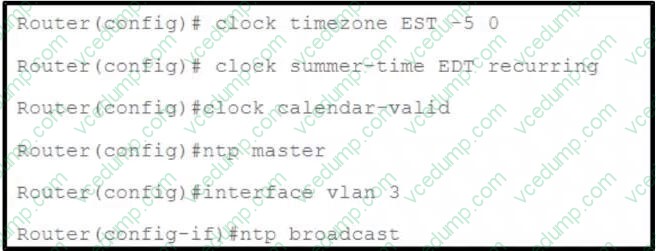
What are two results of the NTP configuration? (Choose two.)
A. It uses other systems as an authoritative time source.
B. It distributes the time via NTP broadcast and multicast packets.
C. It distributes the time via NTP broadcast packets.
D. It forms a peer association with another system.
E. It uses the hardware clock as an authoritative time source. -
Question 252:
Refer to the exhibit. After the code is run on a Cisco IOS-XE router, the response code is 204.
What is the result of the script?
A. The configuration fails because another interface is already configured with IP address 10.10.10.1/24.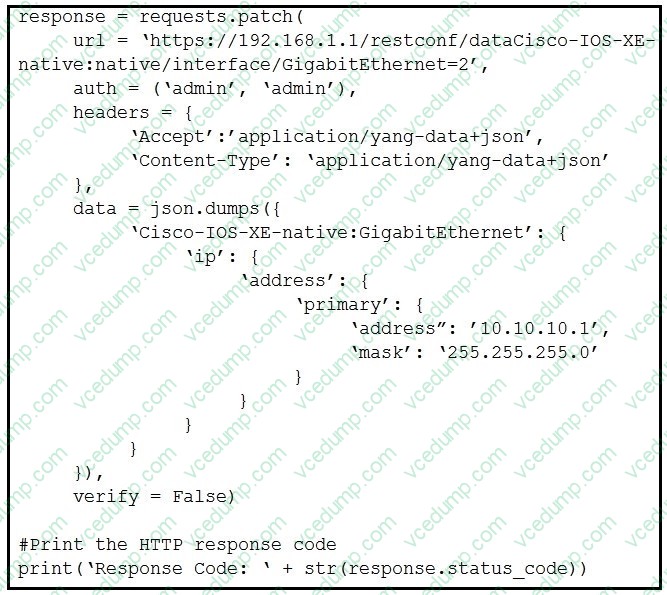
B. The configuration fails because interface GigabitEthernet2 is missing on the target device.
C. The configuration is successfully sent to the device in cleartext.
D. Interface GigabitEthernet2 is configured with IP address 10.10.10.1/24 -
Question 253:
When a wireless client roams between two different wireless controllers, a network connectivity outage is experienced for a period of time.
Which configuration issue would cause this problem?
A. Not all of the controllers in the mobility group are using the same mobility group name.
B. Not all of the controllers within he mobility group are using the same virtual interface IP address.
C. All of the controllers within the mobility group are using the same virtual interface IP address.
D. All of the controllers in the mobility group are using the same mobility group name. -
Question 254:
Refer to the exhibit.
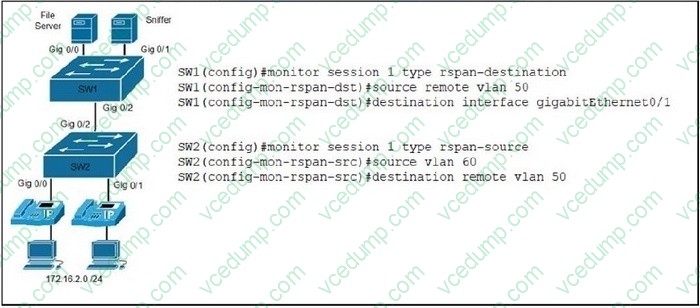
An engineer must send the 172.16.2.0 /24 user traffic to a packet capture tool to troubleshoot an issue.
Which action completes the configuration?
A. Encrypt the traffic between the users and the monitoring servers.
B. Disable the spanning tree protocol on the monitoring server VLAN.
C. Enable the Cisco Discovery Protocol on the server interfaces.
D. Define the remote span VLAN on SW1 and SW2. -
Question 255:
An engineer is concerned with the deployment of a new application that is sensitive to inter-packet delay variance.
Which command configures the router to be the destination of jitter measurements?
A. Router(config)# ip sla responder udp-connect 172.29.139.134 5000
B. Router(config)# ip sla responder tcp-connect 172.29.139.134 5000
C. Router(config)# ip sla responder udp-echo 172.29.139.134 5000
D. Router(config)# ip sla responder tcp-echo 172.29.139.134 5000 -
Question 256:
DRAG DROP
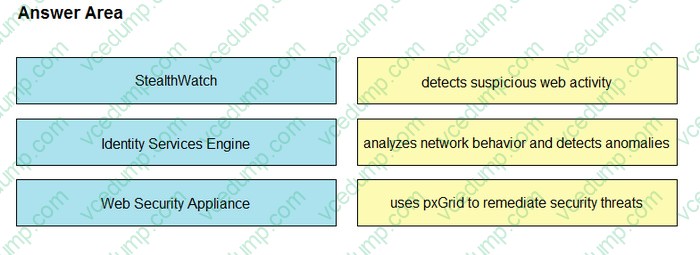
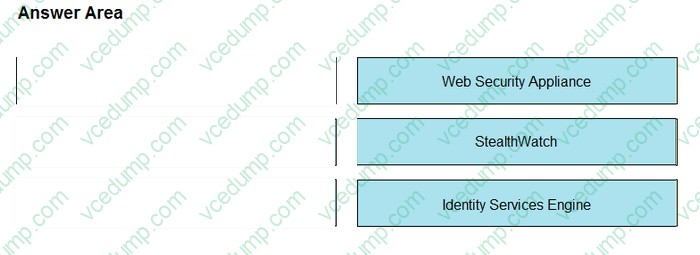
Drag and drop the solutions that comprise Cisco Cyber Threat Defense from the left onto the objectives they accomplish on the right.
Select and Place:
-
Question 257:
Which characteristics applies to Cisco SD-Access?
A. It uses dynamic routing to discover and provision the border and edge switches
B. It uses VXLAN for the control plane
C. It uses PnP to discover and provision border and access switches
D. It uses GRE tor the policy plane -
Question 258:
What is a type 2 hypervisor?
A. Installed as an application on an already installed operating system.
B. Runs directly on a physical server and includes its own operating system.
C. Supports over-allocation of physical resources.
D. Also referred to as a "bare metal hypervisor" because it sits directly on the physical server. -
Question 259:
How must network management traffic be treated when defining QoS policies?
A. as delay-sensitive traffic in a low latency queue
B. using minimal bandwidth guarantee
C. using the same marking as IP routing
D. as best effort -
Question 260:
Which protocol is used to encrypt control plane traffic between SD-WAN controllers and SDWAN endpoints?
A. DTLS
B. IPsec
C. PGP
D. HTTPS
Tips on How to Prepare for the Exams
Nowadays, the certification exams become more and more important and required by more and more enterprises when applying for a job. But how to prepare for the exam effectively? How to prepare for the exam in a short time with less efforts? How to get a ideal result and how to find the most reliable resources? Here on Vcedump.com, you will find all the answers. Vcedump.com provide not only Cisco exam questions, answers and explanations but also complete assistance on your exam preparation and certification application. If you are confused on your 350-401 exam preparations and Cisco certification application, do not hesitate to visit our Vcedump.com to find your solutions here.