350-001 Exam Details
-
Exam Code
:350-001 -
Exam Name
:CCIE Routing and Switching Written -
Certification
:Cisco Certifications -
Vendor
:Cisco -
Total Questions
:581 Q&As -
Last Updated
:Dec 16, 2021
Cisco 350-001 Online Questions & Answers
-
Question 311:
Refer to the exhibit

SW1 is the root bridge for both VLAN_X and VLAN_Y.
How can traffic be load-shared across both trunks while maintaining redundancy in case a link fails, without using any type of EtherChannel link-bundling?
A. Increase the root bridge priority (increasing the numerical priority number) for VLAN_Y on SW2 so that port Gi0/1 becomes the root port on SW2 for VLAN_Y?
B. Decrease the port priority on Gi0/1 for VLAN_Y on SW1 so that port Gi0/0 will be blocked for VLAN_Y and port Gi0/1 will remain blocked for VLAN_X?
C. Decrease the path cost on Gi0/1 on SW1 for VLAN_Y so that port Gi0/0 will be blocked for VLAN_Y and port Gi0/1 will remain blocked for VLAN_X?
D. Increase the root bridge priority (decreasing the numerical priority number) for VLAN_Y on SW1 so that Gi0/1 becomes the root port on SW2 for VLAN_Y? -
Question 312:
Refer to the exhibit. By default, why will BGP choose a locally originated route over any iBGP or eBGP learned route?
A. The IGP metric to the next hop is always shorter.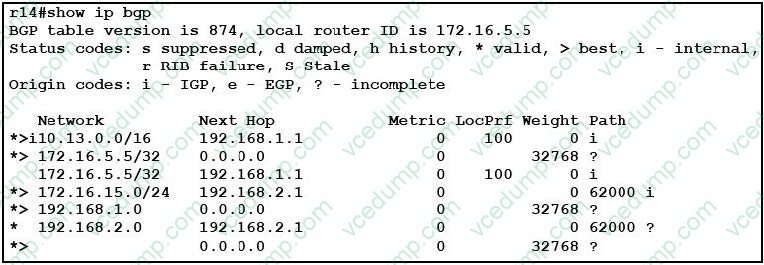
B. Locally originated routes have a better AD than eBGP or iBGP routes.
C. All locally originated routes have a better origin code.
D. Locally originated routes have a higher metric.
E. Locally originated routes have a weight of 32, 768. -
Question 313:
While troubleshooting OSPF issues on a broadcast network, the network administrator notices that some routers are stuck in two-way state. What is the cause of this issue?
A. This is normal on OSPF broadcast network types.
B. The network type is configured incorrectly on these routers
C. There is an MTU mismatch between these routers and their neighbors.
D. This only happens to routers that have their OSPF priority set to 0.
E. Hello packets are not being received on these routers. -
Question 314:
Refer to the exhibit. You are trying to police down to 100 Mb/s. While testing, you notice that you rarely exceed 70-80 Mb/s. What do you need to change in your MQC configuration to allow for 100 Mb/s speeds?
A. Change the CIR value from 100 Mb/s to 200 Mb/s.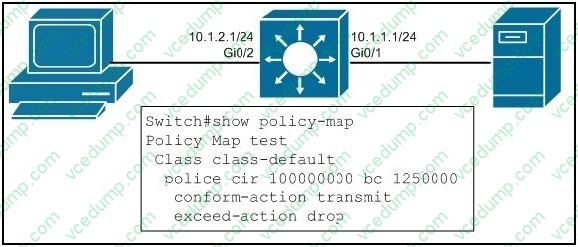
B. Change the Bc value to allow for a large enough burst.
C. Change the QoS queue from default to priority.
D. Change the exceed-action to transmit. -
Question 315:
In Frame Relay, FECN messages indicating congestion are sent or received by which of following?
A. Sent by the destination
B. Received by the sender
C. Received by the destination
D. Sent by the sender -
Question 316:
Which switch port error is an indication of duplex mismatches on 10/100/1000 IEEE 802.3u Gigabit Ethernet ports?
A. FCS errors
B. Runts
C. Multiple collisions
D. Alignment errors -
Question 317:
Refer to the exhibit. Considering that RTB does not use next-hop-self, what will be the next hop for the route 192.168.1.0/24 on RTC?
A. 192.168.1.1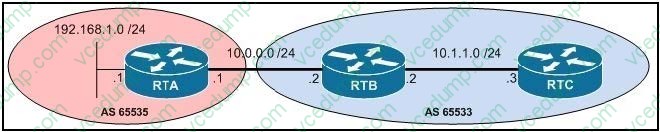
B. 10.0.0.1
C. 10.0.0.2
D. 10.1.1.2
E. 10.1.1.3
F. the BGP router ID of RTA -
Question 318:
Which is the result of enabling IP Source Guard on an untrusted switch port that does not have DHCP snooping enabled?
A. DHCP requests will be switched in the software, which may result in lengthy response times.
B. The switch will run out of ACL hardware resources.
C. All DHCP requests will pass through the switch untested.
D. The DHCP server reply will be dropped and the client will not be able to obtain an IP address. -
Question 319:
Which two statements are true about LACP? (Choose two.)
A. LACP packets are sent with multicast group MAC address 01-80-c2-00-00-02.
B. The Type/Field value is 0x8808.
C. During detection, LACP packets are transmitted every second.
D. The timeout for a failed LACP channel is 30 seconds by default. -
Question 320:
Customer X has a hub-and-spoke Frame Relay network, with a central office and two branch offices (RemoteA and RemoteB). Each location has only one physical link to the Frame Relay cloud and RemoteB has a router that is not a Cisco router. Since the installation, there is no connectivity between RemoteB and the central office.
What is a possible solution to this issue?
A. Because Frame Relay IETF encapsulation is only configurable at interface level, you must use IETF encapsulation on all routers.
B. This is not a possible scenario. A dedicated Frame Relay link to RemoteB is mandatory at the central office.
C. The router at RemoteB must be replaced by a Cisco router.
D. Use Frame Relay IETF encapsulation on a per-VC basis on the central office router.
E. There is a problem in the Frame Relay cloud, because Cisco routers are compatible with IETF Frame Relay.
Related Exams:
-
300-745
Designing Cisco Security Infrastructure (300-745 SDSI) v1.0 -
350-101
Implementing and Operating Cisco Wireless Core Technologies (350-101 WLCOR)v1.0 -
352-011
Cisco Certified Design Expert Practical -
500-052
Cisco Unified Contact Center Express -
500-173
Designing the FlexPod Solution (FPDESIGN) -
500-201
Deploying Cisco Service Provider Mobile Backhaul Solutions -
500-210
SP Optical Technology Field Engineer Representative -
500-220
Engineering Cisco Meraki Solutions (ECMS) v2.2 -
500-230
Cisco Service Provider Routing Field Engineer -
500-240
Cisco Mobile Backhaul for Field Engineers
Tips on How to Prepare for the Exams
Nowadays, the certification exams become more and more important and required by more and more enterprises when applying for a job. But how to prepare for the exam effectively? How to prepare for the exam in a short time with less efforts? How to get a ideal result and how to find the most reliable resources? Here on Vcedump.com, you will find all the answers. Vcedump.com provide not only Cisco exam questions, answers and explanations but also complete assistance on your exam preparation and certification application. If you are confused on your 350-001 exam preparations and Cisco certification application, do not hesitate to visit our Vcedump.com to find your solutions here.