350-001 Exam Details
-
Exam Code
:350-001 -
Exam Name
:CCIE Routing and Switching Written -
Certification
:Cisco Certifications -
Vendor
:Cisco -
Total Questions
:581 Q&As -
Last Updated
:Dec 16, 2021
Cisco 350-001 Online Questions & Answers
-
Question 91:
Refer to the exhibit. R1 has two eBGP sessions to ISP1 and ISP2 (one to each ISP router), and R1 receives the same prefixes through both links.
Which configuration should be applied for the link between R1 and ISP2 to be preferred for incoming traffic (ISP2 to R1)?
A. increase local preference on R1 for routes advertised to ISP2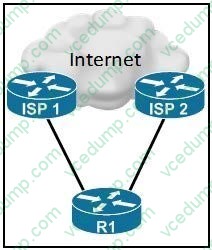
B. decrease local preference on R1 for routes advertised to ISP2
C. increase MED on ISP2 for routes advertised to R1
D. decrease MED on ISP2 for routes advertised to R1 -
Question 92:
An administrator of a peer-to-peer server application reports that the maximum bandwidth that his application receives is 90 Mb/s. You have an 8-port, 100-Mb/s EtherChannel bundle on the switching infrastructure between the two servers, resulting in a bidirectional throughput of more than what is recorded.
Which two solutions would allow for more bandwidth for the application? (Choose two)
A. Change the EtherChannel default hashing algorithm from XOR to use source port Layer 4 port load balancing to better load balance the traffic
B. Change the EtherChannel default hashing algorithm from XOR to use destination Layer 4 port load balancing to better load balance the traffic
C. Have the application recoded to use multiple connections instead of a single connection so EtherChannel can better load balance the traffic
D. Upgrade the CPU and memory of the compute devices so they can better process traffic
E. Upgrade the EtherChannel bundle to a single gigabit link because EtherChannel is not well suited for single-connection traffic -
Question 93:
Which two of these are used in the selection of a root bridge in a network utilizing Spanning Tree Protocol IEEE 802.1 D? (Choose two.)
A. Designated Root Cost
B. bridge ID priority
C. max age
D. bridge ID MAC address
E. Designated Root Priority
F. forward delay -
Question 94:
Refer to the exhibit. Which of the following options is correct?
A. OSPF peers are using Type 1 authentication.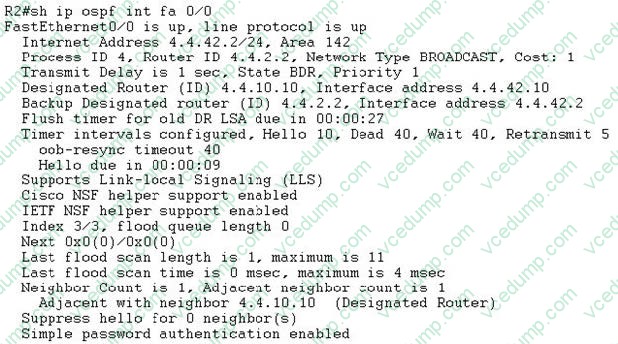
B. OSPF peers are using Type 2 authentication.
C. Authentication is used, but there is a password mismatch.
D. The OSPF peer IP address is 172.16.10.36. -
Question 95:
Refer to the exhibit. Which protocol would allow you to implement a first-hop redundancy connection and make this a multi-vendor solution?
A. Gateway Load Balancing Protocol (GLBP)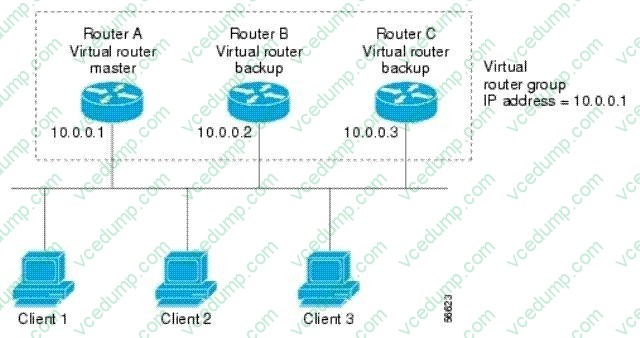
B. Hot Standby Router Protocol (HSRP)
C. Multigroup Hot Standby Router Protocol (MSHRP)
D. Virtual Router Redundancy Protocol (VRRP) -
Question 96:
Which two fundamental modifications, related to traffic forwarding, does MPLS introduce? (Choose two.)
A. IP lookup is performed on every hop within the MPLS core.
B. IP destination routing is reduced to label lookup within the MPLS network.
C. For unicast routing, labels are assigned to FECs (in other words, IP prefixes).
D. For multicast routing, labels are assigned to IP multicast groups. -
Question 97:
Based on the network displayed in the exhibit, both R1 and R2 are configured as EIGRP stub routers. If the link between R1 and R3 is down, will R3 still be able to reach 192.168.1.0/24, and why or why not?
A. No. R3 would remove its route to 192.168.1.0/24 through R1, but would not query R2 for an alternate route, since R2 is a stub.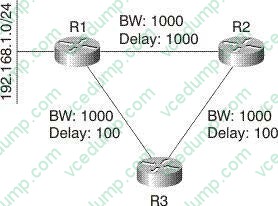
B. No. The path through R2 would always be considered a loop at R3.
C. Yes. When a directly connected link fails, a router is allowed to query all neighbors, including stub neighbors, for an alternate route.
D. Yes, because R3 would know about both routes, through R1 and R2, before the link between R1 and R3 failed. -
Question 98:
Which two statements are true about the Inside Global address in NAT? (Choose two.)
A. the IP address of an inside host as it appears to the outside network
B. the IP address of an outside host as it appears to the inside network
C. if the enterprise is connected to the global Internet, this address can be allocated from a globally unique address space
D. if the enterprise is connected to the global Internet, this address can be allocated from the space defined by RFC 1918 -
Question 99:
What is the command to configure RSVP to reserve up to one-tenth of a Gigabit link, but only allow each individual flow to use 1 MB/s?
A. ip rsvp bandwidth 100000 1000
B. ip rsvp bandwidth 100000 1
C. ip rsvp bandwidth 10 1
D. ip rsvp bandwidth 1000000 1000 -
Question 100:
What is the default behaviour of PIM-SSM If there are multiple equal-cost paths to the multicast source?
A. It will send the join only to the neighbor with the highest IP address.
B. It will send the join only to the neighbor with the lowest IP address.
C. It will send the join in a round-robin fashion across all neighbors.
D. It will send the join to all neighbors.
Related Exams:
-
300-745
Designing Cisco Security Infrastructure (300-745 SDSI) v1.0 -
350-101
Implementing and Operating Cisco Wireless Core Technologies (350-101 WLCOR)v1.0 -
352-011
Cisco Certified Design Expert Practical -
500-052
Cisco Unified Contact Center Express -
500-173
Designing the FlexPod Solution (FPDESIGN) -
500-201
Deploying Cisco Service Provider Mobile Backhaul Solutions -
500-210
SP Optical Technology Field Engineer Representative -
500-220
Engineering Cisco Meraki Solutions (ECMS) v2.2 -
500-230
Cisco Service Provider Routing Field Engineer -
500-240
Cisco Mobile Backhaul for Field Engineers
Tips on How to Prepare for the Exams
Nowadays, the certification exams become more and more important and required by more and more enterprises when applying for a job. But how to prepare for the exam effectively? How to prepare for the exam in a short time with less efforts? How to get a ideal result and how to find the most reliable resources? Here on Vcedump.com, you will find all the answers. Vcedump.com provide not only Cisco exam questions, answers and explanations but also complete assistance on your exam preparation and certification application. If you are confused on your 350-001 exam preparations and Cisco certification application, do not hesitate to visit our Vcedump.com to find your solutions here.