2VB-601 Exam Details
-
Exam Code
:2VB-601 -
Exam Name
:VMware Specialist: vSAN 6.x -
Certification
:VMware Certifications -
Vendor
:VMware -
Total Questions
:109 Q&As -
Last Updated
:Dec 22, 2024
VMware 2VB-601 Online Questions & Answers
-
Question 71:
Which three of the listed performance metrics can be observed for vSAN backend traffic? (Choose three.)
A. Latency
B. Throughput
C. Delayed normalized IOPS
D. Packets per second
E. IOPS -
Question 72:
Which VMware-recommended tool is used to size vSAN deployments?
A. ReadyNode Configuration
B. vSAN TCO and Sizing Calculator
C. vSAN Hardware Compatibility List
D. Sizing spreadsheets available from partners -
Question 73:
For which scenario is network multicast required?
A. Clusters with IGMP disabled on all virtual switches.
B. Network environments where IGMP is disabled.
C. Clusters that have more than four fault domains configured.
D. Clusters running versions of vSAN prior to version 6.6. -
Question 74:
Which statement accurately describes cache tier sizing guidance for an all-flash vSAN cluster that will be supporting write-intensive workloads?
A. Multiple disk groups with larger cache devices should be used.
B. Multiple disk groups with two cache devices per disk group should be used.
C. A single disk group with a small cache device should be used to minimize de-staging write amplification.
D. Two cache devices per disk group should be configured for redundancy. -
Question 75:
Consider the following scenario in a vSAN cluster that contains six hosts:
1.
All virtual machines are assigned the vSAN Default Storage Policy, which has not been modified.
2.
Deduplication and compression are not enabled.
3.
Every vSAN disk group in the cluster contains one cache device and five capacity devices
What happens when a capacity device transmits SCSI sense code errors and fails?
A. All components on the affected device are marked "degraded". vSAN attempts to rebuild the components on other healthy devices in the cluster without delay.
B. All components on the affected device are marked "degraded". The host containing the affected drive is placed into maintenance mode using the `ensure accessibility' option.
C. All components on the affected device are marked "offline". vSAN attempts to rebuild the components on other healthy devices in the cluster after 60 minutes by default.
D. The host containing the affected drive is placed into maintenance mode using the "ensure accessibility" option. An administrator must log into the vSphere Web Client and click Repair Objects Immediately. -
Question 76:
What is required for enabling deduplication and compression in a vSAN cluster?
A. Host client cache enabled
B. At least two disk groups in every host
C. An all-flash configuration
D. More than three hosts -
Question 77:
Which three of the listed statements are true about vSAN deduplication and compression? (Choose three.)
A. Deduplication and compression can help to provide additional host failure tolerance.
B. Deduplication and compression require at least four hosts.
C. Deduplication and compression reduce redundant data within each disk group.
D. Deduplication and compression results vary based on the types of data stored in a vSAN environment. -
Question 78:
Which three objects that belong to virtual machines are contained in a vSAN datastore? (Choose three.)
A. VM Health Status
B. VMDK
C. VM Home Namespace
D. Performance Statistics
E. VM Swap -
Question 79:
Which vSAN health check category displays information about vSAN object health?
A. Online Health
B. Data
C. Limits
D. Performance Service -
Question 80:
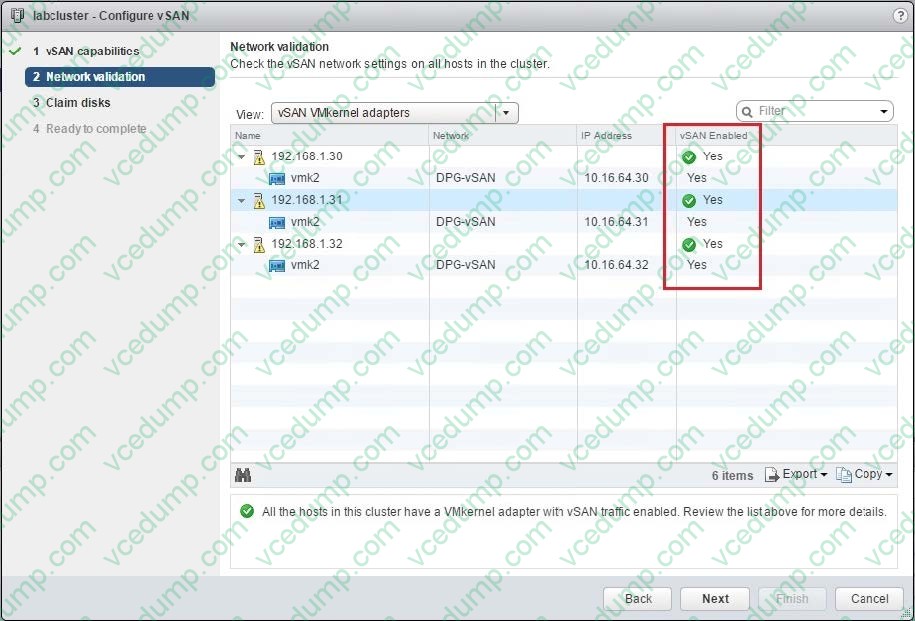
An administrator is deploying vSAN 6.6.
What must the administrator configure to set up vSAN networking?
A. IGMP snooping on the switch
B. A class A network address
C. A matching subnet mask on all vSAN VMkernel ports
D. A vSAN VMkernel port on each host in the cluster
Related Exams:
-
1V0-21.20
Associate VMware Data Center Virtualization -
1V0-31.21
Associate VMware Cloud Management and Automation -
1V0-41.20
Associate VMware Network Virtualization -
1V0-61.21
Associate VMware Digital Workspace -
1V0-71.21
Associate VMware Application Modernization -
1V0-81.20
Associate VMware Security -
2V0-11.24
VMware Cloud Foundation 5.2 Administrator -
2V0-11.25
VMware Cloud Foundation 5.2 Administrator -
2V0-13.24
VMware Cloud Foundation 5.2 Architect -
2V0-13.25
VMware Cloud Foundation 9.0 Architect
Tips on How to Prepare for the Exams
Nowadays, the certification exams become more and more important and required by more and more enterprises when applying for a job. But how to prepare for the exam effectively? How to prepare for the exam in a short time with less efforts? How to get a ideal result and how to find the most reliable resources? Here on Vcedump.com, you will find all the answers. Vcedump.com provide not only VMware exam questions, answers and explanations but also complete assistance on your exam preparation and certification application. If you are confused on your 2VB-601 exam preparations and VMware certification application, do not hesitate to visit our Vcedump.com to find your solutions here.