2VB-601 Exam Details
-
Exam Code
:2VB-601 -
Exam Name
:VMware Specialist: vSAN 6.x -
Certification
:VMware Certifications -
Vendor
:VMware -
Total Questions
:109 Q&As -
Last Updated
:Dec 22, 2024
VMware 2VB-601 Online Questions & Answers
-
Question 1:
Exhibit:
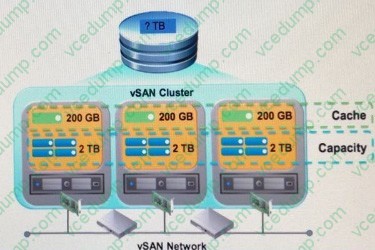
View the exhibit.
The following are configuration details for a three-node all-flash vSAN cluster
1.
Each node is identical in number of drives and disk controllers
2.
Each node has 4 x 500 GB SSD Capacity Tier, 1 x 200 GB SSD cache tier What is the raw capacity of this cluster as configured?
A. 6.6 TB
B. 3 TB
C. 6 TB
D. 4 TB -
Question 2:
Which storage policy is automatically created by Horizon View?
A. Level of failures to tolerate
B. Checksum
C. Horizon Default Storage Policy
D. Linked Clone -
Question 3:
The following are configuration details for a three-node vSAN cluster:
1.
Each host has two disk groups and each disk group has 7x1.2TB 10K SAS drives.
2.
Each host has 16.8TB of raw capacity and the three-node cluster has 50.4TB of raw capacity.
3.
Deduplication and compression are not enabled.
Based on the following FTT Values in the storage policy, what is the total usable capacity?
A. Option A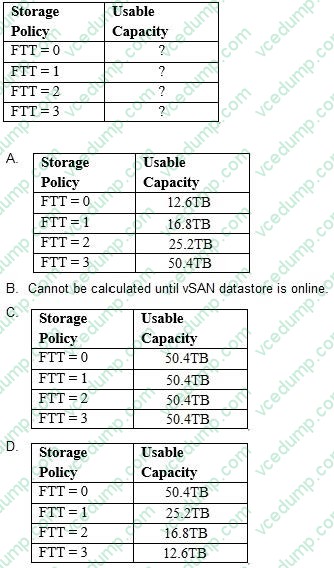
B. Option B
C. Option C
D. Option D -
Question 4:
With the addition of local protection to vSAN stretched clusters, which factors determine the maximum level of object protection?
A. License edition, failure tolerance method, and Primary and/or Secondary level of failures to tolerate
B. Hardware choice (hybrid or all-flash), number of hosts, and object space reservation
C. Failure tolerance method, and Primary and/or Secondary level of failures to tolerate, and host count
D. Hardware choice (hybrid or all-flash), failure tolerance method, and stripe width -
Question 5:
What happens when a healthy capacity tier disk is pulled from one of the ESXi hosts in a vSAN cluster?
A. The components on the affected device are marked "Failed" and the resync starts after 60 minutes by default, if the original disk is NOT reinserted.
B. The components on the affected device are marked "Absent" and the resync starts immediately by default.
C. The components on the affected device are marked "Absent" and the resync starts after 60 minutes by default, if the original disk is NOT reinserted.
D. The components on the affected device are marked "Failed" and the resync starts immediately by default. -
Question 6:
When using vSAN encryption, where and how is the Data Encryption Key (DEK) stored?
A. Persistently on the disk
B. In host memory in a secure KeyCache
C. In vCenter server memory
D. Persistently in the KMS cluster -
Question 7:
Which three of the listed items are required when configuring a vSAN cluster? (Choose three.)
A. Each host in the vSAN cluster has a VMkernel network adapter for vSAN traffic.
B. All hosts contributing storage to the cluster have at least one cache and one capacity device.
C. A valid license for vSAN is applied.
D. RDMA over Converged Ethernet (RoCE) is enabled on the network switches that connect vSAN hosts.
E. Storage controllers are configured as RAID-0 with 100% write cache. -
Question 8:
What is the VMware-recommended network configuration between the three sites in a vSAN stretched cluster?
A. L2 connectivity between the preferred and secondary sites, and L3 from the preferred and secondary sites to the witness site.
B. L3 connectivity between the preferred and secondary sites, and L2 from the preferred and secondary sites to the witness site.
C. L2 connectivity between all three sites.
D. L3 connectivity between all three sites. -
Question 9:
Which statement is true about the deduplication and compression feature in vSAN?
A. Redundant blocks across multiple disk groups are NOT deduplicated.
B. Compression removes redundant data blocks, whereas deduplication removes additional redundant data within each data block.
C. Compression occurs as data is moved from the capacity tier to the cache tier.
D. Deduplication and compression are enabled by default when the vSAN cluster is created. -
Question 10:
What are three fundamental concepts of vSAN clusters? (Choose three.)
A. Flash devices can be shared between disk groups.
B. A maximum of seven capacity disks per disk group is supported.
C. A maximum of five disk groups per host is supported.
D. Dual socket CPU for each host is required.
E. Once cache drive per disk group is required.
Related Exams:
-
1V0-21.20
Associate VMware Data Center Virtualization -
1V0-31.21
Associate VMware Cloud Management and Automation -
1V0-41.20
Associate VMware Network Virtualization -
1V0-61.21
Associate VMware Digital Workspace -
1V0-71.21
Associate VMware Application Modernization -
1V0-81.20
Associate VMware Security -
2V0-11.24
VMware Cloud Foundation 5.2 Administrator -
2V0-11.25
VMware Cloud Foundation 5.2 Administrator -
2V0-13.24
VMware Cloud Foundation 5.2 Architect -
2V0-13.25
VMware Cloud Foundation 9.0 Architect
Tips on How to Prepare for the Exams
Nowadays, the certification exams become more and more important and required by more and more enterprises when applying for a job. But how to prepare for the exam effectively? How to prepare for the exam in a short time with less efforts? How to get a ideal result and how to find the most reliable resources? Here on Vcedump.com, you will find all the answers. Vcedump.com provide not only VMware exam questions, answers and explanations but also complete assistance on your exam preparation and certification application. If you are confused on your 2VB-601 exam preparations and VMware certification application, do not hesitate to visit our Vcedump.com to find your solutions here.