200-125 Exam Details
-
Exam Code
:200-125 -
Exam Name
:Cisco Certified Network Associate -
Certification
:Cisco Certifications -
Vendor
:Cisco -
Total Questions
:1316 Q&As -
Last Updated
:Dec 13, 2021
Cisco 200-125 Online Questions & Answers
-
Question 1051:
Which two statements about RIPv2 are true? (Choose two )
A. It stores RIP neighbor adjacency information in a neighbor table.
B. It does not support clear text authentication, similar to RIPv1.
C. It uses the Bellman-Ford routing algorithm
D. It supports CIDR and VLSM
E. It sends periodic updates via broadcast -
Question 1052:
Refer to the exhibit.
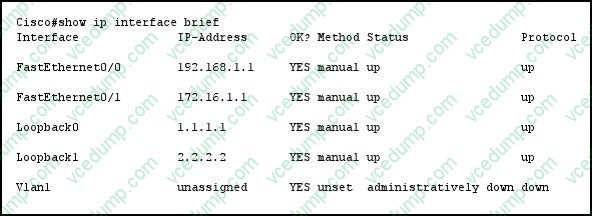
If the router Cisco returns the given output and has not had its router ID set manually, what value will OSPF use as its router ID?
A. 192.168.1.1
B. 172.16.1.1
C. 1.1.1.1
D. 2.2.2.2 -
Question 1053:
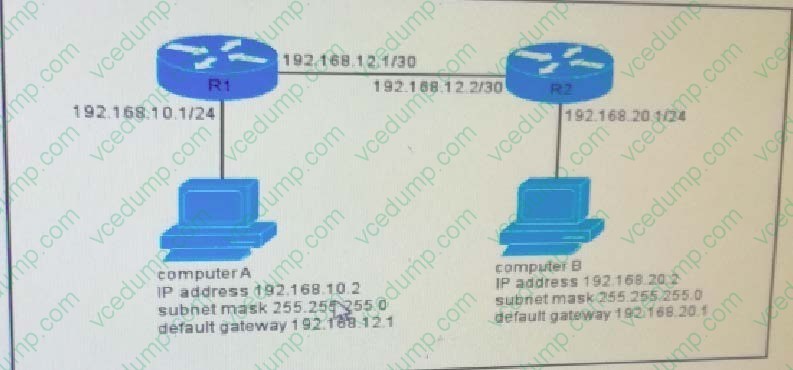
Refer to the exhibit. You have determined that computer A cannot ping computer B. Which reason for the problem is most likely true?
A. The computer A subnet mask is incorrect.
B. The computer B subnet mask is incorrect.
C. The computer B default gateway address is incorrect.
D. The computer A default gateway address is incorrect. -
Question 1054:
How does a Cisco switch respond if you boot it without a valid configuration in the NVRAM?
A. it enters setup mode.
B. it uses the running configuration
C. It prompts you to restore the startup configuration
D. it enters user EXEC mode. -
Question 1055:
Refer to the exhibit.
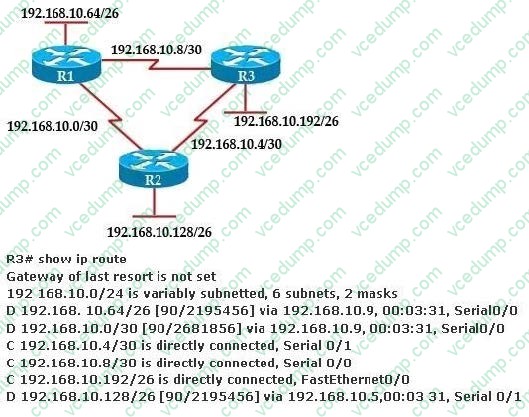
The company uses EIGRP as the routing protocol. What path will packets take from a host on the 192.168.10.192/26 network to a host on the LAN attached to router R1?
A. The path of the packets will be R3 to R2 to R1.
B. The path of the packets will be R3 to R1 to R2.
C. The path of the packets will be both R3 to R2 to R1 AND R3 to R1.
D. The path of the packets will be R3 to R1. -
Question 1056:
Where does the configuration reside when a helper address is configured to support DHCP ?
A. on the switch trunk interface.
B. on the router closest to the client.
C. on the router closest to the server.
D. on every router along the path. -
Question 1057:
Given an IP address 172.16.28.252 with a subnet mask of 255.255.240.0, what is the correct network address?
A. 172.16.16.0
B. 172.16.0.0
C. 172.16.24.0
D. 172.16.28.0 -
Question 1058:
Which type of secure MAC address must be configured manually?
A. static
B. dynamic
C. sticky
D. bia -
Question 1059:
Which three are valid modes for a switch port used as a VLAN trunk? (Choose three.)
A. transparent
B. auto
C. on
D. desirable
E. blocking
F. forwarding -
Question 1060:
What is the first 24 bits in a MAC address called?
A. NIC
B. BIA
C. OUI
D. VAI
Related Exams:
-
300-745
Designing Cisco Security Infrastructure (300-745 SDSI) v1.0 -
350-101
Implementing and Operating Cisco Wireless Core Technologies (350-101 WLCOR)v1.0 -
352-011
Cisco Certified Design Expert Practical -
500-052
Cisco Unified Contact Center Express -
500-173
Designing the FlexPod Solution (FPDESIGN) -
500-201
Deploying Cisco Service Provider Mobile Backhaul Solutions -
500-210
SP Optical Technology Field Engineer Representative -
500-220
Engineering Cisco Meraki Solutions (ECMS) v2.2 -
500-230
Cisco Service Provider Routing Field Engineer -
500-240
Cisco Mobile Backhaul for Field Engineers
Tips on How to Prepare for the Exams
Nowadays, the certification exams become more and more important and required by more and more enterprises when applying for a job. But how to prepare for the exam effectively? How to prepare for the exam in a short time with less efforts? How to get a ideal result and how to find the most reliable resources? Here on Vcedump.com, you will find all the answers. Vcedump.com provide not only Cisco exam questions, answers and explanations but also complete assistance on your exam preparation and certification application. If you are confused on your 200-125 exam preparations and Cisco certification application, do not hesitate to visit our Vcedump.com to find your solutions here.