1Z0-1072-22 Exam Details
-
Exam Code
:1Z0-1072-22 -
Exam Name
:Oracle Cloud Infrastructure 2022 Architect Associate -
Certification
:Oracle Certifications -
Vendor
:Oracle -
Total Questions
:239 Q&As -
Last Updated
:May 27, 2026
Oracle 1Z0-1072-22 Online Questions & Answers
-
Question 161:
Which storage service is used on OCI for a Data Transfer Service job?
A. An instance with enough storage to accommodate the job
B. An object bucket
C. A File System service instance
D. Block Volume -
Question 162:
Your company has decided to move a few applications to Oracle Cloud Infrastructure and you have been asked to design it for Disaster Recovery (DR). One of the items of your design is to deploy the DR at least 300 miles from the home site and minimize the network latency as much as possible. Based on that, what will be the recommended deployment?
A. Deploy applications in two separated VCNs in different Availability Domains and use VCN Remote Peering
B. Deploy applications in different regions and have them connected using VCN Remote Peering
C. Deploy applications in two separated VCNs in different regions and use VCN Local Peering
D. Deploy applications on the same region splitting workloads across Availability Domains. -
Question 163:
You need to transfer over 12 TB of data from on-premises to your cloud account. You started copying this data over the internet and noticed that it will take too long to complete. Without increasing the costs of your subscription, what is the recommended way to send this amount of data to your cloud account?
A. Use Data Transfer Service to send your data.
B. Split the data into multiple parts and use the multipart tool.
C. Use a 10 GB FastConnect line to send the data.
D. Send the data over a VPN IPsec tunnel.
E. Compress the data and use the multipart tool. -
Question 164:
You need to set up instance principals so that an application running on an instance can call Oracle Cloud Infrastructure (OCI) public services, without the need to configure user credentials. A developer in your team has already configured
the application built using an OCI SDK to authenticate using the instance principals provider.
Which is NOT a necessary step to complete this set up?
A. Create a dynamic group with matching rules to specify which instances you want to allow to make API calls against services.
B. Generate Auth Tokens to enable instances in the dynamic group to authenticate with APIs.
C. Create a policy granting permissions to the dynamic group to access services in your compartment or tenancy.
D. Deploy the application and the SDK to all the instances that belong to the dynamic group. -
Question 165:
Which three actions are required to configure a highly available and secure hybrid network between Oracle Cloud and your data center? (Choose three.)
A. Define a non-overlapping IP Address Space between the data center and the cloud.
B. Configure each of the CPEs to leverage each of the IPSec Tunnels created by the connection process.
C. Create two or more CPEs that map to the private IP addresses of the customer routers used in the IPSec VPN Tunnel.
D. Define a default route table entry for the VCN that directs all traffic to the data center network to a single DRG.
E. Create dynamic routing gateways in more than one AD within your region. -
Question 166:
Which two are a valid image source when launching a new compute instance? (Choose two.)
A. bare metal instance
B. object storage
C. custom image
D. boot volume -
Question 167:
Which two choices are true for Autonomous Data Warehouse (ADW)? (Choose two.)
A. Billing stops only when the ADW is terminated
B. Billing stops for both CPU usage and storage usage when ADW is stopped
C. Billing for compute stops when ADW is stopped
D. Billing for storage continues when ADW is stopped -
Question 168:
You have setup your environment as shown below with the Mount Target "MT" successfully mounted on both compute instances CLIENT-X and CLIENT-Y.
For security reasons you want to control the access to the File System A in such a way that CLIENT-X has READ/WRITE and CLIENT-Y has READ only permission.
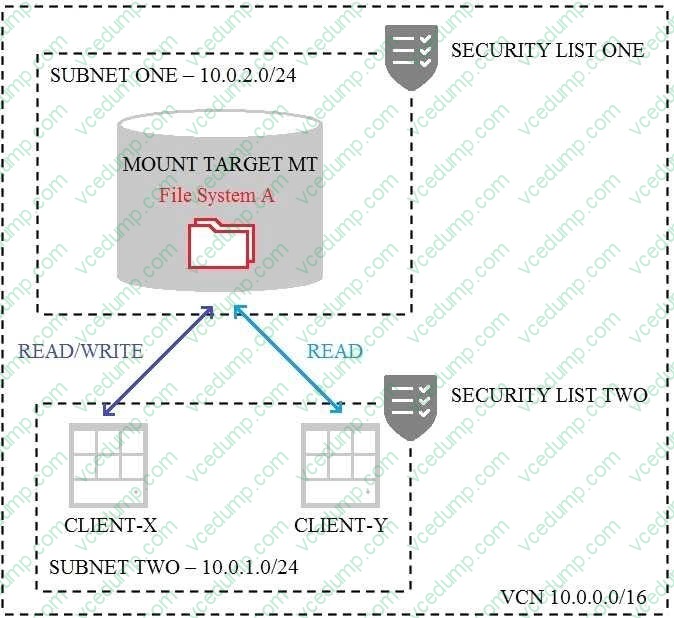
What you should do?
A. Update the OS firewall in CLIENT-X to allow READ/WRITE access.
B. Update the security list TWO to restrict CLIENT-Y access to read-only.
C. Update the mount target export options to restrict CLIENT-Y access to read-only.
D. Update the security list ONE to restrict CLIENT-Y access to read only. -
Question 169:
Which two statements about the Oracle File Storage Service (FSS) Security are accurate? (Choose two.)
A. Oracle IAM controls which filesystems are mountable by which instances.
B. Security lists can be used as a virtual firewall to prevent an instance from mounting an FSS mount target within a subnet.
C. Encryption of file storage in FSS is optional.
D. Data in transit to an FSS mount target is encrypted.
E. FSS leverages UNIX user group and permission checking for file access security. -
Question 170:
You have multiple applications installed on a compute instance and these applications generate a large amount of log files. These log files must reside on the boot volume for a minimum of 15 days and must be retained for at least 60 days.
The 60-day retention requirement is causing an issue with available disk space.
What are the two recommended methods to provide additional boot volume space for this compute instance? (Choose two.)
A. Terminate the instance while preserving the boot volume. Create a new instance from the boot volume and select a DenseIO shape to take advantage of local NVMe storage.
B. Create an object storage bucket and use a script that runs daily to move log files older than 15 days to the bucket.
C. Create and attach a block volume to the compute instance and copy the log files.
D. Create a custom image and launch a new compute instance with a larger boot volume size.
E. Write a custom script to remove the log files on a daily basis and free up the space on the boot volume.
Related Exams:
-
1Z0-020
Oracle8i: New Features for Administrators -
1Z0-023
Architecture and Administration -
1Z0-024
Performance Tuning -
1Z0-025
Backup and Recovery -
1Z0-026
Network Administration -
1Z0-034
Upgrade Oracle9i/10g OCA to Oracle Database OCP -
1Z0-036
Managing Oracle9i on Linux -
1Z0-041
Oracle Database 10g: DBA Assessment -
1Z0-052
Oracle Database 11g: Administration Workshop I -
1Z0-053
Oracle Database 11g: Administration II
Tips on How to Prepare for the Exams
Nowadays, the certification exams become more and more important and required by more and more enterprises when applying for a job. But how to prepare for the exam effectively? How to prepare for the exam in a short time with less efforts? How to get a ideal result and how to find the most reliable resources? Here on Vcedump.com, you will find all the answers. Vcedump.com provide not only Oracle exam questions, answers and explanations but also complete assistance on your exam preparation and certification application. If you are confused on your 1Z0-1072-22 exam preparations and Oracle certification application, do not hesitate to visit our Vcedump.com to find your solutions here.