1Z0-1072-22 Exam Details
-
Exam Code
:1Z0-1072-22 -
Exam Name
:Oracle Cloud Infrastructure 2022 Architect Associate -
Certification
:Oracle Certifications -
Vendor
:Oracle -
Total Questions
:239 Q&As -
Last Updated
:May 27, 2026
Oracle 1Z0-1072-22 Online Questions & Answers
-
Question 151:
Which service would you use if your big data workload required shared access and NFS-based connectivity?
A. block volume
B. archive storage
C. object storage
D. file storage -
Question 152:
You are deploying a highly available web application in Oracle Cloud Infrastructure and have decided to use a public load balancer. The back-end web servers will be distributed across all three availability domains (ADs). How many subnets should you create to deliver a secure highly available application?
A. three subnets in total; one subnet in each AD
B. five subnets in total; two subnets each in the first and second AD with a single subnet in the third AD
C. six subnets in total; two subnets in each AD; one for the load balancer and one for the web servers
D. four subnets in total; one subnet in each AD for the web servers and a single subnet in any one AD for the load balancer -
Question 153:
When terminating a compute instance, which statement is true?
A. The instance needs to be stopped first, and then terminated.
B. The boot volume is always deleted.
C. All block volumes attached to the instance are terminated.
D. Users can preserve the boot volume associated with the instance. -
Question 154:
You have provisioned an Autonomous Data Warehouse (ADW) database with 16 enabled OCPUs and need to configure the consumer group for your application. Which two are true when deciding the number of sessions for each application? (Choose two.)
A. The MEDIUM and LOW consumer group can run up to 16 concurrent SQL statements if HIGH consumer group has 0 SQL statements
B. The HIGH consumer group can run up to 16 concurrent SQL statements as long as MEDIUM and LOW consumer groups have 0 SQL statements
C. The MEDIUM consumer group can run 20 concurrent SQL statements when HIGH consumer group has 0 SQL statements
D. The HIGH consumer group can run up to 16 concurrent SQL statements in addition to 32 concurrent SQL statements in MEDIUM and LOW consumer group each
E. The HIGH consumer group can run 3 concurrent SQL statements when MEDIUM consumer group has 0 SQL statements -
Question 155:
Which two statements about file storage service (FSS) are accurate? (Choose two.)
A. FSS leverages UNIX user group and permission checking for file access security
B. Encryption of file system in FSS is optional
C. Identity and Access Management (IAM) controls which file systems are mountable by which instances
D. Security lists can be used as a virtual firewall to prevent an instance from mounting an FSS mount target within the same subnet
E. Data in transit to an FSS mount target is encrypted -
Question 156:
Which two statements about Oracle Cloud Infrastructure File Storage Service are accurate? (Choose two.)
A. Customer can encrypt the communication to a mount target via export options.
B. Mount targets use Oracle-managed keys by default.
C. File systems use Oracle-managed keys by default.
D. Customer can encrypt data in their file system using their own Vault encryption key.
E. Communication with file systems in a mount target is encrypted via HTTPS. -
Question 157:
Your company has been running several small applications in Oracle Cloud Infrastructure and is planning a proof-of-concept (POC) to deploy PeopleSoft. If your existing resources are being maintained in the root compartment, what is the recommended approach for defining security for the upcoming POC?
A. Create a new compartment for the POC and grant appropriate permissions to create and manage resources within the compartment.
B. Provision all new resources into the root compartment. Grant permissions that only allow for creation and management of resources specific to the POC.
C. Provision all new resources into the root compartment. Use defined tags to separate resources that belong to different applications.
D. Create a new tenancy for the POC. Provision all new resources into the root compartment. Grant appropriate permissions to create and manage resources within the root compartment. -
Question 158:
Which statement is true about a pre-authenticated request in Oracle Cloud Infrastructure Object Storage?
A. You can create only 1, 000 pre-authenticated requests per bucket.
B. You can create a pre-authenticated request only for public buckets.
C. You cannot retire a pre-authenticated request before it expires.
D. You cannot extend the expiration date on a pre-authenticated request. -
Question 159:
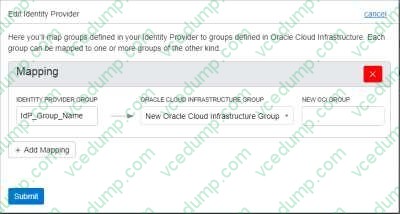
You have successfully configured identity federation between Oracle Cloud Infrastructure (OCI) and Oracle Identity Cloud Services (IDCS). A new project manager wants access to OCI for her team and provides the name of an existing group within IDCS to use when granting access. How do you configure federation to allow the project team access to OCI resources?
A. Create a new IAM group in OCI and map it to the existing IDCS group. Create a new policy in IDCS and reference the name of the IAM group.
B. Create a new Identity and Access Management (IAM) policy in OCI and reference the name of the IDCS group in each policy statement.
C. Create a new compartment in OCI with the same name as the existing IDCS group. Create an IAM policy that references the new compartment and the name of the IDCS group.
D. Create a new IAM group in OCI and map it to the existing IDCS group. Create a new IAM policy and reference the name of the IAM group in each policy statement. -
Question 160:
Which two methods are supported for migrating your on-premises Oracle database to an Oracle Autonomous Transaction Processing (ATP) database in Oracle Cloud Infrastructure? (Choose two.)
A. Load text files into ATP using SQL Developer.
B. Use RMAN duplicate.
C. Use Oracle Data Pump.
D. Transfer the physical database files and re-create the database.
E. Use database backup and restore.
Related Exams:
-
1Z0-020
Oracle8i: New Features for Administrators -
1Z0-023
Architecture and Administration -
1Z0-024
Performance Tuning -
1Z0-025
Backup and Recovery -
1Z0-026
Network Administration -
1Z0-034
Upgrade Oracle9i/10g OCA to Oracle Database OCP -
1Z0-036
Managing Oracle9i on Linux -
1Z0-041
Oracle Database 10g: DBA Assessment -
1Z0-052
Oracle Database 11g: Administration Workshop I -
1Z0-053
Oracle Database 11g: Administration II
Tips on How to Prepare for the Exams
Nowadays, the certification exams become more and more important and required by more and more enterprises when applying for a job. But how to prepare for the exam effectively? How to prepare for the exam in a short time with less efforts? How to get a ideal result and how to find the most reliable resources? Here on Vcedump.com, you will find all the answers. Vcedump.com provide not only Oracle exam questions, answers and explanations but also complete assistance on your exam preparation and certification application. If you are confused on your 1Z0-1072-22 exam preparations and Oracle certification application, do not hesitate to visit our Vcedump.com to find your solutions here.