
1Z0-1072-22 Real Exam Questions

Oracle Cloud Infrastructure 2022 Architect Associate

239 questions available · Page 1 of 24

Updated Exam DumpsVerified AnswersPass Guarantee

Get Complete Exam Dumps
Question 1 Single choice

You have the following compartment structure in your tenancy. Root compartment->Training- >Training-

subl ->Training-sub2 You create a policy in the root compartment to allow the default admin for the account
(Administrators) to manage block volumes in compartment Training-sub2.

What policy would you write to meet this requirement?

  1. A

    Allow group Administrators to manage volume-family in root compartment

  2. B

    Allow group Administrators to manage volume-family in compartment Training-sub1 :Training- sub2

  3. C

    Allow group Administrators to manage volume-family in compartment Training: Training-sub 1
    :Training-sub2

  4. D

    Allow group Administrators to manage volume-family in compartment Training-sub2

Show answer and explanation

Correct answer: C

Explanation

a policy statement must specify the compartment for which access is being granted (or the tenancy).
Where you create the policy determines who can update the policy. If you attach the policy to the compartment or its parent, you can simply specify the compartment name. If you attach the policy further up the hierarchy, you must specify the path. The format of the path is each compartment name (or OCID) in the path, separated by a colon:
<compartment_level_1>:<compartment_level_2>: . . . <compartment_level_n> For example, assume you have a three-level compartment hierarchy, shown here:
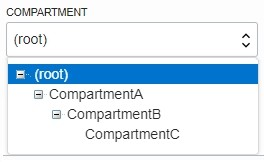
You want to create a policy to allow NetworkAdmins to manage VCNs in CompartmentC. If you want to attach this policy to CompartmentC or to its parent, CompartmentB, write this policy statement: Allow group NewtworkAdmins to manage virtual-network-family in compartment CompartmentC.
However, if you want to attach this policy to CompartmentA (so that only administrators of CompartmentA can modify it), write this policy statement that specifies the path: Allow group NewtworkAdmins to manage virtual-network-family in compartment CompartmentB:CompartmentC
To attach this policy to the tenancy, write this policy statement that specifies the path from CompartmentA to CompartmentC: Allow group NewtworkAdmins to manage virtual-network-family in compartment CompartmentA:CompartmentB:CompartmentC

Question 2 Multiple choice

Which two choices are true for Oracle Autonomous Database with Shared Exadata Infrastructure?

  1. A

    Billing for storage usage continues when autonomous database is stopped.

  2. B

    Billing stops for both CPU and storage usage when autonomous database is stopped.

  3. C

    Billing for compute usage stops when autonomous database is stopped.

  4. D

    Autonomous database does not support per-second billing.

  5. E

    Billing does not stop when autonomous database is terminated.

Show answer and explanation

Correct answers: A, C

Question 3 Multiple choice

Which two resources reside exclusively in a single Oracle Cloud Infrastructure Availability Domain?

  1. A

    Identity and Access Management Groups

  2. B

    Web Application Firewall policy

  3. C

    Block volume

  4. D

    Compute Instance

  5. E

    Object Storage

Show answer and explanation

Correct answers: C, D

Explanation

https://docs.cloud.oracle.com/iaas/Content/General/Concepts/regions.htm#one

Question 4 Multiple choice

Which two options are available when setting up DNS for your bare metal and virtual machine DB Systems? (Choose two.)

  1. A

    Internet and custom resolver

  2. B

    Google DNS servers

  3. C

    custom resolver

  4. D

    Internet and virtual cloud network (VCN) resolver

Show answer and explanation

Correct answers: C, D

Question 5 Single choice

Which of the following statement is true regarding Oracle Cloud Infrastructure Object Storage Pre- Authenticated Requests?

  1. A

    It Is not possible to create pre-authenticated requests for "archive" storage tier

  2. B

    Changing the bucket visibility does not change existing pre-authenticated requests

  3. C

    It is not possible to create pre-authenticated requests for the buckets, but only for the objects

  4. D

    Pre-authenticated requests don't have an expiration

Show answer and explanation

Correct answer: B

Explanation

Pre-authenticated requests provide a way to let users access a bucket or an object without having their own credentials, as long as the request creator has permissions to access those objects. For example, you can create a request that lets an operations support user upload backups to a bucket without owning API keys. Or, you can create a request that lets a business partner update shared data in a bucket without owning API keys.
When you create a pre-authenticated request, a unique URL is generated. Anyone you provide this URL to can access the Object Storage resources identified in the pre-authenticated request, using standard HTTP tools like curl and wget.
Understand the following scope and constraints regarding pre-authenticated requests: Users can't list bucket contents.
You can create an unlimited number of pre-authenticated requests. There is no time limit to the expiration date that you can set. You can't edit a pre-authenticated request. If you want to change user access options in response to changing requirements, you must create a new pre-authenticated request. The target and actions for a pre-authenticated request are based on the creator's permissions. The request is not, however, bound to the creator's account login credentials. If the creator's login credentials change, a pre-authenticated request is not affected. You cannot delete a bucket that has a pre-authenticated request associated with that bucket or with an object in that bucket.
Understand the following scope and constraints regarding public access: Changing the type of access is bi-directional. You can change a bucket's access from public to private or from private to public.
Changing the type of access doesn't affect existing pre-authenticated requests. Existing pre-authenticated requests still work.

Question 6 Single choice

You are responsible for setting up access for all the cloud users of a large enterprise. You log in to the Phoenix region and start creating users and policies. You then realize that some users might be creating resources in the Ashburn region.

Which step should you perform to enable those users?

  1. A

    You can assign a region to each of the users at the time of creation.

  2. B

    IAM users are global and non-admin users can add resources to any region by default.

  3. C

    You need to log in to each region separately to create users for that particular region.

  4. D

    IAM users are global. As an administrator, make sure that you subscribe to the Ashburn region.

Show answer and explanation

Correct answer: D

Question 7 Multiple choice

Which two statements are true about Database Cloud Service (DBCS)? (Choose two.)

  1. A

    Data Guard as a Service is offered among regions.

  2. B

    You have full control over backup schedule and retention.

  3. C

    You can manage Oracle parameters at a global system level.

  4. D

    You cannot manage the database as sys/sysdba.

Show answer and explanation

Correct answers: B, C

Explanation

References:
https://cloud.oracle.com/database/faq#backupCanIsetupDataGuardacrossAvailabilityDomains?
Yes, you can set up Data Guard in the same or different Availability Domains in a region. However, Oracle recommends that you set up your Data Guard configuration across Availability Domains. Can I set up Data Guard across Oracle Cloud Infrastructure regions? Yes, you can set up Data Guard across regions, "but the Database Cloud Service Data Guard feature currently does not support it. " You can manually set up Data Guard across regions by logging on to your host and using DGMGRL. You must enable an internet gateway on the primary and standby DB system VCN for Data Guard to transport logs across regions. Learn more about DGMGRL. To configure a Data Guard system across regions or between on-premises and Oracle Cloud Infrastructure DB systems, you must access the database host directly and use the DGMGRL utility. (https://docs.cloud.oracle.com/iaas/Content/Database/Tasks/usingdataguard.htm)

Question 8 Multiple choice

Which two are true for achieving High Availability on Oracle Cloud Infrastructure? (Choose two.)

  1. A

    Store your database across multiple regions so that half of the data resides in one region and the other half resides in another region.

  2. B

    Attach your block volume form Availability Domain 1 to a compute instance in Availability Domain 2 (and vice versa) so that they are highly available.

  3. C

    Configure your database to have Data Guard in another Availability Domain in Sync mode within a region.

  4. D

    Store your database files on Object Storage so that they are available in all Availability Domains in all regions.

  5. E

    Distribute your application servers across all Availability Domains within a region.

Show answer and explanation

Correct answers: C, E

Question 9 Single choice

Which option is NOT a valid action within the Oracle Cloud Infrastructure (OCI) Block Volume service?

  1. A

    Clone an existing volume to a new, larger volume.

  2. B

    Restore from a volume backup to a larger volume.

  3. C

    Shrink an existing volume in place with offline resizing.

  4. D

    Expand an existing volume in place with offline resizing.

Show answer and explanation

Correct answer: C

Question 10 Multiple choice

You have multiple applications installed on a compute instance and these applications generate a large amount of log files. These log files must reside on the boot volume for a minimum of 15 days and must be retained for at least 60 days. The 60-day retention requirement is causing an issue with available disk space.

What are the two recommended methods to provide additional boot volume space for this compute instance? (Choose two.)

  1. A

    Terminate the instance while preserving the boot volume. Create a new instance from the boot volume and select a DenseIO shape to take advantage of local NVMe storage.

  2. B

    Create an object storage bucket and use a script that runs daily to move log files older than 15 days to the bucket.

  3. C

    Create and attach a block volume to the compute instance and copy the log files.

  4. D

    Create a custom image and launch a new compute instance with a larger boot volume size.

  5. E

    Write a custom script to remove the log files on a daily basis and free up the space on the boot volume.

Show answer and explanation

Correct answers: B, D

Explanation

These log files must reside on the boot volume for a minimum of 15 days so you have to increase the boot Volume