1Z0-1072-22 Exam Details
-
Exam Code
:1Z0-1072-22 -
Exam Name
:Oracle Cloud Infrastructure 2022 Architect Associate -
Certification
:Oracle Certifications -
Vendor
:Oracle -
Total Questions
:239 Q&As -
Last Updated
:May 27, 2026
Oracle 1Z0-1072-22 Online Questions & Answers
-
Question 171:
For a compute instance that is launched in a private subnet in a Virtual Cloud Network (VCN), which action needs to be performed to connect to the Internet, assuming that the required security list is properly set up?
A. Assign a Public IP address to the compute instance.
B. Create and configure Network Address Translation (NAT) in a public subnet and route all traffic to it.
C. There is no way for an instance in a private subnet to connect to the Internet.
D. Create a default route entry in the route table to forward all traffic to the Internet gateway. -
Question 172:
Given: When creating multiple subnets within a Virtual Cloud Network (VCN), security lists are often made to group common services, for example, SSH and RDP (remote access), 80 and 443 (HTTP), and so on. By default, what is the maximum number of security lists that can be associated with a subnet upon creation?
A. 4
B. 2
C. 5
D. 3 -
Question 173:
Which three load-balancing policies can be used with a backend set?
A. throughput
B. least connections
C. IP hash
D. CPU utilization
E. weighted round robin -
Question 174:
You are designing a high bandwidth, redundant connection between your data center and Oracle Cloud Infrastructure (OCI). While researching for OCI FastConnect locations, you notice that you are co-located with Oracle at one of the Oracle
FastConnect locations in the Ashburn region.
What is the recommended design in this scenario?
A. Create a cross-connect group and have two or more cross-connects in that group. Create an IPsec VPN connection on this group.
B. Setup two IPsec connections between your data center and OCI Ashburn region. Create a OCI load balancer to distribute the traffic across the two connections.
C. Create a cross-connect group and have at least two or more cross-connects in that group. Create at least two or more virtual circuits in the group.
D. Create a cross-connect group and have at least one cross-connect in that group. Create at least one virtual circuit in the group. -
Question 175:
Which of the following statements is true about the Oracle Cloud Infrastructure (OCI) Object Storage serverside encryption?
A. Encryption of data encryption keys with a master encryption key is optional.
B. Customer-provided encryption keys are always stored in OCI Vault service.
C. Encryption is enabled by default and cannot be turned off.
D. Each object in a bucket is always encrypted with the same data encryption key. -
Question 176:
Which statement is true about restoring a block volume from a manual or policy-based block volume backup?
A. It can be restored as new volumes to any Availability Domain within the same region.
B. It must be restored as new volumes to the same Availability Domain on which the original block volume backup resides.
C. It can be restored as new volumes to any Availability Domain across different regions.
D. It can be restored as new volumes with different sizes from the backups. -
Question 177:
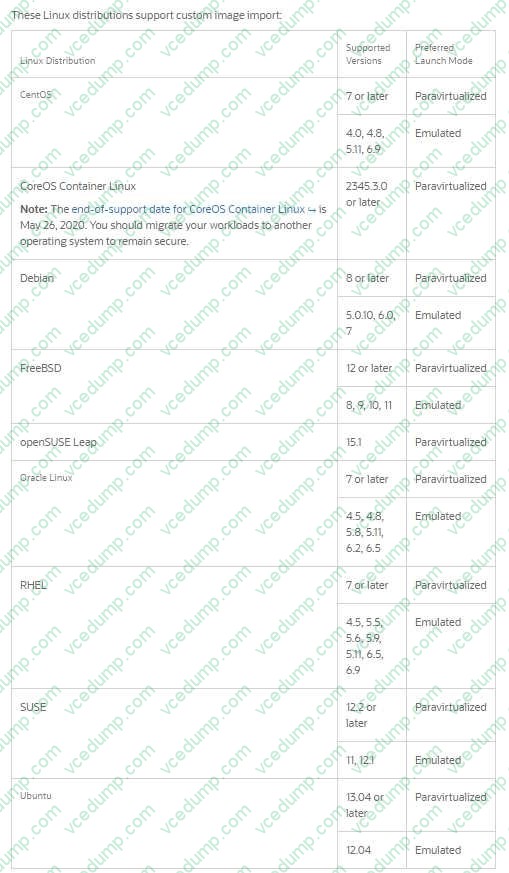
You are running several Linux based operating systems in your on .premises environment that you want to import to OCI as custom images. You can launch your imported images as OCI compute Virtual machines. Which two modes below can be used to launch these imported Linux VMs?
A. Native
B. Mixed
C. Paravirtualized
D. Emulated -
Question 178:
Which statement is true regarding Autonomous Transaction Processing (ATP)?
A. A database name cannot be used concurrently for both an Autonomous Data Warehouse (ADW) and an ATP database
B. After terminating a database, the database name is available for immediate reuse
C. A maximum of 8 cores can be enabled for an ATP database
D. A maximum of 2 TB of storage can be enabled for an ATP database -
Question 179:
Your Operations team has recently created a new, standard image that will be used to launch all new application servers in the Finance compartment. The custom image currently exists in the Operations compartment. You have access to
manage all-resources in the Finance compartment and do not have access to the Operations compartment.
Which two methods would make the new image available for you to use when deploying new servers in the Finance compartment? (Choose two.)
A. Instruct the Operations team to reassign the custom image to the Finance compartment so you can select it from a drop-down list when launching new compute resources.
B. Instruct the Operations team to export the image to an object storage bucket, create a pre- authenticated request (PAR), and provide you with the URL. Download the custom image to your laptop and import it as a custom image in the Finance compartment.
C. Instruct the Administrators team to grant you access to use instance-images in the Operations compartment. Use the Oracle Cloud Identifier (OCID) of the custom image when launching new compute resources in the Finance compartment.
D. Instruct the Operations team to export the image to an object storage bucket, create a PAR, and provide you with the URL. Use that URL as the source when importing a custom image. Import the custom image into the Finance compartment.
E. Instruct the Operations team to export the image to an object storage bucket. Instruct the Administrators team to grant you access to the object storage bucket where the custom image is stored. Use the download URL of the custom image as the image source when launching new compute resources in the Finance compartment. -
Question 180:
In what two ways does Oracle Cloud Infrastructure (OCI) file storage service differ from OCI object storage and block volume services?
A. You can move object storage buckets, block volumes and file storage mount targets between compartments.
B. File Storage uses the network file system (NFS) protocol, whereas block volume uses iSCSI.
C. Block volume service Is NVMe based, while file storage service is not.
D. File storage mount target does not provide a private IP address, while the object storage bucket provides one.

Related Exams:
-
1Z0-020
Oracle8i: New Features for Administrators -
1Z0-023
Architecture and Administration -
1Z0-024
Performance Tuning -
1Z0-025
Backup and Recovery -
1Z0-026
Network Administration -
1Z0-034
Upgrade Oracle9i/10g OCA to Oracle Database OCP -
1Z0-036
Managing Oracle9i on Linux -
1Z0-041
Oracle Database 10g: DBA Assessment -
1Z0-052
Oracle Database 11g: Administration Workshop I -
1Z0-053
Oracle Database 11g: Administration II
Tips on How to Prepare for the Exams
Nowadays, the certification exams become more and more important and required by more and more enterprises when applying for a job. But how to prepare for the exam effectively? How to prepare for the exam in a short time with less efforts? How to get a ideal result and how to find the most reliable resources? Here on Vcedump.com, you will find all the answers. Vcedump.com provide not only Oracle exam questions, answers and explanations but also complete assistance on your exam preparation and certification application. If you are confused on your 1Z0-1072-22 exam preparations and Oracle certification application, do not hesitate to visit our Vcedump.com to find your solutions here.