1Z0-062 Exam Details
-
Exam Code
:1Z0-062 -
Exam Name
:Oracle Database 12c: Installation and Administration -
Certification
:Oracle Certifications -
Vendor
:Oracle -
Total Questions
:411 Q&As -
Last Updated
:Dec 24, 2024
Oracle 1Z0-062 Online Questions & Answers
-
Question 171:
You determine that database performance is sub-optimal due to hard parsing statements. Automatic Shared Memory Management (ASMM) is disabled for your database instance. Which tool would you use to get advice on how to improve performance?
A. Memory Advisor for the PGA
B. SQL Access Advisor
C. Memory Advisor for the shared pool
D. SQL Tuning Advisor -
Question 172:
In your database instance, the UNDO_RETENTION parameter is set to 1000 and undo retention is not guaranteed for the fixed size undo tablespace.
Which statement is true about undo retention?
A. Undo is retained in the UNDO tablespace for 1000 seconds, and then moved to the SYSTEM tablespace to provide read consistency.
B. Inactive undo is retained for at least 1000 seconds if free undo space is available.
C. Inactive undo is retained for 1000 seconds even if new transactions fall due to lack of space in the undo tablespace.
D. Undo becomes expired obsolete after 1000 seconds. -
Question 173:
What is the effect of setting the STATISTICS_LEVEL initialization parameter to BASIC?
A. Optimizer statistics are collected automatically.
B. Only timed operating system (OS) statistics and plan execution statistics are collected.
C. Automatic Workload Repository (AWR) snapshots are not generated automatically.
D. The Oracle server dynamically generates the necessary object-level statistics on tables as part of query optimization. -
Question 174:
You plan to implement the distributed database system in your company. You invoke Database Configuration Assistant (DBCA) to create a database on the server. During the installation, DBCA prompts you to specify the Global Database
Name.
What must this name be made up of?
A. It must be made up of a database name and a domain name.
B. It must be made up of the value in ORACLE_SID and HOSTNAME.
C. It must be made up of the value that you plan to assign for INSTANCE_NAME and HOSTNAME.
D. It must be made up of the value that you plan to assign for ORACLE_SID and SERVICE_NAMES. -
Question 175:
Which two files must you copy from the Oracle home of the database that is being upgraded to the new Oracle home for Oracle Database 12c? (Choose three.)
A. the tnsnames.ora file
B. the sqlnet.ora file
C. the initialization parameter file
D. the password file
E. the listener.ora file -
Question 176:
You use multiple temporary tables frequently in your database. Which two are benefits of configuring temporary undo? (Choose two.)
A. Performance improves because less redo is written to the redo log.
B. Temporary undo reduces the amount of undo stored in undo tablespaces.
C. Performance improves because data manipulation language (DML) operations performed on temporary tables do not use the buffer cache.
D. Performance improves because no redo and undo are generated for the temporary tables. -
Question 177:
Examine the query and its output:
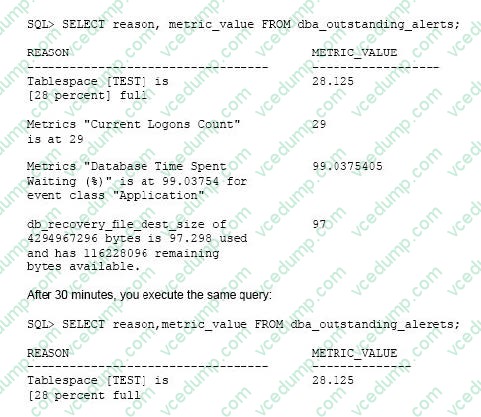
What might have caused three of the alerts to disappear?
A. The threshold alerts were cleared and transferred to DBA_ALERT_HISTORY.
B. An Automatic Workload Repository (AWR) snapshot was taken before the execution of the second query.
C. An Automatic Database Diagnostic Monitor (ADOM) report was generated before the execution of the second query.
D. The database instance was restarted before the execution of the second query. -
Question 178:
All of your live databases run in ARCHIVELOG mode.
On the SALES database there is no LEVEL 0 backup.
Examine these commands issued against the SALES database target:
RMAN> BACKUP AS BACKUPSET DATABASE;
..
backup set complete, elapsed time: 00:00:03
RMAN> BACKUP INCREMENTAL LEVEL 1 DATABASE;
What is true about the execution of these commands?
A. A Level 0 backup of the database is created instead of the Level 1.
B. A backup is created which only contains blocks that have changed since BACKUP AS BACKUPSET command.
C. It throws an error because incremental level 1 backups require image copy backups as the Level 0 backup.
D. It throws an error because a Level 0 backup does not exist. -
Question 179:
You want to capture column group usage and gather extended statistics for better cardinality estimates for the CUSTOMERS table in the SH schema.
Examine the following steps:
1.
Issue the SELECT DBMS_STATS.CREATE_EXTENDED_STATS (`SH', `CUSTOMERS') FROM dual statement.
2.
Execute the DBMS_STATS.SEED_COL_USAGE (null, `SH', 500) procedure.
3.
Execute the required queries on the CUSTOMERS table.
4.
Issue the SELECT DBMS_STATS.REPORT_COL_USAGE (`SH', `CUSTOMERS') FROM dual statement.
Identify the correct sequence of steps.
A. 3, 2, 1, 4
B. 2, 3, 4, 1
C. 4, 1, 3, 2
D. 3, 2, 4, 1 -
Question 180:
Examine the following impdp command to import a database over the network from a pre-12c Oracle database (source):

Which three are prerequisites for successful execution of the command? (Choose three.)
A. The import operation must be performed on the target database by a user with the DATAPUMP_IMP_FULL_DATABASE role, and the database link must connect to a user with the DATAPUMP_EXP_FULL_DATABASE role on the source database.
B. All user-defined tablespaces must be in read-only mode on the source database.
C. The export dump file must be created before starting the import on the target database.
D. The source and target database must be running on the same operating system (OS) with the same endianness.
E. The impdp operation must be performed by the same user that performed the expdp operation.
Related Exams:
-
1Z0-020
Oracle8i: New Features for Administrators -
1Z0-023
Architecture and Administration -
1Z0-024
Performance Tuning -
1Z0-025
Backup and Recovery -
1Z0-026
Network Administration -
1Z0-034
Upgrade Oracle9i/10g OCA to Oracle Database OCP -
1Z0-036
Managing Oracle9i on Linux -
1Z0-041
Oracle Database 10g: DBA Assessment -
1Z0-052
Oracle Database 11g: Administration Workshop I -
1Z0-053
Oracle Database 11g: Administration II
Tips on How to Prepare for the Exams
Nowadays, the certification exams become more and more important and required by more and more enterprises when applying for a job. But how to prepare for the exam effectively? How to prepare for the exam in a short time with less efforts? How to get a ideal result and how to find the most reliable resources? Here on Vcedump.com, you will find all the answers. Vcedump.com provide not only Oracle exam questions, answers and explanations but also complete assistance on your exam preparation and certification application. If you are confused on your 1Z0-062 exam preparations and Oracle certification application, do not hesitate to visit our Vcedump.com to find your solutions here.