1Z0-062 Exam Details
-
Exam Code
:1Z0-062 -
Exam Name
:Oracle Database 12c: Installation and Administration -
Certification
:Oracle Certifications -
Vendor
:Oracle -
Total Questions
:411 Q&As -
Last Updated
:Dec 24, 2024
Oracle 1Z0-062 Online Questions & Answers
-
Question 191:
Your database is open and the LISTENER listener running. You stopped the wrong listener LISTENER by issuing the following command:
1snrctl > STOP
What happens to the sessions that are presently connected to the database Instance?
A. They are able to perform only queries.
B. They are not affected and continue to function normally.
C. They are terminated and the active transactions are rolled back.
D. They are not allowed to perform any operations until the listener LISTENER is started. -
Question 192:
Your multitenant container database has three pluggable databases (PDBs): PDB1, PDB2, and PDB3. Which two RMAN commands may be; used to back up only the PDB1 pluggable database? (Choose two.)
A. BACKUP PLUGGABLE DATABASE PDB1 while connected to the root container
B. BACKUP PLUGGABLE DATABASE PDB1 while connected to the PDB1 container
C. BACKUP DATABASE while connected to the PDB1 container
D. BACKUP DATABASE while connected to the boot container
E. BACKUP PLUGGABLE database PDB1 while connected to PDB2 -
Question 193:
Unified auditing is enabled in your database. The HR_ADMIN and OE_ADMIN roles exist and are granted system privileges.
You execute the command:
SQL>CREATE AUDIT POLICY tab1e_aud PRIVILEGES CREATE ANY TABLE, DROP ANY TABLE ROLES
hr_admin, oe_admin;
Which statement is true?
A. It succeeds and needs to be enabled to capture all SQL statements that require either the specified privileges or any privilege granted to the HR_ADMIN and OE_ADMIN role.
B. It fails because system privileges cannot be granted with roles in the same audit policy.
C. It succeeds and starts capturing only successful SQL statements for all users who have either the specified privileges or roles granted to them.
D. It fails because the command does not specify when the unified audit policy should be enforced. -
Question 194:
Which two statements are true about Automatic Storage Management (ASM)? (Choose two.)
A. It mounts databases and diskgroups to make ASM files available to database instances.
B. It spreads files proportionally across all disks in a diskgroup, aiming to ensure that all the disks in a diskgroup have the same I/O load.
C. It automatically places each disk from an external redundancy diskgroup in its own failure group.
D. It divides files into extents and allows an extent to span disks.
E. It mirrors data at the allocation unit (AU) level across failure groups within a normal or high redundancy diskgroup. -
Question 195:
Which two statements are true about a server parameter file (SPFILE)? (Choose two.)
A. An SPFILE can be created from a PFILE or from memory.
B. A PFILE can be used to start up a database instance even if an SPFILE exists.
C. An SPFILE must reside in the ORACLE_HOME/dbs directory.
D. An SPFILE can be created only before a database instance is started.
E. An SPFILE contains only those dynamic parameters that can be changed without having to restart the database instance. -
Question 196:
Which statement is true about using the Export/Import method for migrating data when upgrading to Oracle Database 12c?
A. It automatically restarts a Data Pump Export or Import job after a failure is connected and the job continues from the point of failure.
B. It can be used to migrate a database only if the source and target databases are hosted on the same endian format.
C. It can be used to migrate a database only if the source database does not have any tablespace in read-only mode.
D. It allows migration of a database directly over network links. -
Question 197:
Which two are true about database table rows? (Choose two.)
A. They always have a row header.
B. They are always stored in a single database block.
C. They are chained across multiple blocks only when the table has more than 255 columns.
D. They have a row header only when they are chained across multiple database blocks.
E. They can be stored in a single database block. -
Question 198:
Which two statements are true about Oracle Managed Files (OMF)? (Choose two.)
A. OMF cannot be used in a database that already has data files created with user-specified directions.
B. The file system directions that are specified by OMF parameters are created automatically.
C. OMF can be used with ASM disk groups, as well as with raw devices, for better file management.
D. OMF automatically creates unique file names for table spaces and control files.
E. OMF may affect the location of the redo log files and archived log files. -
Question 199:
Examine the parameters:
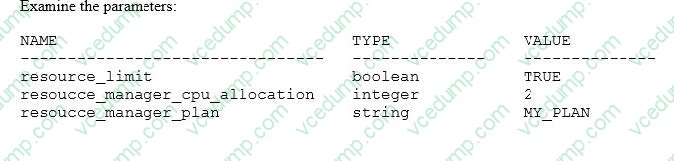
Users complain that their sessions for certain transactions hang. You investigate and discover that some users fail to complete their transactions, causing other transactions to wait on row-level locks.
Which two actions would you take to prevent this problem? (Choose two.)
A. Increase the maximum number of ITL slots for segments on which a blocking user performs a transaction.
B. Decrease the SESSIONS_PER_USER limit in the profiles assigned to blocking users.
C. Set a limit in the profiles of blocking users to control the number of data blocks that can be accessed in a session.
D. Use Database Resource Manager to automatically kill the sessions that are idle and are blocking other sessions.
E. Decrease the IDLE_TIME resource limit in the profiles assigned to blocking users. -
Question 200:
Which three statements are true about the working of system privileges in a multitenant control database (CDB) that has pluggable databases (PDBs)? (Choose three.)
A. System privileges apply only to the PDB in which they are used.
B. Local users cannot use local system privileges on the schema of a common user.
C. The granter of system privileges must possess the set container privilege.
D. Common users connected to a PDB can exercise privileges across other PDBs.
E. System privileges with the with grant option container all clause must be granted to a common user before the common user can grant privileges to other users.
Related Exams:
-
1Z0-020
Oracle8i: New Features for Administrators -
1Z0-023
Architecture and Administration -
1Z0-024
Performance Tuning -
1Z0-025
Backup and Recovery -
1Z0-026
Network Administration -
1Z0-034
Upgrade Oracle9i/10g OCA to Oracle Database OCP -
1Z0-036
Managing Oracle9i on Linux -
1Z0-041
Oracle Database 10g: DBA Assessment -
1Z0-052
Oracle Database 11g: Administration Workshop I -
1Z0-053
Oracle Database 11g: Administration II
Tips on How to Prepare for the Exams
Nowadays, the certification exams become more and more important and required by more and more enterprises when applying for a job. But how to prepare for the exam effectively? How to prepare for the exam in a short time with less efforts? How to get a ideal result and how to find the most reliable resources? Here on Vcedump.com, you will find all the answers. Vcedump.com provide not only Oracle exam questions, answers and explanations but also complete assistance on your exam preparation and certification application. If you are confused on your 1Z0-062 exam preparations and Oracle certification application, do not hesitate to visit our Vcedump.com to find your solutions here.