1Z0-062 Exam Details
-
Exam Code
:1Z0-062 -
Exam Name
:Oracle Database 12c: Installation and Administration -
Certification
:Oracle Certifications -
Vendor
:Oracle -
Total Questions
:411 Q&As -
Last Updated
:Dec 24, 2024
Oracle 1Z0-062 Online Questions & Answers
-
Question 401:
Examine the parameters for a database instance:
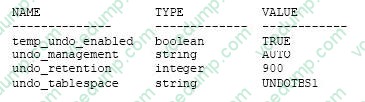
Your database has three undo tablespaces and the default undo tablespace is not autoextensible. Resumable space allocation is not enabled for any sessions in the database instance.
What is the effect on new transactions when all undo space in the default undo tablespace is in use by active transactions?
A. Transactions write their undo in the SYSTEM undo segment.
B. Transactions fail.
C. Transactions wait until space becomes available in UNDOTBS1.
D. Transactions write their undo in a temporary tablespace. -
Question 402:
Which three statements are true about the purpose of checkpoints? (Choose three.)
A. They ensure that uncommitted transactions are rolled back in case of an instance failure.
B. They ensure that all the dirty buffers are written to disk during a normal shutdown.
C. They ensure that instance recovery starts in the event of an instance failure.
D. They ensure that dirty buffers in the buffer cache are written to disk regularly.
E. They reduce the time required for recovery in case of an instance failure. -
Question 403:
Examine this command:
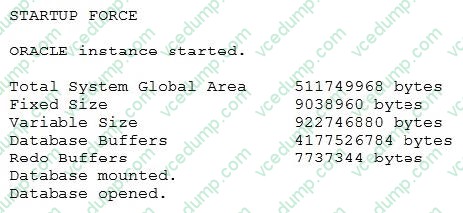
Now examine these steps:
1.
Oracle instance is started.
2.
The control file is read.
3.
Instance recovery is started.
4.
Datafiles and redo log files are opened.
5.
The spfile or pfile is read.
6.
The database is available for use.
7.
The database is mounted.
8.
Instance recovery is completed.
Identify the steps that were executed in the correct order to open the database:
A. 5, 1, 3, 2, 7, 4, 6, 8
B. 5, 2, 1, 7, 4, 3, 6, 8
C. 5, 1, 2, 7, 4, 3, 8, 6
D. 5, 1, 2, 7, 4, 6
E. 5, 1, 2, 7, 4, 3, 6, 8
F. 5, 2, 1, 4, 7, 6 -
Question 404:
An application repeatedly accesses small lookup tables, causing a lot of physical I/O operations.
What do you recommend to minimize this?
A. Configure the nonstandard buffer cache with a buffer size greater than the size of the default buffer cache.
B. Increase the size of the shared pool
C. Configure the KEEP buffer cache and alter the tables to use the KEEP cache.
D. Configure the RECYCLE buffer cache and alter the tables to use the RECYCLE cache. -
Question 405:
In one of your databases, unified auditing is enabled and an SH.SALES table exists. You can successfully execute these commands:

Which statement is true about SALES_POL?
A. Audit records are always stored in an external audit file.
B. It is enabled for all users having SELECT privilege on SH.SALES.
C. It is only enabled for SH.
D. Only successful queries of SH.SALES are written to the audit trail. -
Question 406:
You wish to enable an audit policy for all database users, except SYS, SYSTEM, and SCOTT.
You issue the following statements:
SQL> AUDIT POLICY ORA_DATABASE_PARAMETER EXCEPT SYS;
SQL> AUDIT POLICY ORA_DATABASE_PARAMETER EXCEPT SYSTEM;
SQL> AUDIT POLICY ORA_DATABASE_PARAMETER EXCEPT SCOTT;
For which database users is the audit policy now active?
A. All users except SYS
B. All users except SCOTT
C. All users except sys and SCOTT
D. All users except sys, system, and SCOTT -
Question 407:
Examine the command:

Which statement is true?
A. The data file, TEST01.DBF, can be auto extended to a maximum size of 5M.
B. The tablespace, TEST1, can contain a maximum of one data file.
C. Allocated and free extents are tracked using bitmaps.
D. Segment free space is tracked in the data dictionary. -
Question 408:
Examine this parameter setting:
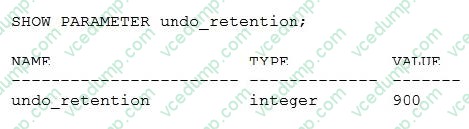
Now examine these statements:
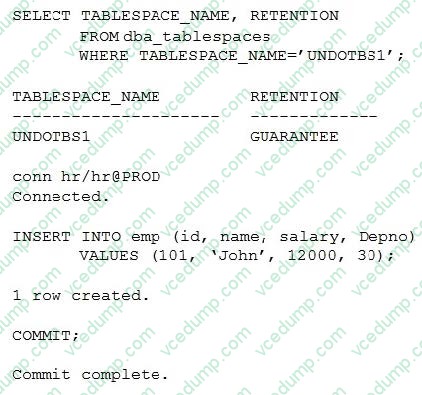
Which three are true about the processing of these statements? (Choose three.)
A. LGWR will only write redo generated by the INSERT statement to the redo log during execution of the COMMIT statement.
B. Undo generated for the transaction will be in an unexpired state immediately after the commit.
C. Only the 900 most recently generated undo statements will be in an unexpired state after the commit.
D. DBWR might write the content of the modified EMP table block image to a data file before the COMMIT is executed.
E. Only the 900 most recently generated undo statements are guaranteed to be retained.
F. LGWR might write redo generated by the INSERT statement to the redo log before the COMMIT is executed.
G. DBWR must write the content of the modified EMP table block image to a data file before the COMMIT executed. -
Question 409:
Your multitenant container database (CDB) contains pluggable databases (PDBs), you are connected to the HR_PDB. You execute the following command:
SQL > CREATE UNDO TABLESPACE undotb01
DATAFILE `u01/oracle/rddb1/undotbs01.dbf' SIZE 60M AUTOEXTEND ON;
What is the result?
A. It executes successfully and creates an UNDO tablespace in HR_PDB.
B. It falls and reports an error because there can be only one undo tablespace in a CDB.
C. It fails and reports an error because the CONTAINER=ALL clause is not specified in the command.
D. It fails and reports an error because the CONTAINER=CURRENT clause is not specified in the command.
E. It executes successfully but neither tablespace nor the data file is created. -
Question 410:
You are required to migrate your 11.2.0.3 database as a pluggable database (PDB) to a multitenant container database (CDB).
The following are the possible steps to accomplish this task:
1.
Place all the user-defined tablespace in read-only mode on the source database.
2.
Upgrade the source database to a 12c version.
3.
Create a new PDB in the target container database.
4.
Perform a full transportable export on the source database with the VERSION parameter set to 12 using the expdp utility.
5.
Copy the associated data files and export the dump file to the desired location in the target database.
6.
Invoke the Data Pump import utility on the new PDB database as a user with the DATAPUMP_IMP_FULL_DATABASE role and specify the full transportable import options.
7.
Synchronize the PDB on the target container database by using the DBMS_PDS.SYNC_ODB function.
Identify the correct order of the required steps.
A. 2, 1, 3, 4, 5, 6
B. 1, 3, 4, 5, 6, 7
C. 1, 4, 3, 5, 6, 7
D. 2, 1, 3, 4, 5, 6, 7
E. 1, 5, 6, 4, 3, 2
Related Exams:
-
1Z0-020
Oracle8i: New Features for Administrators -
1Z0-023
Architecture and Administration -
1Z0-024
Performance Tuning -
1Z0-025
Backup and Recovery -
1Z0-026
Network Administration -
1Z0-034
Upgrade Oracle9i/10g OCA to Oracle Database OCP -
1Z0-036
Managing Oracle9i on Linux -
1Z0-041
Oracle Database 10g: DBA Assessment -
1Z0-052
Oracle Database 11g: Administration Workshop I -
1Z0-053
Oracle Database 11g: Administration II
Tips on How to Prepare for the Exams
Nowadays, the certification exams become more and more important and required by more and more enterprises when applying for a job. But how to prepare for the exam effectively? How to prepare for the exam in a short time with less efforts? How to get a ideal result and how to find the most reliable resources? Here on Vcedump.com, you will find all the answers. Vcedump.com provide not only Oracle exam questions, answers and explanations but also complete assistance on your exam preparation and certification application. If you are confused on your 1Z0-062 exam preparations and Oracle certification application, do not hesitate to visit our Vcedump.com to find your solutions here.