1Z0-062 Exam Details
-
Exam Code
:1Z0-062 -
Exam Name
:Oracle Database 12c: Installation and Administration -
Certification
:Oracle Certifications -
Vendor
:Oracle -
Total Questions
:411 Q&As -
Last Updated
:Dec 24, 2024
Oracle 1Z0-062 Online Questions & Answers
-
Question 161:
Your database is running in ARCHIVELOG mode. You want to take a consistent whole database backup.
Which two statements are true in this scenario? (Choose two.)
A. The user-managed backup consists of only formatted data blocks.
B. The database must be shut down to take a user-managed backup.
C. The RMAN backup contains only data files.
D. The RMAN backup can be performed while the database is open.
E. The database must be in MOUNT state to take RMAN backup. -
Question 162:
You enabled block change tracking for faster incremental backups in your database. Which background process writes to the change tracking file?
A. RBAL
B. CKPT
C. SMON
D. PMON
E. MMON
F. CTWR
G. DBWR -
Question 163:
Examine these commands:
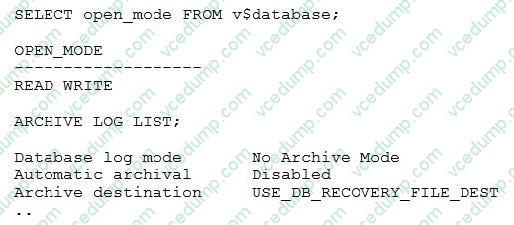
Now examine these steps:
1) STARTUP NOMOUNT 2) STARTUP MOUNT 3) STARTUP FORCE 4) ALTER DATABASE ARCHIVELOG; 5) SHUTDOWN TRANSACTIONAL 6) ALTER DATABASE OPEN; 7) SHUTDOWN ABORT 8) ALTER DATABASE MOUNT
Identify the required steps in the correct order to change the database to run in ARCHIVELOG mode.
A. 5, 2, 4, 6
B. 5, 1, 4, 8, 6
C. 5, 1, 4, 6
D. 7, 1, 4, 8, 6
E. 5, 3, 4, 6
F. 5, 2, 6, 4 -
Question 164:
You configured the Fast Recovery Area (FRA) for your database. The database instance is in ARCHIVELOG mode. The default location for the archived redo log files is the FRA.
Which two files are removed automatically if space is required in the FRA as per the retention policy? (Choose two.)
A. Archived redo log files that have multiple copies in a different archive location
B. user-managed backups of data files and control files
C. RMAN backups that are obsolete
D. flashback logs -
Question 165:
Examine the following parameters for a database instance:
MEMORY_MAX_TARGET=0 MEMORY_TARGET=0 SGA_TARGET=0 PGA_AGGREGATE_TARGET=500m
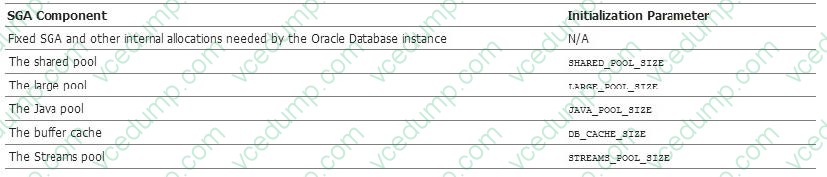
Which three initialization parameters are not controlled by Automatic Shared Memory Management (ASMM)? (Choose three.)
A. LOG_BUFFER
B. SORT_AREA_SIZE
C. JAVA_POOL_SIZE
D. STREAMS_POOL_SIZE
E. DB_16K_CACHE_SZIE
F. DB_KEEP_CACHE_SIZE -
Question 166:
In a recent Automatic Workload Repository (AWR) report for your database, you notice a high number of buffer busy waits. The database consists of locally managed tablespaces with free list managed segments.
On further investigation, you find that buffer busy waits is caused by contention on data blocks.
Which option would you consider first to decrease the wait event immediately?
A. Decreasing PCTUSED
B. Decreasing PCTFREE
C. Increasing the number of DBWN process
D. Using Automatic Segment Space Management (ASSM)
E. Increasing db_buffer_cache based on the V$DB_CACHE_ADVICE recommendation -
Question 167:
Your multitenant container database, CDB1, is running in ARCHIVELOG mode and has two pluggable databases, HR_PDB and ACCOUNTS_PDB. An RMAN backup exists for the database.
You issue the command to open ACCOUNTS_PDB and find that the USERDATA.DBF data file for the default permanent tablespace USERDATA belonging to ACCOUNTS_PDB is corrupted.
What should you do before executing the commands to restore and recover the data file in ACCOUNTS_PDB?
A. Place CDB1 in the mount stage and then the USERDATA tablespace offline in ACCOUNTS_PDB.
B. Place CDB1 in the mount stage and issue the ALTER PLUGGABLE DATABASE accounts_pdb CLOSE IMMEDIATE command.
C. Issue the ALTER PLUGGABLE DATABASE accounts_pdb RESTRICTED command.
D. Take the USERDATA tablespace offline in ACCOUNTS_PDB. -
Question 168:
Your database has archive logging enabled and RMAN backups are taken at regular intervals. A data file in the USERS tablespace is damaged.
Which command must you execute before starting the recovery of this tablespace?
A. ALTER TABLESPACE users OFFLINE
B. STARTUP FORCE NOMOUNT
C. STARTUP FORCE
D. SWITCH DATAFILE ALL -
Question 169:
What are two benefits of installing Grid Infrastructure software for a stand-alone server before installing and creating an Oracle database?
A. Effectively implements role separation
B. Enables you to take advantage of Oracle Managed Files.
C. Automatically registers the database with Oracle Restart.
D. Helps you to easily upgrade the database from a prior release.
E. Enables the Installation of Grid Infrastructure files on block or raw devices. -
Question 170:
A user establishes a connection to a database instance by using an Oracle Net. You want to ensure that:
1.
The user account must be locked after five consecutive unsuccessful login attempts.
2.
Data read per session must be limited for the user.
3.
The user cannot have more than three simultaneous sessions.
4.
The user must have a maximum of 10 minutes session idle time before being logged off automatically. Which two would you do to implement this? (Choose two.)
A. by alerting the appropriate user attributes with an ALTER USER command
B. by using appropriate PASSWORD parameters set in the profile assigned to the user
C. by implementing Database Resource Manager and assign it a profile for the user
D. by implementing Database Resource Manager and assign it a role for the user
E. by using appropriate KERNEL parameters set in the profile assigned to the user
Related Exams:
-
1Z0-020
Oracle8i: New Features for Administrators -
1Z0-023
Architecture and Administration -
1Z0-024
Performance Tuning -
1Z0-025
Backup and Recovery -
1Z0-026
Network Administration -
1Z0-034
Upgrade Oracle9i/10g OCA to Oracle Database OCP -
1Z0-036
Managing Oracle9i on Linux -
1Z0-041
Oracle Database 10g: DBA Assessment -
1Z0-052
Oracle Database 11g: Administration Workshop I -
1Z0-053
Oracle Database 11g: Administration II
Tips on How to Prepare for the Exams
Nowadays, the certification exams become more and more important and required by more and more enterprises when applying for a job. But how to prepare for the exam effectively? How to prepare for the exam in a short time with less efforts? How to get a ideal result and how to find the most reliable resources? Here on Vcedump.com, you will find all the answers. Vcedump.com provide not only Oracle exam questions, answers and explanations but also complete assistance on your exam preparation and certification application. If you are confused on your 1Z0-062 exam preparations and Oracle certification application, do not hesitate to visit our Vcedump.com to find your solutions here.