1Z0-062 Exam Details
-
Exam Code
:1Z0-062 -
Exam Name
:Oracle Database 12c: Installation and Administration -
Certification
:Oracle Certifications -
Vendor
:Oracle -
Total Questions
:411 Q&As -
Last Updated
:Dec 24, 2024
Oracle 1Z0-062 Online Questions & Answers
-
Question 151:
Examine the command:
SQL> ALTER SYSTEM SET ENABLE_DDL_LOGGING=TRUE;
Which two statements are true in this scenario? (Choose two.)
A. All data definition language (DDL) commands are logged in to the alert log file.
B. All DDL commands are logged in to a text file in Automatic Diagnostic Repository (ADR) home.
C. A subset of executed DDL statements is written into an XML file in ADR home.
D. A subset of executed DDL statements is written to the DDL log in ADR home.
E. All DDL commands are logged in to a trace file in ADR home. -
Question 152:
You plan to migrate your database from a File system to Automata Storage Management (ASM) on same platform.
Which two methods or commands would you use to accomplish this task? (Choose two.)
A. RMAN CONVERT command
B. Data Pump Export and import
C. Conventional Export and Import
D. The BACKUP AS COPY DATABASE . . . command of RMAN
E. DBMS_FILE_TRANSFER with transportable tablespace -
Question 153:
Examine this command:
SQL> ALTER SYSTEM SET ENABLE_DDL_LOGGING=TRUE;
Which two statements are true? (Choose two.)
A. All data definition language (DDL) statements are written to the control file
B. Some DDL statements are written to an XML file in the ADR home
C. All DDL statements are logged in to a text file in Automatic Diagnostic Repository (ADR) home
D. Some data definition language (DDL) statements are written to the control file
E. Some DDL statements are written to a text file in the ADR home
F. The Alert Log still contains some DDL statements -
Question 154:
You plan to upgrade your Oracle Database 9i to Oracle Database 12c.
Which two methods can you use? (Choose two.)
A. Perform a rolling upgrade.
B. Perform a direct upgrade by running the Database Upgrade Assistant (DBUA).
C. Perform a direct upgrade by manually running the catctl.pl and catupgrd.sql scripts before issuing the STARTUPUPGRADE command.
D. Install the Oracle Database 12c software, create a new Oracle 12c database, and then use the Oracle Data Pump to import data from the source Oracle 9i database to the target Oracle 12c database.
E. Upgrade your current database to Oracle Database release 10.2.0.5, and then upgrade to Oracle Database 12c. -
Question 155:
What must you use to read data from a table in your database and write it to an external table?
A. Use SQL* LOADER conventional path load.
B. Use SQL* LOADER direct path load.
C. Use CREATE TABLE. . ORGANIZATION EXTERNAL command with ORACLE_LOADER access driver.
D. Use CREATE TABLE. . ORGANIZATION EXTERNAL command with ORACLE_DATAPUMP access driver. -
Question 156:
Which two statements are true about Oracle network connections? (Choose two.)
A. A listener may listen on behalf of only one database instance at a time.
B. A server process checks a user's authentication credentials and creates a session if the credentials are valid.
C. The listener continuously monitors a connection after the user process connects to a service handler.
D. The listener always spawns a new server process to deal with each new connection.
E. A connection request from a client is always first received by a listener running on the port that is used for the connection request for the database server. -
Question 157:
You have the following entry in the tnsnames.ors of your hq.us.example.com host machine:
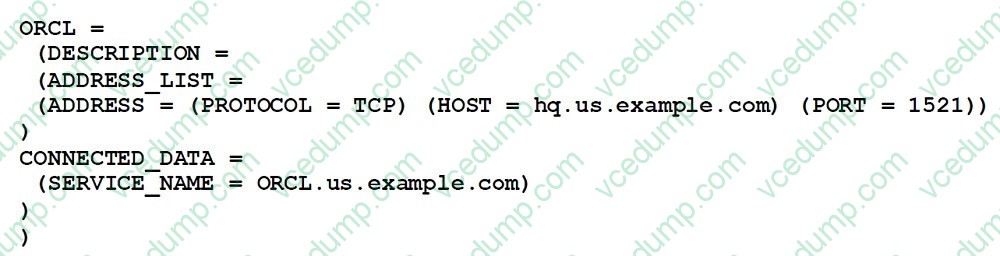
You issue the following command at the command prompt:
Sqlplus HR/HR@ORCL
Which statement is true about the connection to the ORCL database instance?
A. The connection succeeds, provided the NAMES.DEFAULT_DOMAIN parameter is set to us.example.com in the sqlnet.ora file on the client side.
B. The connection fails because the net service name does not have the suffix us.example.com.
C. The connection succeeds, provided the SERVICE_NAMES initialization parameter is set to ORCL.
D. The connection succeeds, provided the ORCL.us.example.com database service is registered with a listener, the listener is up, and the database is open. -
Question 158:
On your Oracle 12c database, you invoked SQL *Loader to load data into the EMPLOYEES table in the HR schema by issuing the following command:
$> sqlldr hr/hr@pdb table=employees
Which two statements are true regarding the command? (Choose two.)
A. It succeeds with default settings if the EMPLOYEES table belonging to HR is already defined in the database.
B. It fails because no SQL *Loader data file location is specified.
C. It fails if the HR user does not have the CREATE ANY DIRECTORY privilege.
D. It fails because no SQL *Loader control file location is specified. -
Question 159:
You perform RMAN backups for your database and use a recovery catalog for managing the backups. To free space, you execute this command:
RMAN> DELETE OBSOLETE;
Which three statements are true is this scenario? (Choose three.)
A. The backup sets marked as expired are deleted.
B. The information related to the backups is removed from the recovery catalog and the control file.
C. The physical files related to the backup need to be manually deleted.
D. The physical files related to the backup are deleted automatically.
E. The backups deleted are based on the backup retention policy. -
Question 160:
Examine this command executed on a client that is remote from the database server.
SQL> CONNECT hr/hr@orcl
Which two are required for this command to connect the SQLPLUS client to a database instance? (Choose two.)
A. An orcl TNS entry must be defined in the client-side and server-side tnsnames.ora files
B. An orcl TNS entry must be defined in the client-side tnsnames.ora file
C. A service name must be defined to the listener that matches the service name in the orcl TNS entry
D. An orcl TNS entry must be defined in the server-side tnsnames.ora file
E. The service name orcl must be defined to the listener
Related Exams:
-
1Z0-020
Oracle8i: New Features for Administrators -
1Z0-023
Architecture and Administration -
1Z0-024
Performance Tuning -
1Z0-025
Backup and Recovery -
1Z0-026
Network Administration -
1Z0-034
Upgrade Oracle9i/10g OCA to Oracle Database OCP -
1Z0-036
Managing Oracle9i on Linux -
1Z0-041
Oracle Database 10g: DBA Assessment -
1Z0-052
Oracle Database 11g: Administration Workshop I -
1Z0-053
Oracle Database 11g: Administration II
Tips on How to Prepare for the Exams
Nowadays, the certification exams become more and more important and required by more and more enterprises when applying for a job. But how to prepare for the exam effectively? How to prepare for the exam in a short time with less efforts? How to get a ideal result and how to find the most reliable resources? Here on Vcedump.com, you will find all the answers. Vcedump.com provide not only Oracle exam questions, answers and explanations but also complete assistance on your exam preparation and certification application. If you are confused on your 1Z0-062 exam preparations and Oracle certification application, do not hesitate to visit our Vcedump.com to find your solutions here.