1Z0-058 Exam Details
-
Exam Code
:1Z0-058 -
Exam Name
:Oracle Real Application Clusters 11g Release 2 and Grid Infrastructure Administration -
Certification
:Oracle Certifications -
Vendor
:Oracle -
Total Questions
:139 Q&As -
Last Updated
:Dec 14, 2021
Oracle 1Z0-058 Online Questions & Answers
-
Question 41:
orcl1, orcl2, and orcl3 are tnsnames that connect to predefined instances of a three-instance RAC database which uses ASM for shared storage.
The database is in archivelog mode.
Examine the Exhibit for the tnsnames.ora entries for orcl1, orcl2, and orcl3.
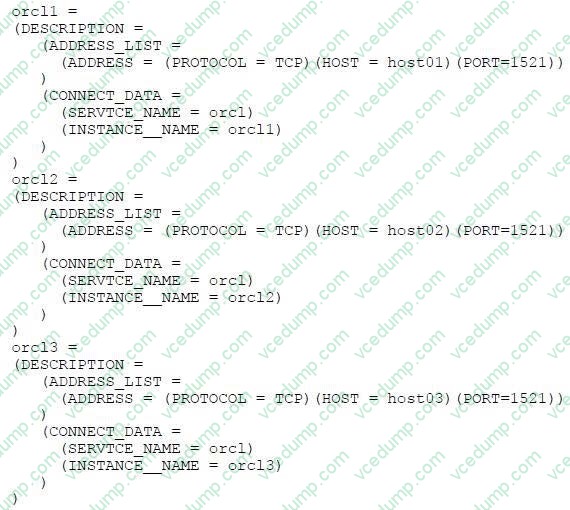
You plan to execute the following RMAN commands to back up the database:
RUN{
ALLOCATE CHANNEL CH1 DEVICE TYPE DISK CONNECT 'user1/pwd1@orcl1'; ALLOCATE CHANNEL CH2 DEVICE TYPE DISK CONNECT 'user2/pwd2@orcl2'; ALLOCATE CHANNEL CH3 DEVICE TYPE DISK CONNECT 'user3/
pwd3@orcl3'; BACKUP DATABASE PLUS ARCHIVELOG; }
What should be the database mode on each of the three instances for this backup to succeed?
A. The database can be either mounted or open on all three instances.
B. The database must be open on all three instances.
C. The database must be open on any one instance and mounted on the other two instances.
D. The database must be mounted on any one of the instances and the other instances will be mounted automatically. -
Question 42:
What are the default connect strings used by SQL*Plus and ASMCMD when connecting to ASM instances?
A. operating system authentication for ASMCMD; none for SQL*Plus
B. "/ AS SYSASM" for ASMCMD; "/" for SQL*Plus
C. "SYS/ AS SYSASM" for ASMCMD; "/ AS SYSDBA" for SQL*Pius
D. operating system authentication for ASMCMD; operating system authentication for SQL*Plus
E. "/ AS SYSASM" for ASMCMD; operating system authentication for SQL*Plus -
Question 43:
Which three programs or utilities can be used to convert a single-instance database to a Real Application Cluster database?
A. DBCA
B. the SRVCTL utility
C. Enterprise Manager
D. the RCONFIG utility
E. the CRSCTLl utility -
Question 44:
The Oracle 11g Release 2 (version 11.2.0.1) ASM instance has a new diskgroup named DATA that is currently not mounted. You log in to a cluster node as the Grid Infrastructure software owner and set the environment variables to point to
the ASM instance on that node. Using SQL*Plus, you issue the commands:
CONNECT / AS SYSDBA
ALTER DISKGROUP DATA MOUNT;
The system response is:
ERROR at line 1:
ORA-15032: not all alterations performed
ORA-15260: permission denied on ASM disk group
How do you diagnose this error?
A. Check v$asm_operation for operations halted by the error.
B. Check v$asm_attributes to determine the asm.compatible setting.
C. Check v$asm_usergroup to determine the owning user group for this diskgroup.
D. Check v$xs_session_role to determine the role privileges of the current user.
E. Check the connect string for the privileged role. -
Question 45:
You are managing a three-instance Oracle RAC database which uses a Cluster File System for shared storage.
Which two options can you use to ensure that the redo logs from all the instances are available during RMAN recovery from any instance?
A. Set the LOG_ARCHIVE_DEST_1 parameter to a single location on the Cluster File System for each of the three instances and leave the LOG_ARCHIVE_FORMAT parameter with the default value.
B. Set only the LOG_ARCHIVE_DEST_1 parameter to a single location on the Cluster File System for any one of the three instances and leave the LOG_ARCHIVE_FORMAT parameter with the default value.
C. Set the LOG_ARCHIVE_DEST_1 parameter to a single location on the Cluster File System for each of the three instances, and the LOG_ARCHIVE_FORMAT parameter for each instance, to the same format including the thread number.
D. Set the LOG_ARCHIVE_DEST_1 parameter to a single location on the Cluster File System, and set LOG_ARCHIVE_FORMAT parameter on only one instance. -
Question 46:
Your cluster has Oracle Grid Infrastructure installed and working to support RAC databases and all the related resources.
There is also a vendor HA software on the cluster providing HA services for some non-Oracle applications. You want to remove the vendor HA software and use Oracle Grid Infrastructure to provide the HA framework for your applications.
The first application to be migrated to Oracle HA is used to display financial currency information at various fixed flat screens at a business park. This application must be owned by the Financial Application owner.
Which three components of the framework are required to support this application for HA?
A. an application VIP to support sending data to the screens
B. a resource definition defining the application and various HA attributes
C. privileges to permit the application to run as the correct user and to have the correct access rights to files
D. an action program called by the HA framework for starting, stopping, and monitoring the application
E. a resource dependency to make certain that the application VIP is started before the application is started and to start VIP automatically if it is down -
Question 47:
You notice that there is a very high percentage of wait time for RAC database that has frequent insert operations. Which two recommendations may reduce this problem?
A. shorter transactions
B. increasing sequence cache sizes
C. using reverse key indexes
D. uniform and large extent sizes
E. automatic segment space management
F. smaller extent sizes -
Question 48:
Which three describe how often OCR backups are taken and how many are retained, according to the default backup schedule?
A. every 12 hours and the Clusterware keeps the last four copies
B. every 4 hours and the Clusterware keeps the last three copies
C. every day and the Clusterware keeps the last two copies
D. every day and the Clusterware keeps the last three copies
E. every week and the Clusterware keeps the last two copies -
Question 49:
Which three statements are true about ASM dynamic volume manager (ADVM)?
A. ADVM provides volume management services and a standard disk device driver interface to file system drivers.
B. The administrator can use ADVM to create volumes that contain bootable vendor operating systems.
C. File systems and other disk-based applications issue I/O requests to ADVM volume devices as they would to other storage devices on a vendor operating system.
D. ADVM extends ASM by providing a disk driver interface to storage backed by an ASM volume.
E. To use the ADVM driver, the oraclesacfs, oradeoks, and oracleadvm drivers must be loaded, but an ASM instance is not required. -
Question 50:
When creating an Oracle Cluster database using DBCA the "Memory size (SGA and PGA)" field is supplied on value of 2000 MB. Identify the default block Size used for the database.
A. 2 KB
B. 4 KB
C. 8 KB
D. 16 KB
E. 32 KB
Related Exams:
-
1Z0-020
Oracle8i: New Features for Administrators -
1Z0-023
Architecture and Administration -
1Z0-024
Performance Tuning -
1Z0-025
Backup and Recovery -
1Z0-026
Network Administration -
1Z0-034
Upgrade Oracle9i/10g OCA to Oracle Database OCP -
1Z0-036
Managing Oracle9i on Linux -
1Z0-041
Oracle Database 10g: DBA Assessment -
1Z0-052
Oracle Database 11g: Administration Workshop I -
1Z0-053
Oracle Database 11g: Administration II
Tips on How to Prepare for the Exams
Nowadays, the certification exams become more and more important and required by more and more enterprises when applying for a job. But how to prepare for the exam effectively? How to prepare for the exam in a short time with less efforts? How to get a ideal result and how to find the most reliable resources? Here on Vcedump.com, you will find all the answers. Vcedump.com provide not only Oracle exam questions, answers and explanations but also complete assistance on your exam preparation and certification application. If you are confused on your 1Z0-058 exam preparations and Oracle certification application, do not hesitate to visit our Vcedump.com to find your solutions here.