1Z0-058 Exam Details
-
Exam Code
:1Z0-058 -
Exam Name
:Oracle Real Application Clusters 11g Release 2 and Grid Infrastructure Administration -
Certification
:Oracle Certifications -
Vendor
:Oracle -
Total Questions
:139 Q&As -
Last Updated
:Dec 14, 2021
Oracle 1Z0-058 Online Questions & Answers
-
Question 121:
Examine the Exhibit.
*** Exhibit is Missing ***
Which three statements are correct?
A. Global Cache Block Access Latency indicates how many block transfers incurred a delay (busy) or an unexpected longer delay (congested).
B. Global Cache Block Access Latency indicates how many block transfers received blocks cached by other instances as well as blocks read from disk.
C. Global Cache Block Transfer Rate shows the total aggregated number of blocks received by all instances in the cluster over the interconnect.
D. Global Cache Block Transfer Rate is essentially a profile of how much work is performed in the local buffer cache, rather than the portion of remote references and physical reads, which both have higher latencies.
E. Global Cache Block Transfers and Physical Reads shows the percentage of read operations that retrieved blocks from disk, and the buffer cache of other instances using Cache Fusion.
F. Global Cache Block Transfers and Physical Reads shows the aggregated number of data blocks received by all instances in the cluster over the interconnect. -
Question 122:
The original cluster on RACNODE1, RACNODE 2, RACNODE 3, and RACNODE4 had the Oracle Grid Infrastructure installed to support Grid Naming Service (GNS). What should be done to verify that the two new nodes called RACNODE5, RACNODE6 are physically connected?
A. cluvfy stage -post crsinst -n RACNODE5,RACNODE6 -verbose
B. cluvfy stage -post nodeadd -n RACNODE5,RACNODE6 -verbose
C. cluvfy stage -post hacfg -verbose
D. cluvfy stage -post nodeadd -n all verbose -
Question 123:
Which command will set full debugging for the communications and resource management components; of the CRS module on nodes host01 and host03?
A. srvctl set log -m CRS -C CRSCTI 5, CRSCOMM 5 -n host0l,host03
B. ocrconfig set log CRS "CRSRTI,CRSCOMM:5 " -nodelist host01,host03
C. crsctl set log CRS "CRSRTI:5,CRSCOMM:5" -nodelist host0l,host03
D. crsctl lsmodules crs set log CRSRTI:5,CRSCOMM:5 -nodelist host0l, host03 -
Question 124:
Which three statements are true about ASM performance and scalability?
A. Disks in a diskgroup may be of varying speed and capacity without affecting performance.
B. Disks in a diskgroup should match in speed and capacity for best performance.
C. A database seldom needs more than two diskgroups: one for data and the other for a fast recovery area.
D. A database needs a separate diskgroup for each major tablespace, redo logs, and fast recovery area.
E. Multiple databases that use the same diskgroup make the best use of space.
F. Multiple databases that use a separate diskgroup for each database make the best use of space. -
Question 125:
As part of your data center's high availability strategy, you are creating resource definitions to control the management of a web-based application by the Oracle Grid Infrastructure clusterware stack. The application and its VIP are normally
online on one node of a four-node cluster due to the CARDINALITY of the resource type being set to 1.
You have chosen a policy-managed resource type for the application by using a server pool that uses only RACNODE3 and RACNODE4. The START ATTEMPTS attribute for the resource is set to 2 and FAILURE INTERVAL is set to 60.
What is true about the attributes that may be set to control the application?
A. The clusterware will attempt to start the application on the same node twice within the server pool as long as that node is up. If the node fails, then the VIP and the application will be failed over to the other node in the server pool immediately.
B. The clusterware will attempt to start the application on the same node twice within the server pool as long as that node is up. If the node fails, then the VIP and the application will be failed over to the other node in the server pool only after two 60-second intervals have elapsed.
C. The clusterware will attempt to start the application on the same node twice within the server pool as long as that node is up. If the application fails to start after 60 seconds, but the node is still up, then the VIP and the application will NOT be failed over to the other node in the server pool.
D. The clusterware will attempt to start the application on the same node twice within the server pool as long as that node is up. If the application fails to start immediately but the node is still up, then the VIP and the application will NOT be failed over to the other node in the server pool. -
Question 126:
Which four statements about mounting ASM cluster file systems are true?
A. An ACFS volume can be mounted by using ASMCA.
B. The standard Linux/UNIX mount command can be used to mount an ACFS volume, provided the ACFS type is specified; (mount -t acfs).
C. ACFS volumes can be mounted by using the ASMCMD utility.
D. The acfsmountvol command can be used to mount ACFS volumes on Windows platforms.
E. Oracle Enterprise Manager can be used to mount ACFS volumes. -
Question 127:
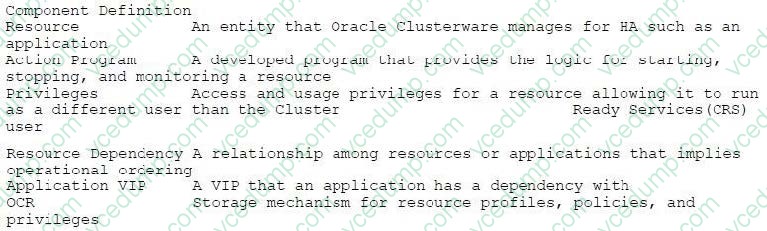
Which three are components of Oracle HA Framework for protecting third-party applications using Oracle Clusterware?
A. resources
B. action programs
C. voting disks
D. application VIPS
E. SCAN VIPS -
Question 128:
How does the Oracle Grid Infrastructure administrator determine the location of the Oracle Clusterware voting disk?
A. Run cat /etc/oracle/vote.loc from any node.
B. Run srvctl query css votedisk from any node.
C. Run crsctl query css votedisk from any node.
D. Run select name, path from v$votedisk from any RAC database instance of any database on the cluster. -
Question 129:
Which two statements are true regarding the Automatic Workload Repository (AWR) In a RAC environment?
A. The AWR includes time model statistics based on time usage for activities displayed In the VSSYS_TIME_MODEL and VSSESS_TIHE_HODEL views.
B. The AWR is controlled by the statistics_level initialization parameter and it must be set to TYPICAL or BASIC
C. The Manageability Monitor Processes (MMON) process gathers statistics every hour from every instance and creates an AWR snapshot and stores it In the SGA.
D. The MMON process gathers statistics from its' own instance and kicks off statistics collection form other instances every hour from other instances and creates an AWR snapshot which is written to the sysaux tablespace. -
Question 130:
What does a high "gc current block busy" event value indicate?
A. Access to cached data blocks was delayed because they were busy either in the remote or the local cache.
B. A large number of requested blocks were not cached In any instance.
C. Asynchronous input/output (I/O) is disabled.
D. Delay in processing has occurred In the GCS, caused by CPU saturation and would have to be solved by additional CPUs and load-balancing.
Related Exams:
-
1Z0-020
Oracle8i: New Features for Administrators -
1Z0-023
Architecture and Administration -
1Z0-024
Performance Tuning -
1Z0-025
Backup and Recovery -
1Z0-026
Network Administration -
1Z0-034
Upgrade Oracle9i/10g OCA to Oracle Database OCP -
1Z0-036
Managing Oracle9i on Linux -
1Z0-041
Oracle Database 10g: DBA Assessment -
1Z0-052
Oracle Database 11g: Administration Workshop I -
1Z0-053
Oracle Database 11g: Administration II
Tips on How to Prepare for the Exams
Nowadays, the certification exams become more and more important and required by more and more enterprises when applying for a job. But how to prepare for the exam effectively? How to prepare for the exam in a short time with less efforts? How to get a ideal result and how to find the most reliable resources? Here on Vcedump.com, you will find all the answers. Vcedump.com provide not only Oracle exam questions, answers and explanations but also complete assistance on your exam preparation and certification application. If you are confused on your 1Z0-058 exam preparations and Oracle certification application, do not hesitate to visit our Vcedump.com to find your solutions here.