1Z0-058 Exam Details
-
Exam Code
:1Z0-058 -
Exam Name
:Oracle Real Application Clusters 11g Release 2 and Grid Infrastructure Administration -
Certification
:Oracle Certifications -
Vendor
:Oracle -
Total Questions
:139 Q&As -
Last Updated
:Dec 14, 2021
Oracle 1Z0-058 Online Questions & Answers
-
Question 11:
You have two administrator-defined server pools on your eight-node cluster called OLTP and DSS.
Hosts RACNODE3, RACNODE4, and RACNODE5 are currently assigned to the DSS Pool. Hosts RACNODE6, RACNODE7, and RACNODE8 are assigned to the OLTP Pool. Hosts RACNODE1 and RACNODE2 are assigned to the Generic
pool.
You are patching the Oracle Grid Infrastructure in a rolling fashion for your cluster and you have completed patching nodes RACNODE3, RACNODE4, RACNODE5, and RACNODE6, but you have not patched nodes RACNODE1 and
RACNODE2.
While examining the status of RACNODE2 software, you get this output:
$ crsctl query crs softwareversion
Oracle Cluster-ware version on node [RACNODE2] is [11.2.0.2.0] $ crsctl query crs activeversion Oracle Clusterware active version on node [RACNODE2] is [11.2.0.1.0]
Which two statements describe the reasons for the active versions on the nodes of the cluster?
A. The active version is 11.2.0.2.0 on RACNODE3, RACNODE4, and RACNODE5 because all the nodes in the DSS server pool have the same installed version.
B. The active version is 11.2.0.1.0 on RACNODE6, RACNODE7, and RACNODE8 because some nodes in the cluster still have version 11.2.0.1.0 installed.
C. The active version is 11.2.0.1.0 on RACNODE6, RACNODE7, and RACNODE8 because some nodes in the OLTP Pool still have version 11.2.0.1.0 installed.
D. The active version is 11.2.0.1.0 on RACNODE3, RACNODE4, and RACNODE5 because some nodes in the cluster still have version 11.2.0.1.0 installed. -
Question 12:
The storage administrator is adding several disks to a pool of ASM disks. The current ASM_DISKSTRING parameter is "/dev/sda*", "/dev/sdb*", "/dev/sd*6". There are several hundred disk partitions currently.
The new disks are /dev/sdf1, /dev/sdg1, /dev/sdh1, and /dev/sdd6. Which ASM_DISKSTRING parameter would perform the best by searching the fewest number of devices for ASM discovery?
A. ASM_DISKSTRING="/dev/sda*", "/dev/sdb*", "/dev/sd*6","/dev/sd*1"
B. ASM_DISKSTRING="/dev/sda*", "/dev/sdb*", "/dev/sd*6","/dev/sd*"
C. ASM_DISRSTRING="/dev/sd*"
D. ASM_DISKSTRING=""
E. ASM_DISKSTRING="/dev/sda*", "/dev/sdb*", "/dev/sd*6", "/dev/sdf1", "/dev/sdg1", "/dev/sdh1" -
Question 13:
Which four statements are true about services and connection load balancing?
A. Services provide the ability to balance client connections across the instances in an Oracle RAC configuration.
B. There are two types of load balancing that you can implement; load balancing decisions can be made by the client and by the listener.
C. In a RAC database environment, you should select only one load balancing method.
D. With server-side load balancing, the listener directs a connection request to the best instance that is currently providing the service based on the load-balancing options selected by the DBA.
E. Client-side load balancing balances the connection requests across the listeners. -
Question 14:
The Oracle Grid Infrastructure administrator runs ocrconfig -backupioc
A. The master node may change if the node running the master CRS daemon shuts down causing another node to become the master. Because the default location is a nonshared storage, and only the master node performs backups, the backups could be spread around on many nodes making management or recovery more difficult.after completing the installation of the Grid Infrastructure. What are the two reasons for doing this
B. The cluster node currently acting as the master node for CRS is the only node that backs up the OCR to the default location, and by changing the location, all cluster nodes will then take backups.
C. This is done to move the backup location into an ASM Cluster File System directory so that the backups benefit from ASM striping and mirroring.
D. If for any reason CRS must be stopped on all nodes for a time spanning a scheduled backup, then on restart, the backup timer will be reset. This could result in longer time duration between automatic backups than the standard four-hour interval. -
Question 15:
You want to install a database patch on your eight-node cluster by using Opatch with, the minimum amount of down time to your cluster nodes.
You have already been prompted for the first set of nodes and you replied with node names RACNODE1 RACNODE2, and RACNODE3.
Which two statements are true about the procedure for minimizing down time?
A. The patch must be propagated to, applied, and the inventory updated on all the remaining nodes before restarting the instances on the first set of nodes.
B. When the first set of nodes has been patched, the instances on the remaining nodes are shut down automatically by opatch.
C. The instances must be started on the first set of nodes and then stopped on the remaining set to make certain that some nodes are always available.
D. When the first set of nodes has been patched, the administrator is prompted to shut down the instances on the remaining nodes.
E. The patch must be propagated to and the inventory updated on all the remaining nodes before restarting the instances on the first set of nodes. -
Question 16:
After evaluating the various methods for extending a cluster, you decide to use addNode.sh.
The cluster originally consisted of four nodes: RACNODE1, RACNODE2, RACNODE3, and RACNODE4. Now two nodes called RACNODES and RACNODE6 have been installed and connected to the cluster by OS administrations.
Which three actions should be performed to check whether the new nodes are ready for running addNode.sh and to help correct any problems?
A. cluvfy stage -pre crsinst -n RACNODE5/ RACNODE6 -C + DATA -q +VOTE -orainv
B. -fixup -verbose
C. cluvfy stage -post hwos -n RACNODE5, RACNODE6 -verbose
D. cluvfy comp peer -refnode RACNODE1 -n RACNODE5, RACNODE6 -orainv -osdba -verbose
E. cluvfy stage -post hwos -n all -verbose
F. cluvfy stage -pre nodeadd -n RACNODE5, RACNODE6 -fixup
G. cluvfy comp peer -refnode RACNODES -n RACNODE6 -orainv -osdba -verbose -
Question 17:
Which two statements are true about ACFS snapshots?
A. They can be created for ACFS file systems only if the ASM disk group hosting the ADVM volume file used by the file system has free space available.
B. They can be created for ACFS file systems only if the ADVM volume file used by the file system has free space available.
C. They can be created only if the ASM disk group hosting the ADVM volume used by the file system has no other ASM files contained in the disk group.
D. They can be created when ACFS is used both on clusters and on stand-alone servers.
E. They are accessible only on the cluster node that was used when creating the snapshot. -
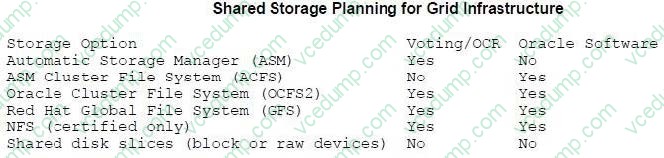
Question 18:
Identify the three valid storage options for Grid Infrastructure voting disk and Install.
A. a certified Cluster File System (CFS)
B. a certified Network File System (NFS)
C. ASM Cluster File System (ACFS)
D. Automatic Storage Management (ASM)
E. shared disk slices (block or raw devices) -
Question 19:
The Oracle Grid Infrastructure administrator decides to make more copies of the voting disks that are currently stored in the ASM disk group +VOTE. How can this be done?
A. by running crsctl add css votedisk to make a copy to a shared location on a shared device or file system
B. by running crsctl add css votedisk +VOTE, thereby adding another copy of the voting disk to the +VOTE disk group
C. by running srvctl replace votedisk +asm_disk_group on another disk group that has greater redundancy, thereby causing additional copies to be created
D. by running crsctl replace votedisk +asm_disk_group on another disk group that has greater redundancy, thereby causing additional copies to be created -
Question 20:
Which two statements are true regarding undo management in the RAC environment?
A. You can use Automatic Undo Management (AUM) in some of the instances and manual undo management in the rest of the instances in a RAC database.
B. In a policy-managed RAC database, Oracle automatically allocates the undo tablespace even the Oracle Managed Files (OMF) is disabled in a database.
C. In a policy-managed RAC database, Oracle automatically allocates the undo tablespace if the database is OMF enabled.
D. You can dynamically switch undo tablespace assignments by executing the ALTER SYSTEM SET UNDO_TABLESPACE statement from any instance in a administrator managed database.
Related Exams:
-
1Z0-020
Oracle8i: New Features for Administrators -
1Z0-023
Architecture and Administration -
1Z0-024
Performance Tuning -
1Z0-025
Backup and Recovery -
1Z0-026
Network Administration -
1Z0-034
Upgrade Oracle9i/10g OCA to Oracle Database OCP -
1Z0-036
Managing Oracle9i on Linux -
1Z0-041
Oracle Database 10g: DBA Assessment -
1Z0-052
Oracle Database 11g: Administration Workshop I -
1Z0-053
Oracle Database 11g: Administration II
Tips on How to Prepare for the Exams
Nowadays, the certification exams become more and more important and required by more and more enterprises when applying for a job. But how to prepare for the exam effectively? How to prepare for the exam in a short time with less efforts? How to get a ideal result and how to find the most reliable resources? Here on Vcedump.com, you will find all the answers. Vcedump.com provide not only Oracle exam questions, answers and explanations but also complete assistance on your exam preparation and certification application. If you are confused on your 1Z0-058 exam preparations and Oracle certification application, do not hesitate to visit our Vcedump.com to find your solutions here.