1Z0-058 Exam Details
-
Exam Code
:1Z0-058 -
Exam Name
:Oracle Real Application Clusters 11g Release 2 and Grid Infrastructure Administration -
Certification
:Oracle Certifications -
Vendor
:Oracle -
Total Questions
:139 Q&As -
Last Updated
:Dec 14, 2021
Oracle 1Z0-058 Online Questions & Answers
-
Question 31:
The disk groups on the current ASM instance at version 11.2 were configured to support a version 10.2 database instance. The 10.2 instance has the COMPATIBLE parameter defined as 10.2.0. The compatible.asm attribute is set to 11.2 for each disk group. The database has been upgraded to 11.2. Which statement indicates the proper time to change the compatible.rdbms disk group attribute to 11.2?
A. Change the disk group attribute after the database instance COMPATIBLE parameter is upgraded to 11.2.
B. Change the disk group attribute after the database instance is started with the 11.2 software.
C. Change the disk group attribute after the database instance optimizer_features_enabled parameter is set to 11.2.
D. Change each disk group after the 11.2 features are required for use on the disk group.
E. Never, upgrading the attribute is not reversible. -
Question 32:
Choose four tools that can be used to create ASM disk groups.
A. Enterprise Manager
B. SRVCTL
C. ASMCMD
D. CRSCTL
E. ASMCA
F. SQL*Plus -
Question 33:
You plan to use Enterprise Manager to locate and stage patches to your Oracle Home. The software library has been configured to be downloaded to /u01/app/oracle and your "My Oracle Support" credentials have been entered.
You want to start the provisioning daemon in order to use the deployment procedure manager to view, edit, monitor, and run deployment procedures.
How would you start the provisioning daemon?
A. using pafctl start
B. using crsctl start paf
C. using srvctl start paf
D. using emctl start paf -
Question 34:
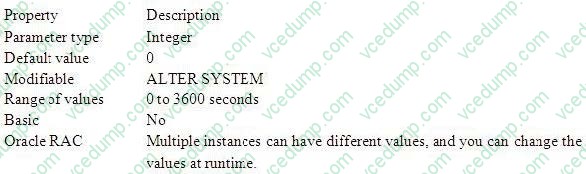
In your two-instance RAC database, you find that FAST_START_MTTR_TARGET is set to 300 on both the nodes. The ESTD_CLUSTER_AVAILABLE_TIME column in the V$INSTANCE_RECOVERY view shows the value 100. What is the correct interpretation? (Choose 2)
A. In the event of an instance failure, the database will become partially available In 100 seconds.
B. In the event of an instance failure, the database will become fully available in 100 seconds.
C. In the event of an instance failure, the failed instance will become fully available In 300 seconds.
D. In the event of an instance failure, the database will become partially available in 200 seconds.
E. In the event of an instance failure, the failed instance will become available In 300 seconds. -
Question 35:
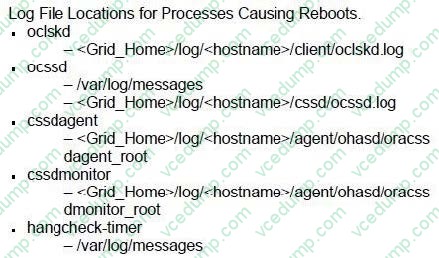
Which three actions would be helpful in determining the cause of a node reboot?
A. determining the time of the node reboot by using the uptime command and subtracting the up time from the current system time
B. looking for messages such as "Oracle CSSD failure. Rebooting for cluster integrity" in /var/log/ messages
C. using the crsctl command to view tracing information
D. inspecting the ocssd log for "Begin Dump" or "End Dump" messages
E. inspecting the database alert log for reboot messages -
Question 36:
You are ready to add two new nodes called RACNODE 5 and RACNODE 6 to your existing four-node cluster by using addNode.sh.
You have run cluvfy -peer to check the new nodes against a reference node. When you originally created the cluster, the network administrators chose to statically define the SCAN VIP addresses in the corporate DNS server, and you
installed the Oracle Grid Infrastructure without using GNS.
What is the correct way to silently add the nodes?
A. addNode.sh -silent "CLUSTER_NEW_NODES={RACNODE5, RACNODE6} "
B. addNode.sh -silent " CLUSTER_NEW_VIRTUAL_HOSTNAMES={RACNODE5-VIP, RACNODE6-VIP} "
C. addNode.sh -silent "CLUSTER_NEW_NODES={RACNODE5, RACNODE6}" "CLUSTER_NEW_VIRTUAL_HOSTNAMES={RACNODE5-VIP, RACNODE6-VIP}"
D. addNode.sh -silent -responseFile mynewnodes.txt with the response file containing only "CLUSTER_NEW_NODES={RACNODE5, RACNODE6} "
E. addNode.sh -silent -responseFile mynewnodes.txt With the response file containing "CLUSTER_NEW_VIRTUAL_HOSTNAMES={RACNODE3-VIP, RACNODE4-VIP}" -
Question 37:
Various clients can access and manipulate ASM files. Which two statements are true?
A. The DBMS_FILE_TRANSFER.COPY_FILE procedure can move a database file from one ASM to another ASM, but not to an operating system file system.
B. The ASMCMD cp command can move database files from a file system to ASM, but not from ASM to ASM.
C. The SQL*Plus command ALTER DISKGROUP orcl MOVE '+DATA/orcl/example01.dbf' to '+OLDDATA/ orcl/example01.dbf' can move the example01 data file to a different diskgroup.
D. The DBMS_FILE_TRANSFER.GET_FILE procedure reads an ASM file from a remote machine and makes a local copy on an ASM or a file system.
E. The ASMCMD rm command will delete ASM files and directories, but not database files on an operating system file system. -
Question 38:
Which command will resize an ACFS file system on the DATA diskgroup?
-The ADVM volume is named VOL1.
-The mount point is >/u01/app/oracle/afsmounts/vol1.
-The new, larger size is 20G.
A. ASMCMD [+] > volsize -G data -s 20G VOL1
B. /sbin/acfsutil size 20G /u01/app/oracle/afsmounts/vol1
C. SQL> ALTER DISKGROUP data RESIZE VOLUME vol1 SIZE 20G;
D. None, an ACFS file system cannot be resized.
E. fsadm /u0l/app/orlacle/afsmounts/vol1 20G -
Question 39:
You have defined two server pools.
One is called OLTP with MIN_SIZE=3, MAX_SIZE =5 and IMPORTANCE=3. The other is called DSS with MIN_SIZE =2, MAX_SIZE =4 and IMPORTANCE =5. Your cluster currently has four nodes with two nodes in each of the pools. A fifth
node is added to the cluster. What is true about the server pool to which the node will be assigned?
A. The node will have the server assigned to the DSS pool because the current size is less than MAX_SIZE and the DSS pool has a greater importance than the OLTP pool.
B. The node will have the server assigned to the OLTP pool because the OLTP pool's MAX_SIZE is greater than MAX_SIZE of the DSS pool.
C. The node will have the server assigned to the OLTP pool because the OLTP pool's current size is less than its MIN_SIZE and the DSS pool has enough servers to equal its own MIN_SIZE.
D. The node will have the server assigned to the DSS pool on the basis of having a greater IMPORTANCE. -
Question 40:
From a command line, you can create an ASM volume with the same properties by using either SQL or ASMCMD. Which two commands will create a 500 MB volume called TESTVOL in the ACFSDG ACFS diskgroup by storing only one copy of the volume file extents in the diskgroup
A. SQL> alter diskgroup ACFSDG add volume TESTVOL size 500M unprotected;
B. ASMCMD> volcreate -G ASMFS -s 500M
C. SQL> alter diskgroup ACFS add volume TESTVOL size 500M;
D. ASMCMD> volcreate -G ACFSDG -s 500M --redundancy unprotected TESTVOL
E. SQL> create volume TESTVOL diskgroup ACFSDG size 500M unprotected;
Related Exams:
-
1Z0-020
Oracle8i: New Features for Administrators -
1Z0-023
Architecture and Administration -
1Z0-024
Performance Tuning -
1Z0-025
Backup and Recovery -
1Z0-026
Network Administration -
1Z0-034
Upgrade Oracle9i/10g OCA to Oracle Database OCP -
1Z0-036
Managing Oracle9i on Linux -
1Z0-041
Oracle Database 10g: DBA Assessment -
1Z0-052
Oracle Database 11g: Administration Workshop I -
1Z0-053
Oracle Database 11g: Administration II
Tips on How to Prepare for the Exams
Nowadays, the certification exams become more and more important and required by more and more enterprises when applying for a job. But how to prepare for the exam effectively? How to prepare for the exam in a short time with less efforts? How to get a ideal result and how to find the most reliable resources? Here on Vcedump.com, you will find all the answers. Vcedump.com provide not only Oracle exam questions, answers and explanations but also complete assistance on your exam preparation and certification application. If you are confused on your 1Z0-058 exam preparations and Oracle certification application, do not hesitate to visit our Vcedump.com to find your solutions here.