VCPN610 Exam Details
-
Exam Code
:VCPN610 -
Exam Name
:VMware Certified Professional - Network Virtualization -
Certification
:VMware Certifications -
Vendor
:VMware -
Total Questions
:178 Q&As -
Last Updated
:Dec 22, 2024
VMware VCPN610 Online Questions & Answers
-
Question 81:
Which statement is true regarding the configuration of vSphere Standard Switches on ESXi 5.5 hosts?
A. Additional ports must be manually added to a vSwitch when the configured number of ports has been exhausted. The host requires a reboot when this configuration change is made.
B. Additional ports must be manually added to a vSwitch when the configured number of ports has been exhausted. The host does not require a reboot when this configuration change is made.
C. Additional ports are automatically added to a vSwitch when the configured number of ports has been exhausted. The host does not require a reboot when this configuration change is made.
D. Additional ports are automatically added to a vSwitch as needed, and a set number of ports is not configured. The host does not require a reboot when this configuration change is made. -
Question 82:
A vSphere administrator added a new interface to a Distributed Router with a subnet of 172.16.10.0/24 and wants to make this subnet reachable to the rest of the network. How can the vSphere administrator achieve this?
A. Enable OSPF on the Distributed Router. Configure the uplink interface in the Backbone area and redistribute into OSPF the 172.16.10.0/24 subnet.
B. Enable OSPF in the Distributed Router. Configure the uplink interface in the normal area and the new interface with the subnet 172.16.10.0/24 in a Backbone area.
C. Enable OSPF on the Distributed Router. Configure the uplink interface in the Backbone area and redistribute from OSPF the 172.16.10.0/24 subnet.
D. Enable OSPF on the Distributed Router. Configure the uplink interface in the Backbone area and the new interface with the subnet 172.16.10.0/24 in a normal area. -
Question 83:
How does NSX simplify physical network design?
A. VLANs are moved into the virtual network for virtual machine traffic, eliminating the need to use PVLANs on the physical network.
B. Network administrators only need to configure routing on the physical network for virtual machine traffic since all other network functions are moved to the virtual network.
C. Transport zones are created in the virtual network for virtual machine traffic, removing the need to make changes to the physical network.
D. Virtual network integration can make changes to the physical network programmatically using REST API calls which automates network changes and increases agility. -
Question 84:
Which two statements are true regarding NSX? (Choose two.)
A. Workloads can be placed and moved independently of physical topology.
B. Operational efficiency can be achieved through automation of the physical network.
C. Workload deployments are non-disruptive over the existing physical network.
D. NSX implementation requires a VMware vSphere environment. -
Question 85:
Which components are required to enable layer 2 bridging? (Choose two.)
A. Distributed firewall rule to allow layer 2 traffic in the bridge.
B. Deployed Logical Switch.
C. Deployed Logical Router.
D. VLAN trunk configured on logical switch. -
Question 86:
-- Exhibit
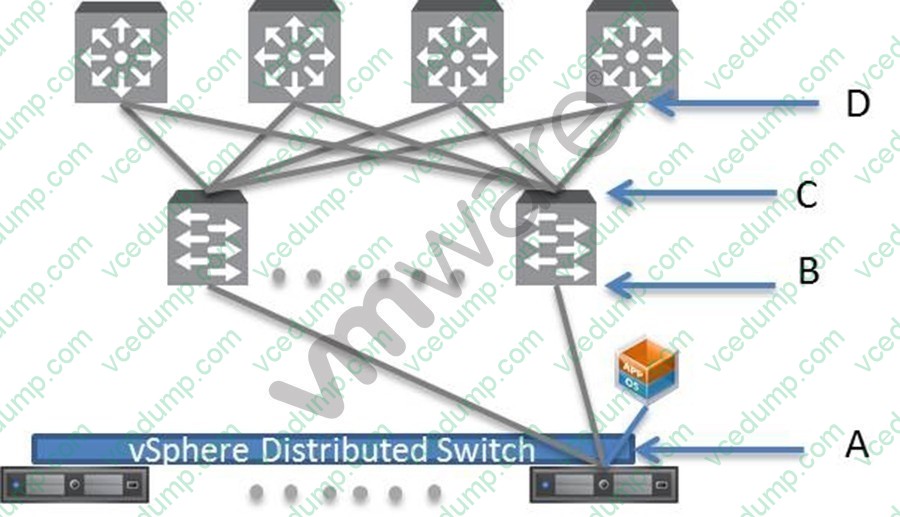
-- Exhibit -This diagram details the network connectivity from an NSX network and the supporting physical netwo rk. Locations C and D may be required to process packets with QoS tags.
Based on the diagram, which statement details proper processing of packets if they are QoS tagged?
A. Locations C and D will trust the QoS tags of the encapsulated frame when passing packets.
B. Location B should trust the QoS tags of the encapsulated frames that are switched.
C. Location A will mark the inner header of the encapsulated frame.
D. Location B should trust the QoS tags of the external header. -
Question 87:
Which tool is used to display VXLAN connection information?
A. pktcap-uw
B. NSX Controller CLI
C. esxtop
D. VDS Health Check -
Question 88:
An administrator wants to perform Activity Monitoring on a large group of virtual machines in an NSX environment. How would this task be accomplished with minimal administrative effort?
A. Create a PowerCLI script to enable virtual machine data collection on each virtual machine.
B. Create a security group in Service Composer and add the virtual machines to the security group.
C. Add the virtual machines to the pre-defined Activity Monitoring security group in Service Composer.
D. Add the virtual machines to a VM folder in vCenter Server and enable data collection. -
Question 89:
Which two statements describe the network connectivity provided by a vSphere Standard Switch (vSS)? (Choose two.)
A. A vSS provides a direct and logical connection between a virtual machine NIC and a physical NIC.
B. A vSS provides a direct and logical connection between two vSphere Distributed Switches.
C. A vSS connects the vNIC of a virtual machine to the physical network based on the bandwidth of the VM's configured network adapter.
D. A vSS connects the vNIC of a virtual machine to the physical network and is not restricted to a specific bandwidth allocation based on the VM's configured network adapter. -
Question 90:
Which condition could prevent an ESXi host from receiving VXLAN Tunnel End Point (VTEP) tables?
A. The ESXi host is disconnected from vCenter Server
B. The netcpa agent is not running on the ESXi host
C. The vsfwd agent is not running on the ESXi host
D. The NSX controller on the ESXi host is down
Related Exams:
-
1V0-21.20
Associate VMware Data Center Virtualization -
1V0-31.21
Associate VMware Cloud Management and Automation -
1V0-41.20
Associate VMware Network Virtualization -
1V0-61.21
Associate VMware Digital Workspace -
1V0-71.21
Associate VMware Application Modernization -
1V0-81.20
Associate VMware Security -
2V0-11.24
VMware Cloud Foundation 5.2 Administrator -
2V0-11.25
VMware Cloud Foundation 5.2 Administrator -
2V0-13.24
VMware Cloud Foundation 5.2 Architect -
2V0-13.25
VMware Cloud Foundation 9.0 Architect
Tips on How to Prepare for the Exams
Nowadays, the certification exams become more and more important and required by more and more enterprises when applying for a job. But how to prepare for the exam effectively? How to prepare for the exam in a short time with less efforts? How to get a ideal result and how to find the most reliable resources? Here on Vcedump.com, you will find all the answers. Vcedump.com provide not only VMware exam questions, answers and explanations but also complete assistance on your exam preparation and certification application. If you are confused on your VCPN610 exam preparations and VMware certification application, do not hesitate to visit our Vcedump.com to find your solutions here.