USMLE USMLE-STEP-2 Online Practice
Questions and Exam Preparation
USMLE-STEP-2 Exam Details
Exam Code
:USMLE-STEP-2
Exam Name
:United States Medical Licensing Step 2
Certification
:USMLE Certifications
Vendor
:USMLE
Total Questions
:738 Q&As
Last Updated
:May 25, 2026
USMLE USMLE-STEP-2 Online Questions &
Answers
Question 641:
A55-year-old man with a 50 pack-year history of smoking presents with hemoptysis. CXR shows a left upper lobe mass and laboratory evaluation reveals hypercalcemia. Which of the following is the most likely diagnosis?
A. small cell lung cancer B. tuberculosis C. squamous cell lung cancer D. adenocarcinoma of the lung E. metastatic testicular cancer
C. squamous cell lung cancer
Explanation
Although 515% of patients with lung cancer are identified while they are asymptomatic, most patients present with signs and symptoms including cough, hemoptysis, wheeze, stridor, shortness of breath, and postobstructive pneumonia. Paraneoplastic syndromes are common among patients with lung cancer. Endocrine paraneoplastic syndromes are seen in 12% of patients. Hypercalcemia may result from ectopic production of PTH or PTH-related peptides by squamous cell carcinomas. Small cell cancers may secrete ACTH or excessive amounts of ADH leading to hyponatremia and SIADH. Other nonendocrine paraneoplastic manifestations may include anorexia, cachexia, weight loss, fever, suppressed immunity. peripheral neuropathy, and the myasthenic Eaton-Lambert syndrome.
Question 642:
A 60-year-old patient with long-standing diabetes has a creatinine of 3.6, which has been stable for several years. Which of the following antibiotics requires the most dosage modification in chronic renal failure?
A. tetracycline B. gentamicin C. erythromycin D. nafcillin E. chloramphenicol
B. gentamicin
Explanation
Many drugs require dosage modifications in chronic renal insufficiency. Bioavailability, distribution, action, and elimination of drugs all may be altered. Drugs that are nephrotoxic may be contraindicated or used only with extreme care in renal insufficiency. The aminoglycosides, vancomycin, ampicillin, most cephalosporins, methicillin, penicillin G, sulfonamides, and trimethoprim all should be given in reduced dosage to patients with chronic renal failure. The aminoglycosides and vancomycin can be nephrotoxic and should be used with caution in renal insufficiency. The small group of antibiotics not needing dosage modification includes chloramphenicol, erythromycin, the isoxazolyl penicillins (nafcillin and oxacillin), and moxifloxacin.
Question 643:
A 12-year-old girl presents with chest pain when she plays basketball. The pain is substernal, is associated with dyspnea, and occurs after she has been playing vigorously. The pain does not radiate. The pain and dyspnea resolve with rest. She does not have palpitations or any lightheadedness associated with the pain. She does not have pain or dyspnea at other times. There is no history of early cardiac deaths or unexplained deaths of young people in her family. Her physical examination is normal, except
for a grade 2/6 systolic vibratory murmur heard at the left lower sternal border.
The same patient now complains of palpitations and dizziness with the chest pain. Which of the following tests should be ordered for this patient?
A. chest x-ray B. echocardiogram C. pulmonary function tests D. 24-hour Holter monitoring E. cardiac enzymes
E. cardiac enzymes
Explanation
In a patient with symptoms and signs consistent with exercise-induced asthma, a therapeutic trial of inhaled albuterol is the first line of therapy and diagnosis. If there is evidence of cardiac disease on history or physical examination, then one should proceed with the indicated tests. Pulmonary function tests could be used to confirm the diagnosis and are used in cases in which the diagnosis is uncertain or if patients fail the therapeutic trial.
Question 644:
An 11-year-old girl has become uncharacteristically and markedly withdrawn in the past 8 months, staying in her room so that she can "talk to the ghosts in the attic." Select the diagnosis with which it is most likely to be associated.
A. childhood depression B. childhood schizophrenia C. conduct disorder D. ADHD E. infantile autism
B. childhood schizophrenia
Explanation
Infantile autism, called a pervasive developmental disorder in DSM-IV, typically is diagnosed when children do not demonstrate the acquisition of communication skills. Ability to form interpersonal relationships also is grossly impaired. Other behavioral manifestations of infantile autism include unusual repetitive mannerisms (e.g., spinning), marked anxiety during environmental changes, and high pain threshold. As to be expected, school performance is poor, though autistic children may display isolated areas (islands) of normal or superior intellectual functioning. Behavioral manipulation is useful in trying to contain the behavior of autistic children. Unlike infantile autism, childhood schizophrenia usually develops later in childhood and follows an intermittent course. Deterioration in social or school functioning is a characteristic presenting feature, along with hallucinations, delusions, and other manifestations of psychosis. Phenothiazine drugs offer effective treatment. Symptoms and signs of depression in children are similar to those in adults. However, children may not be able to recognize depressed feelings. Persistence of puzzling physical problems in association with apathetic, withdrawn behavior is a common presentation. The use of antidepressants is controversial; family and individual counseling often can be quite helpful. ADHD once was called hyperactivity and minimal brain dysfunction. Characteristic signs include impulsivity, distractibility, inattention in school, and (usually but not universally) hyperactivity.
A variety of pharmacologic agents, including imipramine, dextroamphetamine, and methylphenidate (Ritalin), have been recommended for treatment of ADHD.
Question 645:
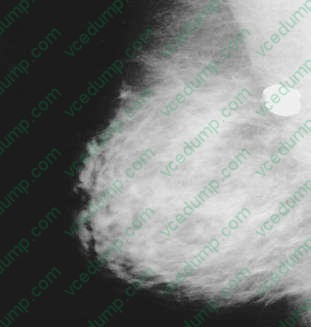
A 55-year-old-woman presents to the physician's office for evaluation of mammographic findings on a screening mammogram. She denies any breast masses, nipple discharge, pain, or skin changes. Past history is pertinent for insulin-dependent diabetes. Family history is positive for postmenopausal breast cancer in her mother. She has a normal breast examination and no axillary adenopathy. A mediolateral oblique (MLO) view of the right breast is shown in the figure below.
Which of the following is the most appropriate next step in management?
A. observation, with repeat mammogram in 612 months B. ultrasound C. biopsy D. lumpectomy, radiation therapy, and sentinel lymph node (SLN) biopsy E. total mastectomy
A. observation, with repeat mammogram in 612 months
Explanation
The mammographic appearance of popcornlike, coarse calcifications in the breast is characteristic of an involuting, or degenerating fibroadenoma in a postmenopausal woman. Mammographic follow-up is appropriate. A repeat study at 6 months would be considered if no prior films are available in order to assess stability of a new mammographic finding. Though ultrasound is often performed for solid masses, the amount of calcification in the mass would lead to artifact, making interpretation difficult. Biopsy would not be suggested based on the characteristic mammographic findings. Other surgical procedures would not be indicated
Question 646:
Which of the following patterns is most consistent with the physiologic profile of cardiogenic shock?
A. CVP B. CO C. SVR D. SVO2
B. CO
Explanation
Patients with cardiogenic shock B. demonstrate a pattern with increased CVP, low CO, increased SVR, and decreased SVO2. Those with hypovolemic shock A. demonstrate low CVP, low CO, increased SVR, and decreased SVO2. The distinguishing feature of early septic shock C. is an increased cardiac output. Patients with neurogenic shock D. have severe loss of vasomotor tone leading to the unusual combination of low SVR and low CO. CVP = central venous pressure, CO = cardiac output, SVR = systemic vascular resistance, SVO2 = venous O2 saturation
Question 647:
A54-year-old man presents to the emergency department on transfer from another hospital at the request of the family. He was admitted to the outside hospital 2 weeks ago with abdominal pain, nausea, vomiting, and fever. He was treated with antibiotics, NG tube decompression, and TPN without significant improvement. He developed jaundice 2 days ago. His past history is pertinent for a 40 pack- year smoking history, chronic alcohol abuse, and diabetes. Examination reveals a mildly jaundiced patient with vital signs of temperature 100°F, pulse rate 95/min, and BP 110 /60 mmHg. Cardiac examination is unremarkable, lung examination reveals decreased breath sounds at the bases bilaterally, and abdominal examination reveals fullness in the epigastrium with tenderness and voluntary guarding. For above patient with jaundice, select the one most likely diagnosis.
A. hepatitis A B. hemolysis C. choledocholithiasis D. biliary stricture E. choledochal cyst F. pancreatic carcinoma G. liver metastases H. cirrhosis I. pancreatitis
I. pancreatitis
Explanation
Pancreatitis may be the cause of jaundice by different mechanisms, resulting in compression of the common bile duct (CBD). Acute pancreatitis may cause edema of the head with resultant compression of the CBD; pancreatitis may lead to a pseudocyst in the head with compression of the duct; and chronic pancreatitis may lead to dense scarring around the duct with a resultant stricture. The clinical scenario of an alcohol abuser with acute abdominal pain; nausea; vomiting; jaundice; and a tender, palpable epigastric mass is most consistent with acute pancreatitis with CBD obstruction attributable to a pseudocyst.
Question 648:
Primarily a selective serotonin reuptake inhibitor (SSRI). Match the antidepressants below with the effect described.
A. amitriptyline B. nefazodone C. citalopram D. phenelzine E. duloxetine
C. citalopram
Explanation
The drugs listed in this question are examples of the various classes of antidepressants. These classes include the tricyclics, the SSRIs, the MAOIs, the triazolopyridines, and the serotonin-norepinephrine reuptake inhibitors. Understanding the site of action, neurotransmitter( s) involved, and side effects characteristic of these classes is helpful in selecting an antidepressant for a particular patient. SSRIs that are comparable in their antidepressant effects to the older tricyclics but significantly safer when taken in larger doses, as in suicidal overdose, are frequently used as the first choice in the treatment of depression. An example here is citalopram. Drugs that both inhibit serotonin reuptake and block 5-HT2 receptors are characteristic of the triazolopyridines. The overall effect of these actions is believed to decrease both depression and anxiety in patients. There are two drugs in this class: trazodone and nefazodone. Strong sedation caused by histaminergic and anticholinergic activity is seen in the older antidepressants--the tricyclics. These also have both serotonin and norepinephrine effects that are important in decreasing depression. Amitriptyline is the drug example listed here.
Drugs demonstrating little sedation and significant serotonin, norepinephrine, and dopamine effects are more characteristic of the serotoninnorepinephrine reuptake inhibitors. They are effective in managing depression because there is no antihistaminergic activity and little sedation is seen. Duloxetine and Venlafaxine are examples. MAOIs increase the concentrations of serotonin, norepinephrine, and dopamine by inhibiting their degradation. The MAOIs, although effective as antidepressants, are used relatively infrequently because of the potential development of a hypertensive crisis induced by consuming tyramine- containing foods while on the MAOI. An example here is phenelzine.
Question 649:
Identify the following personality disorders with the symptoms listed below.
Seems to not care what others think or feel; is aloof
A. antisocial B. avoidant C. borderline D. dependent E. histrionic F. narcissistic G. obsessive-compulsive H. paranoid I. schizoid J. schizotypal
I. schizoid
Explanation
Persons with personality disorders are rigidly bound to the use of patterns of defense and various traits that distinguish the disorders. All have problems with interpersonal relationships
Question 650:
A 12-month-old patient has allergies to multiple foods. The child's mother has eliminated the foods from the diet and wants to know if these allergies will be lifelong. You tell her that some allergies do get better if the food is eliminated for 12 years. In which of the following is the allergy most likely to resolve, with elimination of the food from the diet?
A. peanuts B. milk C. nuts D. fish E. shellfish
B. milk
Explanation
Cow's milk allergy may occur in 23% of infants and toddlers. After elimination from the diet, by age 3, 85% no longer have symptoms on food challenge. Older children and adults may also lose sensitivity to an offending food when it is eliminated from the diet for 12 years. The exceptions are IgE-mediated allergies to peanuts, nuts, fish, or shellfish.
Nowadays, the certification exams become more and more important and required by more and more
enterprises when applying for a job. But how to prepare for the exam effectively? How to prepare
for the exam in a short time with less efforts? How to get a ideal result and how to find the
most reliable resources? Here on Vcedump.com, you will find all the answers.
Vcedump.com provide not only USMLE exam questions,
answers and explanations but also complete assistance on your exam preparation and certification
application. If you are confused on your USMLE-STEP-2 exam preparations
and USMLE certification application, do not hesitate to visit our
Vcedump.com to find your solutions here.