USMLE USMLE-STEP-2 Online Practice
Questions and Exam Preparation
USMLE-STEP-2 Exam Details
Exam Code
:USMLE-STEP-2
Exam Name
:United States Medical Licensing Step 2
Certification
:USMLE Certifications
Vendor
:USMLE
Total Questions
:738 Q&As
Last Updated
:May 25, 2026
USMLE USMLE-STEP-2 Online Questions &
Answers
Question 661:
A 58-year-old G6P4Ab2 diabetic woman who weighs 122.6 kg (270 lb) has her first episode of vaginal bleeding in 5 years. Her physician performs an outpatient operative hysteroscopy and dilatation and curettage (D&C). Which of the following is an indication for the procedure and the most likely diagnosis?
A. endometrial cancer because of her high parity B. endometrial cancer because of her obesity C. cervical cancer because of her age D. cervical cancer because of her diabetes E. ovarian cancer because of her obesity
B. endometrial cancer because of her obesity
Explanation
Obesity, advanced age, and hepatic disease are associated with an increased risk of endometrial adenocarcinoma. While postmenopausal bleeding is most commonly caused by atrophic changes in the genital tract, cancer must be considered. Cervical cytology and examination of endometrial histology are absolutely indicated. The risk of endometrial cancer is increased approximately threefold in diabetic women, and obese women have a three- to fourfold increased risk. High parity is a risk factor for cervical cancer; low parity is a risk factor for ovarian and endometrial cancer. Postmenopausal bleeding is a sign of ovarian cancer only if the malignancy secretes estrogen to stimulate the endometrium. An office endometrial biopsy has a sensitivity of about 90%. If postmenopausal bleeding persists, a D&C with hysteroscopy should be done. AD&C alone samples about 50% of the endometrium. For this reason, many gynecologists are performing a hysteroscopy and directed endometrial biopsy in addition to a D&C.
Question 662:
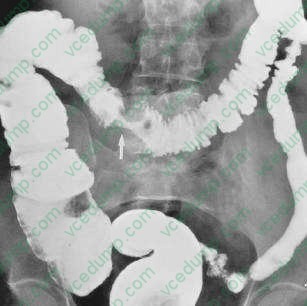
A 65-year-old man presents to the physician's office for his yearly physical examination. His only complaint relates to early fatigue while playing golf. Past history is pertinent for mild hypertension. Examination is unremarkable except for trace hematest-positive stool. Blood tests are normal except for a hematocrit of 32. A UGI series is performed and is normal. A barium enema is performed, and one view is shown in the figure below.
Which of the following is the most likely diagnosis?
A. diverticular disease B. colon cancer C. lymphoma D. ischemia with stricture E. Crohn's colitis with stricture
B. colon cancer
Explanation
The clinical features of colon cancer are variable depending on the location. On the right, fatigue, as a manifestation of anemia, may be the predominant symptom; whereas, obstructive complaints may predominate for lesions on the left. In the figure, an annular or "apple core" lesion is noted, consistent with carcinoma. Radiography of diverticular disease would show numerous protrusions from the lumen, usually localized to the sigmoid colon. Lymphoma may occur in the colon, but this site of disease is rare, and widespread disease can be documented in most cases. Ischemia usually occurs at the splenic flexure, and the resultant stricture would produce a longer segment of narrowing than that usually seen with carcinoma. Patients with Crohn's disease would manifest symptoms of abdominal pain and diarrhea, and barium x- rays would show thickened bowel wall, mucosal ulcerations, and cobblestone appearance. The treatment of colon cancer in this patient would be surgical resection and anastomosis.
Colostomy may be appropriate in selected patients with obstruction in an unstable patient in whom resection is not feasible. Surgical bypass would be appropriate only or palliative therapy of unresectable disease. Radiation therapy or chemotherapy without surgical resection and staging is not recommended.
Question 663:
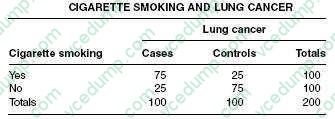
A large segment of the population in your community smokes. In order to convince your patient population that it would be beneficial to quit smoking in order to prevent lung cancer, you conduct a casecontrol study of cigarette smoking and lung cancer. The results from that study can be found in the table below.
Which of the following is most true concerning ORs and relative risk calculations, as pertaining to this study?
A. The overall size of the series is too large to estimate relative risk. B. If the number of controls were increased, the two ratios would be similar. C. The number of controls is twice as many as the cases. D. The OR is not appropriate for this series. E. The disease is rare.
B. If the number of controls were increased, the two ratios would be similar.
Explanation
For ease of calculation, to illustrate the concept, the numbers in the question were kept simple. If the numbers of controls were increased, the difference would be smaller. The ORs are a reasonable estimate when denominator data are missing. Relative risk is determined when denominator data are available. Few case-control experiments have denominator data.
Question 664:
The following questions identify health care planning methods used by various organizations. The answer options are strategies that may correspond to these methods. Select the strategy that best corresponds to each health care planning method.
A Health Maintenance Organization (HMO) employs institutional planning to identify its goals and objectives.
A. identifying what the market for services are and estimating future demands B. identifying mechanisms for carrying out established goals within specific program areas C. identifying financial resources to meet community needs D. identifying barriers to growth and the resources needed to overcome them
B. identifying mechanisms for carrying out established goals within specific program areas
Explanation
A distinction is frequently made between what the patient wants (which would be used if available and money was no object), needs (services determined by professionals to be appropriate), and demands (services that are actually used in the current market situation). Planning for an HMO is based on that segment of the population or "market" for which the HMO is responsible. The population may or may not live in contiguous areas. The planning is designed to identify goals and objectives in institutional terms: What is the market for the services the organization provides, and what is the estimate of future demands? The population need (as opposed to the population demand) is rarely a concern of institutional planners.
Question 665:
A 1-year-old African American infant is in for well-child care. He is primarily breast-fed. His parents do not give him much solid food because he has no teeth. He receives no medications or supplements. His parents are concerned about his bowed legs. On examination, you note some other bony abnormalities including frontal bossing, enlargement of the costochondral junctions, a protuberant sternum (pigeon chest), and severe bowing of the legs. You obtain x-rays to confirm your clinical diagnosis and also note a healing fracture of the left femur.
Which of the following is the most likely diagnosis?
A. osteogenesis imperfecta B. scurvy C. congenital syphilis D. rickets E. chondrodystrophy
D. rickets
Explanation
Babies who are exclusively breast-fed for prolonged periods of time are at risk for developing rickets. Dark- skinned infants are at high risk, especially during winter months when they receive inadequate sunlight. Supplementation with vitamin D is recommended in children who are at high risk, as well as pregnant and lactating mothers. Clinical features include craniotabes, a thinning of the outer table of the skull. This may also occur in osteogenesis imperfecta. Enlargement of the costochondral junctions rachitic rosary) may be seen in rickets, scurvy, and chondrodystrophy. Other features may include delayed primary teeth, enamel defects, and caries. There may be thickening of the wrists and ankles; bending of the femur, tibia, and fibula result in bowlegs or knock-knees. Greenstick fractures of long bones may occur without symptoms. Diagnosis is based on history of inadequate vitamin D intake and clinical features. Diagnosis may be confirmed by x-rays and chemistry; serum calcium is low or normal, serum phosphorus is low, serum alkaline phosphatase is elevated, and serum 25- hydroxycholecalciferol is decreased. Breast milk contains adequate vitamin C as long as the mother is not deficient.
Question 666:
A woman at 31 weeks' gestation complains of feeling dizzy and lightheaded when she lies on her back. She is Rh negative but denies vaginal bleeding, abdominal trauma, or abdominal pain. The diagnosis is probably the supine hypotensive syndrome.
She has an uncomplicated spontaneous vaginal delivery with an estimated blood loss of 450 mL. Her infant is Rh positive and she receives 300 g of Rh immunoglobulin (one vial) within 72 hours after delivery. This dose is sufficient to prevent Rh isoimmunization after what amount of fetal red cells enters the maternal circulation?
A. 5 mL B. 30 mL C. 100 mL D. 200 mL E. 300 mL
B. 30 mL
Explanation
One vial of Rh immunoglobulin will prevent Rh isoimmunization if the amount of fetal whole blood entering the maternal circulation is 30 mL or less. If the woman has a condition where a greater amount of fetal blood may enter the maternal circulation, the amount of fetal blood should be estimated by submitting a maternal blood sample for a Kleihauer-Betke test. The dose of Rh immunoglobulin is then based on the results of this test.
Question 667:
Select the organism associated with the following clinical findings:
A2-year-old child is pulling on her earlobe and has a temperature of 39°C and a bulging eardrum.
A. aureus B. beta-hemolytic Streptococcus C. perfringens D. Mycoplasma pneumoniae E. Haemophilus pertussis F. Helicobacter pylori G. Escherichia coli H. Rickettsia prowazekii I. Giardia lamblia
C. perfringens
Explanation
Giardiasis may cause cramping and a chronic diarrheal syndrome, with malabsorption and weight loss. Its distribution is worldwide, particularly where hygienic standards are not high. It also occurs sporadically in high-risk individuals. Streptococcal pyoderma, including erysipelas and impetigo, has been demonstrated to precede acute glomerulonephritis. Even when appropriate antibiotics are given in adequate dosage and duration for these conditions, renal damage may still result. Prevention thus consists of wound care, including cleaning wounds well and removal of crust. Mycoplasma infections are particularly common in families with younger children. They are frequently imported to the family by school-aged children, leading to a low-grade fever and persisting tracheobronchitis in the parents, or more acutely, an atypical pneumonia. G. lamblia is found in up to 20% of homosexual males, and may cause chronic diarrhea, although in these patients it tends to be asymptomatic. E. coli was first reported as a cause of watery diarrhea in nurseries in the 1940s. Although nursery epidemics with enteropathogenic serotypes had decreased in recent years in the United States, the increase of infant- child day care centers has resulted in their relatively frequent occurrence. Furunculosis is most frequently caused by coagulase-positive staphylococcal infections. The public health significance of this largely relates to the hazards of skin infections in food handlers and subsequent staphylococcal toxin in the food, leading to staphylococcal intoxication food-borne disease. H. pylori has been associated with gastric ulcers, but not with duodenal ulcers. Otitis media, whether acute or with effusion, commonly results from viral infection, such as by RSV. Various other organisms may be responsible including Streptococcu pneumoniae, H. influenzae, and others. C. perfringens, with rare exceptions, is transmitted in a meat dish prepared in bulk. Under propitious circumstances for the organism, especially on cooling of the food, bacterial multiplication can be very rapid. Symptoms begin to occur in the affected population in about 12 hours. Epidemic typhus is a rickettsial illness. Man is the host and long-term reservoir. The vectors are body lice (P. humanus corporis). The rickettsia are not present in human excretions and cannot be transmitted by person-to-person contact.
Question 668:
A 19-year-old high school senior complains of feeling "fat and ugly" despite being extremely thin. She takes small amounts of food at meals and occasionally gags herself to induce vomiting after meals. Which of the following is commonly associated with this disorder?
A. menorrhagia B. metrorrhagia C. loss of body hair D. bradycardia E. thrombocytopenia
D. bradycardia
Explanation
The history of severe, self-induced weight loss with an abnormal attitude toward food, weight, and body image in an adolescent female strongly suggests anorexia nervosa. Common symptoms are amenorrhea, not menorrhagia or metrorrhagia, constipation, and cold intolerance. Examination frequently reveals cachexia, hypothermia, bradycardia, hypotension, percarotenemic skin, and increased lanugo-like body hair. Decreased thyroid and pituitary function are evident on laboratory tests, but thrombocytopenia and anemia are not common
Question 669:
You make the diagnosis of Marfan syndrome in a very tall 22-year-old man with long, thin extremities. Which of the following is the best way to monitor these patients for cardiovascular changes?
A. electrocardiogram (ECG) B. chest x-ray (CXR) C. angiography D. pulmonary function tests E. echocardiography
E. echocardiography
Explanation
Marfan syndrome is an inherited disorder of connective tissue, but at least one-fourth of patients do not have an affected parent. Abnormal metabolism of collagen or elastin is suspected as the cause. Clinical features involve the eyes (upward subluxation of the lenses, myopia), cardiovascular system (aortic dilation, regurgitation, and aneurysms; mitral valve prolapse), and the skeleton (arachnodactyly, pectus deformity, joint laxity). Mental retardation and malar rash are not associated with Marfan. Afrequent finding is increased length of the limbs as compared with the trunk. Aortic root dilatation is a serious complication that can lead to aortic regurgitation, dissection, and even rupture.
Mitral valve prolapse is also seen, but pulmonary stenosis, VSD, pulmonary hypertension, and CAD are not increased with Marfan syndrome. Echocardiography should be performed to follow the course of the heart. The other tests will not reveal aortic root dilatation or aneurysm formation.
Question 670:
A 45-year-old man with HIV is being evaluated in the clinic. His HIV diagnosis was made 6 months ago and he wants to know more about medication treatment options. Which of the following is an indication to initiate HIV medication treatment?
A. CD4 count less than 700 B. HIV viral load less than 55,000 C. CD4 count greater than 700 D. history of hepatitis A E. HIV viral load greater than 55,000
E. HIV viral load greater than 55,000
Explanation
Adherence to a drug regimen is critical to prevent antiretroviral drug resistance. Treatment usually should be offered to patients who are symptomatic from their HIV infection. Asymptomatic patients should have antiretroviral therapy offered if their CD4 counts are less than 350 or plasma HIV viral load is greater than 50,000 copies. A high viral load (>100,000 copies) correlates with poor prognosis and an increased likelihood of developing opportunistic infections.
Nowadays, the certification exams become more and more important and required by more and more
enterprises when applying for a job. But how to prepare for the exam effectively? How to prepare
for the exam in a short time with less efforts? How to get a ideal result and how to find the
most reliable resources? Here on Vcedump.com, you will find all the answers.
Vcedump.com provide not only USMLE exam questions,
answers and explanations but also complete assistance on your exam preparation and certification
application. If you are confused on your USMLE-STEP-2 exam preparations
and USMLE certification application, do not hesitate to visit our
Vcedump.com to find your solutions here.