USMLE USMLE-STEP-2 Online Practice
Questions and Exam Preparation
USMLE-STEP-2 Exam Details
Exam Code
:USMLE-STEP-2
Exam Name
:United States Medical Licensing Step 2
Certification
:USMLE Certifications
Vendor
:USMLE
Total Questions
:738 Q&As
Last Updated
:May 25, 2026
USMLE USMLE-STEP-2 Online Questions &
Answers
Question 561:
A 35-year-old woman comes into the ER after cutting her wrists for the 10th time. She did this after her boyfriend of 2 weeks left her yesterday. She reports a history of unstable interpersonal relationships, chronic feelings of emptiness, impulsive sexual relationships, and problems with her sense of identity.
Which of the following is the most likely axis II diagnosis?
A. histrionic personality disorder B. borderline personality disorder C. antisocial personality disorder D. dependent personality disorder E. avoidant personality disorder
B. borderline personality disorder
Explanation
Recurrent suicidal behaviors, affective instability, unstable interpersonal relationships, chronic feelings of emptiness, and rejection sensitivity are all traits of borderline personality disorder.
Question 562:
A70-year-old man presents with back pain and increasing difficulty with initiating a urinary stream. On rectal examination, he is found to have a hard, irregularly enlarged prostate. He has an elevated prostate-specific antigen (PSA), and osteoblastic lesions in the vertebral column and bones of the pelvis. Aneedle biopsy of the prostate shows well-differentiated adenocarcinoma.
Which of the following is the treatment of choice?
A. radical prostatectomy B. transurethral prostatectomy C. cytotoxic chemotherapy D. hormonal manipulation E. radiotherapy
D. hormonal manipulation
Explanation
This elderly patient has metastatic adenocarcinoma of the prostate, and management is, therefore, aimed at tumor control for palliation of symptoms. This is achieved with hormonal manipulation, either by orchiectomy or exogenous estrogen therapy. Radical prostatectomy is indicated only for patients in whom the malignancy is confined to the prostate gland. Transurethral prostatectomy is used to treat benign prostatic hypertrophy, and is not considered adequate surgical therapy for prostatic malignancy.
Cytotoxic chemotherapy may be useful as an adjunct to radical surgical excision of localized disease. Chemotherapy is not indicated for the treatment of metastatic disease. Radiation therapy has been used for the management of localized disease, and there is some evidence that it affords equivalent survival when compared to surgical excision. In patients with bone pain that is not well palliated with hormonal manipulation, radiation therapy may be useful.
Question 563:
Workers in certain occupations are exposed to diseases for which animals are the reservoir. These workers may then become a source of infection to others.
Livestock worker are most likely to acquire and transmit the infectious disease?
A. anthrax B. brucellosis C. Lyme disease D. murine (endemic) typhus E. salmonellosis
B. brucellosis
Explanation
Brucella infections in humans follow a varied and sometimes chronic or recurrent course. Chronic disease is rare in appropriately treated patients. Human infections generally occur through one of three routes:
ingestion, direct contact, or inhalation. Cattle sheds become infected after abortion, a manifestation of the disease, or occasionally after normal parturition.Worldwide, ingestion of unpasteurized dairy products is the primary source of infection.
Question 564:
A 43-year-old man with AIDS complains of shortness of breath and worsening diarrhea. His temperature is 98°F, respiration rate is 26/min, pulse rate is 100 /min, and BP is 100/70 mmHg. His lung and heart examination are unremarkable. A room air ABG reveals: pH 7.10/PCO2 5/PO2 130/calculated bicarbonate 6. What is the primary acid-based disorder?
A. respiratory acidosis B. respiratory alkalosis C. metabolic acidosis D. metabolic alkalosis
C. metabolic acidosis
Explanation
The pH is 7.10, which indicates the primary disorder to be an acidosis. The low bicarbonate and the low carbon dioxide both are indicative of a metabolic cause for the acidosis. For the primary cause of the acidosis to be respiratory, the carbon dioxide would need to be greater than 40. In this case, the patient is compensating for the metabolic acidosis due to chronic diarrhea by hyperventilation.
Question 565:
A 50-year-old woman with a long history of taking trifluoperazine is noted to have repetitive chewing motions, and periodically protrudes her tongue. Her arms and shoulders seem to jerk fairly often, and there is a peculiar twisting movement in her right hand. She tried several of the "newer" medications that are not supposed to cause the movement problems, but then her auditory hallucinations started again. According to the patient's psychiatric symptoms, select the most appropriate medication.
Presume no medical problems other than those mentioned.
A. amitriptyline B. clozapine C. divalproex D. fluoxetine E. hypericum perforatum F. olanzapine G. lorazepam H. propranolol I. temazepam J. thiothixene
B. clozapine
Explanation
Signs of tardive dyskinesia are evident in this woman. She also was tried on several "newer" medications, one of which may have been olanzapine. This would have to be determined. Assuming this is so, a good choice is clozapine, which does not contribute to the development of tardive dyskinesia.
Question 566:
A 55-year-old man presents to the emergency department with left lower quadrant abdominal pain. The pain has been present for 1 week, but has increased in intensity over the last 2 days associated with nausea, constipation, and dysuria. Past history is unremarkable. Examination reveals a temperature of 101°F, pulse rate of 95/min, BP of 130/70 mmHg, and normal heart and lung examinations. Abdominal examination reveals fullness and marked tenderness in the left lower quadrant, with voluntary guarding and decreased bowel sounds. Laboratory tests reveal a WBC count of 18,000 with a left shift and 20 50 WBCs in the urinalysis. A CT scan of the abdomen reveals a thickened sigmoid colon with pericolonic inflammation. He is admitted to the hospital for treatment. Which of the following is the most appropriate management of this patient?
A. NPO, IV fluids, and IV antibiotics for gram-negative and anaerobic coverage B. NPO, IV fluid hydration, followed by immediate sigmoid colon resection C. NPO, IV fluids, and anticoagulation D. NPO, IV fluids, evaluation of stool for Clostridium difficile toxin, and eithermetronidazole or vancomycin antibiotic therapy E. NPO, IV fluids, initiation of bowel preparation for elective sigmoid colon resection during the current hospitalization
A. NPO, IV fluids, and IV antibiotics for gram-negative and anaerobic coverage
Explanation
The gradual onset of left lower quadrant pain over a number of days with left lower quadrant abdominal tenderness and CT scan showing sigmoid colon inflammatory changes is most consistent with diverticulitis. Acontained perforation, either due to the diverticulitis or colon cancer, should be noted on the CT scan. There is no history of antecedent antibiotic therapy to suggest the diagnosis of pseudomembranous colitis. Though WBCs were present in the urinalysis, a diagnosis of pyelonephritis cannot be made on this basis alone, because pericolonic inflammation may be responsible for the WBCs. CT scanning is very accurate in diagnosing diverticulitis, so there is no need for any additional test. Barium enema and colonoscopy should not be performed in patients with suspected acute diverticulitis. The increased intraluminal pressure from either of these examinations may lead to free rupture of a contained abscess or phlegmon, leading to emergency surgery. However, either examination, or both, should be performed after complete resolution of diverticulitis (e.g., in 6 weeks' time) to evaluate for extent of disease, complications, and carcinoma. IVP and angiography are not indicated for diverticulitis. The appropriate management in this patient with his first episode of diverticulitis is medical management with IV antibiotics for gram- negative and anaerobic bacteria. Colon resection, either immediate or elective, should not be undertaken unless the patient's condition deteriorates or recurs. Bowel preparation cannot be performed safely in patients with acute diverticulitis. Anticoagulation has no role in therapy. Metronidazole or vancomycin therapy would be appropriate for pseudomembranous colitis, but not for diverticulitis
Question 567:
A 70-year-old man was admitted to the ICU with severe pancreatitis. During his ICU course, he underwent several CT scans with IV contrast and was also treated with an aminoglycoside for a urinary tract infection. The patient required a prolonged course of TPN, and developed Candida sepsis treated with amphotericin. He subsequently developed polyuria with urine osmolality of 250 mOsm/L and serum osmolality of 350 mOsm/L. After receiving 5 units of vasopressin intravenously, there is no change in urine osmolality or urine output.
Select the most likely diagnosis for each of the patients with polyuria.
A. central diabetes insipidus (DI) B. nephrogenic DI C. water intoxication D. solute overload E. diabetes mellitus
B. nephrogenic DI
Explanation
DI is a disorder due to impaired renal conservation of water. DI presents with polyuria and dilute urine in the presence of an elevated serum osmolality. This is either secondary to impaired production of antidiuretic hormone (ADH) from the posterior pituitary (central DI), or refractoriness of the distal renal tubules to ADH (nephrogenic DI). Central DI may complicate closed-head injury, and is considered a poor prognostic sign. These patients will respond to exogenous IV vasopressin, with resultant increase in urine osmolality and decrease in urine volume. Nephrogenic DI may be congenital, familial, or acquired. Acquired nephrogenic DI may occur in the setting of repeated renal tubular insults such as sepsis, IV contrast, and nephrotoxic drug therapy. With administration of vasopressin, these patients will have no change in urine osmolality or urine volume because the renal tubules are unresponsive. DI must be differentiated from other causes of polyuria. Water intoxication results from ingestion of a large volume of fluid, with resultant dilutional hyponatremia. If the patient has a normal diluting capacity, there will be polyuria, with a proportionally low serum and urine osmolality. Prolonged fluid restriction will result in appropriate rise in urine osmolality. Osmotic diuresis may occur from solute overload when the renal tubules are unable to reabsorb adequate quantities of filtered solutes. This is associated with administration of mannitol or, in the presence of glycosuria, from diabetes mellitus.
Question 568:
Which of the following statements is true regarding contraception?
A. The vaginal contraceptive ring is changed weekly for 3 consecutive weeks, then removed for 1 week to allow for withdrawal bleeding. B. Because of effects on the cytochrome P450 system, Depo-Provera should not be used in patients taking antiepileptic drugs (e.g., phenytoin). C. Amenorrhea while using the levonorgestrel ntrauterine system (IUD) should raise concern immediately for ectopic pregnancy. D. A diaphragm should be inserted no more than 6 hours before intercourse and should remain in place about 6 hours after intercourse. E. Failure rate for tubal ligation over 10 years is less than 1 pregnancy per 1000 surgeries performed.
D. A diaphragm should be inserted no more than 6 hours before intercourse and should remain in place about 6 hours after intercourse.
Explanation
Diaphragms can be used successfully for contraception with proper patient education and motivation. Proper fitting is most important for efficacy. The diaphragm should be coated with spermicide prior to insertion (within the dome and along the rim), and inserted no more than 6 hours before intercourse is planned. Conversely, the device should be left in place at least 6 hours but no more than 24 hours after intercourse. If multiple episodes of intercourse take place, additional spermicide should be used. The vaginal ring is designed to be worn for 3 consecutive weeks (i.e., one ring, not three rings changed weekly) and then removed for 1 week. Depo- Provera does not affect liver enzymes but actually increases the seizure threshold, making it a great choice for patients with seizure disorders. Amenorrhea is common (20- 60%) with patients using the levonorgestrel IUD, and is so effective in preventing pregnancy that this symptom should not raise alarm (as long as other pregnancy symptoms --e.g., nausea and breast tenderness--are not present). Over 10 years, tubal ligation failure rates approach 1 per 100 procedures
Question 569:
For each item, select the ONE best lettered option that is most closely associated with it. Each lettered heading may be selected once, more than once, or not at all. A 47-year-old man complains of fatigue and dizziness. On laboratory evaluation, he is noted to have significant hyponatremia and hyperkalemia.
A. Cushing's syndrome B. Addison's disease C. Klinefelter syndrome D. hyperparathyroidism E. hypothyroidism F. pheochromocytoma G. acromegaly H. diabetes insipidus I. diabetes mellitus J. polycystic ovarian disease
B. Addison's disease
Explanation
Addison disease, or primary adrenocortical deficiency, commonly results in a low serum Na+, a low serum Cl-, and a high serum K+. Aldosterone deficiency causes loss of sodium in the urine and contributes to the hyperkalemia. The original description of Addison disease summarizes well the key clinical findings:
general languor and debility, feebleness of the heart's action, irritability of the stomach, and a peculiar change of the color of the skin. The hyperpigmentation of the skin is often seen on the elbows and in the creases of the hands.
Question 570:
A 65-year-old woman presents to the physician's office with a 6-month history of epigastric discomfort, poor appetite, and 10-lb weight loss. Past history is pertinent for hypertension, diabetes, a 30 pack-year smoking history, and occasional alcohol intake. Examination is unremarkable except for mild epigastric tenderness to deep palpation. An abdominal ultrasound reveals cholelithiasis, and one view of a UGI x-ray series is shown in the figure.
Which of the following is the most likely diagnosis?
A. cholecystoenteric fistula B. duodenal ulcer C. gastric ulcer D. gastric diverticulum E. duodenal diverticulum
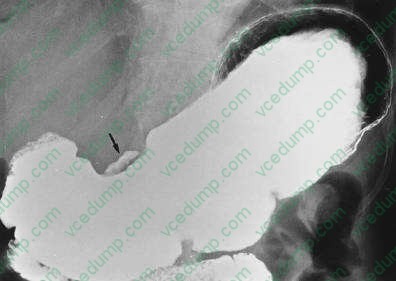
C. gastric ulcer
Explanation
The symptoms of gastric cancer are nonspecific and may mimic those of such benign conditions as benign gastric ulcer. Pain, nausea, anorexia, and weight loss are common nonspecific symptoms. A UGI series shows a gastric ulcer that has characteristics of malignancy, including an intraluminal crater with nodular margins. Agastric diverticulum would extend as a protrusion beyond the gastric lumen. The duodenum is not well visualized in the x-ray, making the diagnosis of duodenal disease difficult.
Afistula would be suggested by contrast filling of the gallbladder and biliary tree. Given the x-ray findings suggestive of malignancy, the next step would be to obtain a tissue diagnosis for confirmation by endoscopy. Once malignancy is confirmed, a CT scan would be helpful to evaluate for liver metastasis and extent of disease. Operative intervention may be determined at that time, usually a subtotal or total gastrectomy. Vagotomy and pyloroplasty would not be appropriate for gastric cancer. Medical therapy with H2 blockers may improve the patient's symptoms but should not delay endoscopy and biopsy.
Nowadays, the certification exams become more and more important and required by more and more
enterprises when applying for a job. But how to prepare for the exam effectively? How to prepare
for the exam in a short time with less efforts? How to get a ideal result and how to find the
most reliable resources? Here on Vcedump.com, you will find all the answers.
Vcedump.com provide not only USMLE exam questions,
answers and explanations but also complete assistance on your exam preparation and certification
application. If you are confused on your USMLE-STEP-2 exam preparations
and USMLE certification application, do not hesitate to visit our
Vcedump.com to find your solutions here.