USMLE-STEP-2 Exam Details
-
Exam Code
:USMLE-STEP-2 -
Exam Name
:United States Medical Licensing Step 2 -
Certification
:USMLE Certifications -
Vendor
:USMLE -
Total Questions
:738 Q&As -
Last Updated
:May 25, 2026
USMLE USMLE-STEP-2 Online Questions & Answers
-
Question 541:
A 55-year-old woman presents with a 6-month history of weight loss, abdominal cramps, and intermittent nonbloody diarrhea. On examination, her abdomen is mildly distended and there is a palpable mass in the right lower quadrant. Stool cultures yield normal fecal flora. CT scan with oral contrast demonstrates an inflammatory mass in the right lower quadrant, with thickening of the terminal ileum and ileocecal valve.
Which of the following is the most likely diagnosis?
A. ulcerative colitis
B. appendicitis
C. Crohn's disease
D. irritable bowel syndrome
E. lactose intolerance -
Question 542:
For each item, select the ONE best lettered option that is most closely associated with it. Each lettered heading may be selected once, more than once, or not at all. A 55-year-old man complains of abdominal pain and is found to have a kidney stone. Laboratory evaluation reveals hypercalcemia.
A. Cushing's syndrome
B. Addison's disease
C. Klinefelter syndrome
D. hyperparathyroidism
E. hypothyroidism
F. pheochromocytoma
G. acromegaly
H. diabetes insipidus
I. diabetes mellitus
J. polycystic ovarian disease -
Question 543:
For each clinical setting described below, select the set of ABG determinations with which it is most likely to be associated.
A30-year-old woman with salicylate intoxication
pH PaO2 PaCO2
A. 7.23 64 80
B. 7.39 88 40
C. 7.22 74 33
D. 7.54 75 24
E. 7.37 67 52 -
Question 544:
A specific pattern of abnormalities has been identified among infants born to mothers who consume moderate-to-large amounts of alcohol during their pregnancies. Which of the following abnormalities is characteristic of these infants?
A. cataracts
B. developmental dysplasia of the hip
C. gonadal dysgenesis
D. neural tube defects
E. mental retardation -
Question 545:
A beekeeper's previously healthy 6-month-old son develops gradual onset of lethargy, poor feeding, constipation, and generalized weakness. On taking a history, you determine that the child has recently been placed on a homemade formula consisting of evaporated milk, water, and honey. Which of the following is the most likely explanation for this symptom complex?
A. sodium intoxication
B. Hirschsprung disease
C. hypothyroidism
D. spinal cord tumor
E. botulism -
Question 546:
After 10 days of nasal congestion and rhinorrhea, a 3-month-old infant develops a severe hacking cough during which he repeatedly turns dusky and appears to choke on or to vomit profuse thick, clear nasopharyngeal mucus. For 7 days, the coughing continues unabated. On physical examination, he is afebrile and his lungs are clear. His chest x-ray is normal. His WBC count is 24,000/mm3, with 15% polymorphonuclear cells, 82% lymphocytes, and 3% monocytes. Which of the following antibiotics should be used to treat this patient?
A. amoxicillin
B. amoxicillin-clavulanic acid
C. erythromycin
D. tetracycline
E. no antibiotics are necessary -
Question 547:
You evaluate a 38-year-old man who complains of muscle weakness. Her appearance is remarkable for a periorbital heliotrope rash with edema and erythema on his upper chest, neck, and face. Which of the following is the most likely diagnosis?
A. polymyositis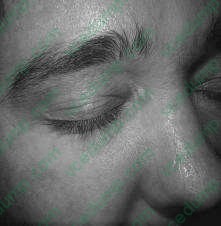
B. dermatomyositis
C. spinocerebellar degeneration
D. vasculitis
E. rheumatoid arthritis -
Question 548:
A 13-year-old boy presents for evaluation of short stature. His growth chart from ages 2 through 12 years is shown in Figure. His growth in the first 2 years of life was typically at the 25th percentile. He has been healthy, has a good appetite, and is doing well in school. He lives with his parents and is an only child. His parents' heights are both at the 50th percentile. His father states that he grew several inches after he completed high school. A complete physical examination is normal. His Tanner stage is
A. Which of the following is the most likely cause of this patient's short stature?
B. constitutional delay
C. deprivational dwarfism
D. familial short stature
E. growth hormone deficiency
F. hypothyroidism -
Question 549:
A 53-year-old woman with five adult children complains of losing urine shortly after coughing or jumping. She occasionally loses urine while lying in bed if she happens to cough vigorously. She is unable to stop the urine once it has begun to flow.
Which of the following is the most likely diagnosis?
A. GSI
B. a vesicovaginal fistula
C. a urethrovaginal fistula
D. an atonic bladder
E. detrusor dyssynergia -
Question 550:
An 11-year-old girl has become markedly withdrawn in the past 8 months and has complained of persisting abdominal pain and constipation, for which no organic cause has been found. Select the diagnosis with which it is most likely to be associated.
A. childhood depression
B. childhood schizophrenia
C. conduct disorder
D. ADHD
E. infantile autism
Tips on How to Prepare for the Exams
Nowadays, the certification exams become more and more important and required by more and more enterprises when applying for a job. But how to prepare for the exam effectively? How to prepare for the exam in a short time with less efforts? How to get a ideal result and how to find the most reliable resources? Here on Vcedump.com, you will find all the answers. Vcedump.com provide not only USMLE exam questions, answers and explanations but also complete assistance on your exam preparation and certification application. If you are confused on your USMLE-STEP-2 exam preparations and USMLE certification application, do not hesitate to visit our Vcedump.com to find your solutions here.