USMLE-STEP-2 Exam Details
-
Exam Code
:USMLE-STEP-2 -
Exam Name
:United States Medical Licensing Step 2 -
Certification
:USMLE Certifications -
Vendor
:USMLE -
Total Questions
:738 Q&As -
Last Updated
:May 25, 2026
USMLE USMLE-STEP-2 Online Questions & Answers
-
Question 511:
A 44-year-old man presents with fears that his mathematical abilities have been slowly sucked out of his brain for the last 4 years. He believes an "alien force disguised as a human being" is responsible. To avoid contacting this being, he has isolated himself in a room in a boarding house. His wife divorced him and left with their children. After 10 years teaching math at a local high school, he resigned about 3 years ago. He supports himself by "collecting cans." His affect is blunted. His appearance is disheveled, unshaven, and unwashed.
Considering the information learned thus far, which of the following would be an appropriate first-line treatment for this patient?
A. thiamine
B. olanzapine
C. amitriptyline
D. lithium carbonate
E. fluoxetine -
Question 512:
A term infant is born at a small community hospital by cesarean section for failure to progress. The infant is noted to have the following abnormality at birth
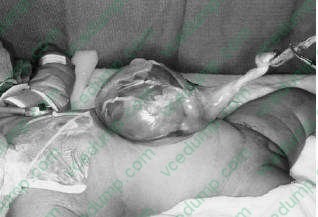
Which of the following is the most likely diagnosis?
A. umbilical hernia
B. omphalitis
C. omphalocele
D. gastroschisis
E. traumatic evisceration -
Question 513:
A 40-year-old woman presents to the emergency room with a 3-day history of worsening abdominal pain, with nausea and vomiting. Examination reveals a low-grade fever and abdominal tenderness in the right upper quadrant with guarding, especially during inspiration. Laboratory findings include a mild leukocytosis and a slightly elevated bilirubin. For the above patient with abdominal pain, select the most likely diagnosis.
A. gastroenteritis
B. regional enteritis
C. acute appendicitis
D. perforated peptic ulcer
E. sigmoid diverticulitis
F. acute pancreatitis
G. acute cholecystitis
H. superior mesenteric artery embolism
I. ruptured abdominal aortic aneurysm
J. ruptured ovarian cystK. cecal volvulus -
Question 514:
A 38-year-old G4P3013 woman is seeing you for her annual gynecologic examination. She has no specific complaints, but notes that her menses have gradually become heavier over the past 23 years. Your pelvic examination is normal aside from an enlarged uterus, which you estimate at 12 weeks' size. Office ultrasonography confirms that she has multiple uterine fibroids. Which of the following statements is true regarding leiomyomata?
A. OCs cause leiomyomata to grow more rapidly.
B. Leiomyomata not removed by hysterectomy may eventually degenerate into malignant tumors (i.e., leiomyosarcoma).
C. Submucosal fibroids are more likely to cause painful, heavy periods than are subserosal fibroids.
D. Leiomyomata occur in up to 5% of all women.
E. Typical bleeding abnormalities seen with uterine fibroids are heavy menstrual bleeding as well as frequent intermenstrual bleeding episodes. -
Question 515:
A 59-year-old woman complains of shortness of breath and aching left-sided chest pain that radiates to the left shoulder. Physical examination shows no abnormalities; her CXRs are shown in Figure below. Which of the following statements is true concerning this disease?
A. This tumor frequently metastasizes to distant sites.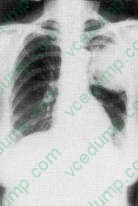
B. Direct exposure to asbestos is required.
C. Most cases are associated with recent, massive exposure to asbestos.
D. Diffuse forms may be cured by chemotherapy alone.
E. Localized forms may be cured by surgery alone. -
Question 516:
A 16-year-old girl presents with a history of primary amenorrhea. On examination, short stature and a short neck with a low posterior hairline are noted. Chromosomal analysis most likely would reveal which of the following?
A. fragile X
B. trisomy 18
C. trisomy 21
D. 45,XO
E. XXY -
Question 517:
A 55-year-old woman presents with a 6-month history of weight loss, abdominal cramps, and intermittent nonbloody diarrhea. On examination, her abdomen is mildly distended and there is a palpable mass in the right lower quadrant. Stool cultures yield normal fecal flora. CT scan with oral contrast demonstrates an inflammatory mass in the right lower quadrant, with thickening of the terminal ileum and ileocecal valve.
Initial management should include which of the following?
A. antibiotics and IV fluids
B. lactose-free diet
C. antispasmodics
D. nutritional supplementation and systemic steroids
E. laparotomy -
Question 518:
The mother of a 3-year-old girl brings her daughter to see you because the girl developed breasts 6 months ago. The girl has had no vaginal bleeding, and there is no pubic hair. She takes no medication
The tests you ordered are normal for a prepubertal girl. Which of the following is the most likely diagnosis?
A. ingestion of the mother's OC pills
B. a granulosa cell tumor
C. 21-hydroxylase deficiency
D. polycystic ovary syndrome
E. premature thelarche -
Question 519:
A5-year-old child was hit in the right eye by a toy. He is rubbing at his eye, which is watering profusely. There is a small abrasion at the corner of the eye. He is mildly photophobic, but his pupils are equal, symmetric, and reactive to light and accommodation. His vision is normal.
Which of the following is the most appropriate next step in the management of this patient?
A. Perform a fluorescein dye stain of the cornea to determine if there is a corneal abrasion.
B. Refer him immediately to an ophthalmologist.
C. Irrigate the eye with sterile normal saline.
D. Discharge him to home with antibiotic eye ointment.
E. Apply a patch to the eye and follow-up in a week. -
Question 520:
A 62-year-old man is undergoing neurologic evaluation. His arteriogram demonstrates the lesion shown in the figure below. Which of the following deficits is compatible with this lesion?
A. diplopia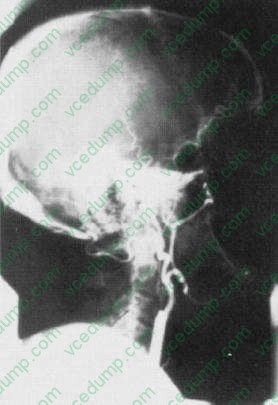
B. transient monocular blindness
C. ataxia
D. vertigo
E. dysarthria
Tips on How to Prepare for the Exams
Nowadays, the certification exams become more and more important and required by more and more enterprises when applying for a job. But how to prepare for the exam effectively? How to prepare for the exam in a short time with less efforts? How to get a ideal result and how to find the most reliable resources? Here on Vcedump.com, you will find all the answers. Vcedump.com provide not only USMLE exam questions, answers and explanations but also complete assistance on your exam preparation and certification application. If you are confused on your USMLE-STEP-2 exam preparations and USMLE certification application, do not hesitate to visit our Vcedump.com to find your solutions here.