USMLE-STEP-2 Exam Details
-
Exam Code
:USMLE-STEP-2 -
Exam Name
:United States Medical Licensing Step 2 -
Certification
:USMLE Certifications -
Vendor
:USMLE -
Total Questions
:738 Q&As -
Last Updated
:May 25, 2026
USMLE USMLE-STEP-2 Online Questions & Answers
-
Question 501:
Select the ONE best lettered option that is the most likely diagnosis of vaginal bleeding in pregnancy. Each lettered option may be selected once, more than once, or not at all. A 31-year-old woman has an uncomplicated labor and vaginal delivery of a healthy 3400-g male infant. However, her placenta has not yet delivered 2 hours after the delivery of her child. Under appropriate anesthesia manual extraction of the placenta is attempted, but the placenta is removed in fragments. She continues to have excessive vaginal bleeding after manual removal of her placenta. Her first child was delivered by a low transverse cesarean section because of fetal distress.
A. threatened abortion
B. gestational trophoblastic disease
C. cervicitis
D. placenta previa
E. placental abruption
F. uterine rupture
G. placenta accreta
H. uterine inversion
I. uterine atony
J. vaginal lacerationK. tubal pregnancy -
Question 502:
A 65-year-old woman presents to the physician's office for evaluation of an abnormal screening mammogram. She denies any breast masses, nipple discharge, pain, or skin changes. Past history is pertinent for hypertension. Family history is positive for postmenopausal breast cancer in a sister. She has a normal breast examination and no axillary adenopathy. The remainder of her examination is unremarkable. An MLO view of the right breast is shown in Figure along with a magnification view of the craniocaudal (CC) film
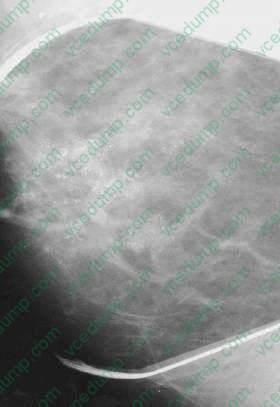
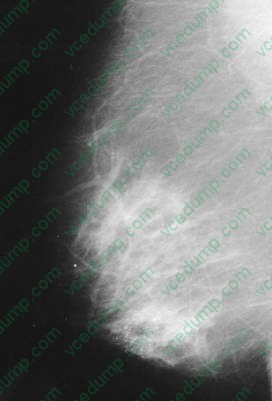
Which of the following is the most likely diagnosis?
A. milk of calcium
B. LCIS with or without an invasive component
C. DCIS with or without an invasive component
D. involuting fibroadenoma
E. phyllodes tumor -
Question 503:
Select the ONE best lettered option that is the most likely diagnosis of vaginal bleeding in pregnancy. Each lettered option may be selected once, more than once, or not at all.
A 29-year-old pregnant woman at 38 weeks' gestation presents to your labor and delivery unit complaining of dizziness, heavy vaginal bleeding, and loss of fetal movement. She had been having uterine contractions for approximately 4 hours, but these stopped when the bleeding began. Her previous pregnancy was delivered by classical cesarean section because of a transverse lie.
A. threatened abortion
B. gestational trophoblastic disease
C. cervicitis
D. placenta previa
E. placental abruption
F. uterine rupture
G. placenta accreta
H. uterine inversion
I. uterine atony
J. vaginal lacerationK. tubal pregnancy -
Question 504:
For each of the following scenarios, select the gas exposure responsible for the signs and symptoms. A garage worker turns on the ventilation system in the winter time while testing a motor, and now complains of a headache and vertigo
A. carbon monoxide
B. methane
C. hydrogen sulfide
D. ozone
E. sulfur dioxide -
Question 505:
A 25-year-old woman has a positive cervical culture for Neisseria gonorrhoeae. She has had at least two positive cultures for gonorrhea treated in the past. She is afebrile and has no symptoms. The incidence of penicillin-resistant gonorrhea in some areas of the United States is currently as great as 10%. Because of this, the recommended treatment for gonorrhea includes which of the following?
A. 125 mg intramuscular ceftriaxone as a single dose
B. 1 g spectinomycin
C. 2 g ampicillin orally as a single dose
D. 2 g intramuscular cefoxitin
E. 2 g metronidazole as a single dose -
Question 506:
A 35-year-old woman is seen by her primary care physician for a physical examination. She tells him she has a twin brother who has bipolar disorder and has been worried that she will develop it. Which of the following would be most helpful for her to hear?
A. "You're past the age when bipolar disorder develops, so don't worry about it."
B. "There is no clear evidence that a bipolar disorder is genetically determined."
C. "The concordance rate for bipolar disorder for dizygotic twins is 19%."
D. "The concordance rate for bipolar disorder for dizygotic twins is 79%."
E. "Prophylactic treatment with lithium is advisable." -
Question 507:
A2-year-old child is brought to the emergency department with sudden onset of nresponsiveness, miosis, bradycardia, and muscle fasciculations. These findings are most suggestive of poisoning with which of the following?
A. acetaminophen
B. organophosphates
C. salicylates
D. tricyclic antidepressants
E. vitamin A -
Question 508:
Schedules for the routine immunization of young children are developed jointly by the Advisory Commission on Immunization Practices (a federal commission) and the American Academy of Pediatrics. Which of the following vaccines is recommended for routine vaccination for all children in the United States?
A. anthrax vaccine
B. rabies vaccine
C. Haemophilus influenzae b (Hib) vaccine
D. hepatitis A vaccine
E. typhoid vaccine -
Question 509:
For each of the following scenarios, select the gas exposure responsible for the signs and symptoms. A patient working with an electric arc noted a pungent odor, and now has signs of asthma or early pulmonary edema.
A. carbon monoxide
B. methane
C. hydrogen sulfide
D. ozone
E. sulfur dioxide -
Question 510:
A 58-year-old woman with a history of chronic paranoid schizophrenia, who has been continuously treated with antipsychotics for the past 20 years, lives in a community-based residential facility. She has recently suffered an increase in auditory hallucinations, and her haloperidol dose has been increased from 2.5 to 10 mg/day. Four days later, she is brought by a visiting nurse to the emergency room, where she presents with confusion, marked flexor and extensor rigidity in her legs and arms, and a temperature of 103.5°F. Her blood pressure is160/120 mmHg, her pulse is 120/min and irregular. Which of the following is the most important laboratory test to evaluate the possibility of the diagnosis?
A. serum creatine phosphokinase (CPK) level
B. serum sodium level
C. serum potassium level
D. serum glucose level
E. serum calcium level
Tips on How to Prepare for the Exams
Nowadays, the certification exams become more and more important and required by more and more enterprises when applying for a job. But how to prepare for the exam effectively? How to prepare for the exam in a short time with less efforts? How to get a ideal result and how to find the most reliable resources? Here on Vcedump.com, you will find all the answers. Vcedump.com provide not only USMLE exam questions, answers and explanations but also complete assistance on your exam preparation and certification application. If you are confused on your USMLE-STEP-2 exam preparations and USMLE certification application, do not hesitate to visit our Vcedump.com to find your solutions here.