USMLE USMLE-STEP-2 Online Practice
Questions and Exam Preparation
USMLE-STEP-2 Exam Details
Exam Code
:USMLE-STEP-2
Exam Name
:United States Medical Licensing Step 2
Certification
:USMLE Certifications
Vendor
:USMLE
Total Questions
:738 Q&As
Last Updated
:May 25, 2026
USMLE USMLE-STEP-2 Online Questions &
Answers
Question 331:
A 50-year-old woman with a history of essential hypertension presents to the emergency department with sudden onset of a severe headache, nausea and vomiting, and photophobia. On examination, her BP is 160/100 mmHg. She is mildly confused and has nuchal rigidity, without focal neurologic signs.
Which of the following is the most likely diagnosis?
A. meningitis B. ruptured cerebral aneurysm C. hemorrhagic stroke D. ischemic cerebrovascular accident E. transient ischemic attack
B. ruptured cerebral aneurysm
Explanation
Ruptured cerebral aneurysms often occur in the setting of hypertension. The severe headache, nausea and vomiting, photophobia, and nuchal rigidity are the result of meningeal irritation from subarachnoid blood. Subarachnoid hemorrhage is visualized on CT scan, with definitive diagnosis of the aneurysm and its location by cerebral angiography. Early surgical clipping is the current neurosurgical approach because of the significant risk of rebleeding in the first 24 hours after initial presentation.
Hydrocephalus may occur as a late complication of subarachnoid hemorrhage and require serial lumbar puncture to drain CSF and control ICP. A hemorrhagic stroke can occur in association with malignant hypertension and may have concurrent subarachnoid hemorrhage. Focal neurologic signs are usually present. Meningitis will produce similar signs of meningeal irritation, but usually with other systemic signs of infection and a clinical prodromesuggesting an infectious etiology. Lumbar puncture is diagnostic, and if a bacterial source is suspected, systemic antibiotics are initiated pending culture of CSF. Ischemic cerebrovascular accidents and transient ischemic attacks are not associated with subarachnoid hemorrhage and, hence, do not present with signs of meningeal irritation. Focal neurologic signs are usually present. Evaluation of a possible cause includes Doppler examination of the carotid arteries. Management includes anticoagulation and antiplatelet therapy. EEG measures brain electrical activity and is indicated in the diagnostic evaluation of seizures.
Question 332:
A13-year-old girl had growth of breast buds at 11 years, followed by the appearance of pubic hair between the ages of 11 1/2 and 12 years. Which pubertal event is most likely to occur next?
A. beginning of accelerated growth B. menarche C. Tanner stage 5 breast development D. maximal growth rate E. Tanner stage 5 pubic hair
D. maximal growth rate
Explanation
The mean age of onset of any pubertal event is approximately 11 years, beginning with the appearance of breast buds. Pubic hair appears approximately 6 months later, and this is followed by the peak height velocity (greatest rate of linear growth per unit time). Six to 12 months later, menstrual bleeding begins. Increased rate of growth begins early in the pubertal process. The sequence of pubertal events and the approximate age of appearance of each event is sufficiently predictable that significant variation in age of onset or sequence should lead to an evaluation of a cause of abnormal puberty.
Question 333:
A 16-year-old girl with a history of ulcerative colitis managed with steroid therapy presents to the emergency department with a 36-hour history of nausea, crampy abdominal pain, and severe bloody diarrhea. On examination, the patient is febrile and pale, with a blood pressure of 90/60 mmHg and heart rate of 130 beats/min. Her abdomen is distended and diffusely tender. Acomplete blood count (CBC) demonstrates a leukocytosis with a left shift. The patient receives IV fluid resuscitation and nasogastric (NG) tube decompression.
Further therapeutic interventions should include which one of the following?
A. 6-mercaptopurine B. azathioprine C. opioid antidiarrheals D. colonoscopic decompression E. high-dose IV steroids and broad-spectrum antibiotics
E. high-dose IV steroids and broad-spectrum antibiotics
Explanation
This patient presents with an acute exacerbation of ulcerative colitis with systemic toxicity. Toxic megacolon is potentially life threatening and requires aggressive fluid resuscitation, bowel rest, and systemic antibiotics. High-dose steroids are initiated to treat the colonic inflammation. If there is no clinical improvement after 48 hours of medical therapy, urgent surgery is indicated. Azathioprine and 6- mercaptopurine are immunosuppressive agents that may be beneficial in the treatment of steroid refractory colitis, but they are not indicated in the management of an acute toxic exacerbation. Opioid antidiarrheals are contraindicated, because they may increase colonic distention and increase the risk of perforation. Colonoscopy may also cause increased colonic distention with perforation. Urgent surgery in a patient with toxic megacolon should consist of abdominal colectomy, Hartmann's procedure (closure of the rectal stump), and ileostomy. Ileal pouchanal anastomosis is a lengthy procedure, and is considered only for elective reconstruction.
When performed in a systemically ill patient undergoing emergency colectomy of an unprepped colon, there are increased risks of anastomotic complications. Ileorectal anastomosis is no longer appropriate for the management of ulcerative colitis because of the retained diseased rectal mucosa, with concomitant risk of malignancy.
Question 334:
When making recommendations to a state general assembly against routine premarital screening, the State Health Commissioner used the following data to arrive at his conclusions. The state had a young adult population of 100,000. Their actual prevalence of human immunodeficiency virus (HIV) infection was 1 per 1000. The best screening test available had a sensitivity of 98% and a specificity of 95%.
How many people would have screened as false negative?
A. 4995 B. 98 C. 2 D. 100 E. 5000
C. 2
Explanation
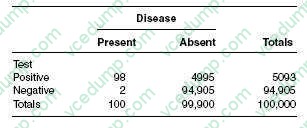
The following table was constructed using the data in the question. There would be 4995 FPs, 98 TPs, and 2 FNs.
Question 335:
An 11-month-old girl presents to your office with a fever of 39°C she has had for 2 days. She has also vomited frequently and had decreased fluid intake. She looked tired and ill but on examination, had no apparent source of infection. She appeared to be 510% dehydrated.
Her urine culture is positive at 24 hours. Which of the following is the most likely organism?
A. Klebsiella B. Escherichia coli C. Staphylococcus saprophyticus D. Proteus E. Enterococcus
B. Escherichia coli
Explanation
Urine for urinalysis and culture must be properly obtained. Catheterization is the most reliable method of the choices offered. Suprapubic tap is considered the "gold-standard" but is not always technically feasible, especially in an outpatient office setting. Amidstream, clean catch specimen would be acceptable in an older, toilet-trained child. "Bagged" specimens are not recommended because of possible skin or fecal contamination of the specimen. Similarly, obtaining a sample from a diaper or potty would be unacceptable. Urinalysis includes dipstick method and microscopic examination. Leukocyte esterase (an enzyme in WBC) and nitrites suggest probable infection. Microscopic analysis of unspun urine for WBC (>10/ highpower field) or bacteria is also predictive of infection. RBCs are often present in a UTI. The patient is vomiting and dehydrated; this may indicate possible pyelonephritis. The most appropriate course would be IV hydration and empiric treatment with antibiotics (ceftriaxone) while awaiting cultures. Children with pyelonephritis are at increased risk of renal scarring, especially younger children, and should be treated early. E. coli is the most common organism cultured; others include Proteus, Klebsiella, S saprophyticus, and Enterococcus. The occurrence of a UTI in a girl under age 35 years and in a boy of any age may be a marker for an underlying congenital anatomic abnormality, in particular, vesicourethral reflux. Radiologic investigation with renal ultrasound and VCUG is recommended
Question 336:
Match the antidepressant with the side effect or characteristic that need to avoid tyramine with this medication
A. phenelzine B. venlafaxine C. trazodone D. fluoxetine E. mirtazapine F. nortriptyline G. escitalopram
A. phenelzine
Explanation
Fluoxetine has the longest half-life of the current SSRIs (escitalopram's half-life is shorter--less than 24 hours), phenelzine is an MAOI and foods rich in tyramine can induce a hypertensive crisis. Venlafaxine can induce hypertension, especially at higher doses. Trazodone can rarely induce priapism (a painful sustained erection). Nortriptyline is a tricyclic antidepressant, and at high doses, it can cause arrhythmias.
Question 337:
A 72-year-old man has the sudden onset of suprapubic pain and oliguria. His temperature is 38.0°C (100.4°F), pulse is 100/min, respiration rate is 12 /min, and BP is 110/72 mmHg. Abdominal examination is remarkable only for a tender, distended urinary bladder. Which of the following is the most appropriate immediate management of this patient?
A. plain x-ray of the abdomen B. abdominal ultrasonography C. urethral catheter D. IV furosemide E. intravenous pyelogram (IVP)
C. urethral catheter
Explanation
Acute oliguria is a medical emergency requiring the immediate identification of any correctable cause. Distention of the urinary bladder indicates bladder outlet obstruction. Immediate management should be the passage of a urethral catheter to relieve the obstruction and provide urine for examination. An abdominal flat plate, ultrasonography, or IVP may yield a diagnosis but delay the relief of obstruction. Furosemide may be harmful if given while the bladder is obstructed. Bladder outlet obstruction may be caused by prostatic hypertrophy or prostatitis, stones, clots, malignancy, or urethral stricture; it may also be neurogenic. Posterior urethral valves are a congenital defect that could cause obstruction in children but rarely in adults. Renal carcinoma would not cause outlet obstruction. Renal arterial occlusion can cause acute renal failure but not obstructive uropathy. If urethral catheterization fails to relieve the obstruction, further evaluation, including radiographic or ultrasound studies, is in order. Suprapubic cystostomy may be necessary to empty the bladder.
Question 338:
Select the ONE best lettered option that is most closely associated with the question below. A 32-year-old White female with anemia, arthralgia, alopecia, and RBC casts on urinalysis.
A. rheumatoid arthritis B. SLE C. Wegener's granulomatosus D. polyarteritis nodosa E. Goodpasture syndrome F. fibromyalgia G. osteoarthritis (OA) H. giant cell arteritis I. sarcoidosis
B. SLE
Explanation
SLE is characterized by tissue and cell damage from pathogenic autoantibodies and immune complexes. Ninety percent of patients are women in childbearing years and the disease is more common in African Americans. Multiple organ system manifestations can occur, including musculoskeletal (arthralgias, myalgias), cutaneous (malar rash, photosensitivity, hair loss), renal (nephritis, nephritic syndrome), nervous (seizures, headaches), cardiopulmonary (pericarditis, pleuritis), hematologic (anemia, leukopenia)
Question 339:
A young mother seeks psychiatric help because she is unable to remember events surrounding her 3- year-old son's death after being struck by a car 2 months ago. She is worried that maybe she did something that put him at risk. Except for this brief time period, she is able to recall other events both before and after the tragedy.
Given the information above, which of the following is the most likely diagnosis?
A. depersonalization disorder B. posttraumatic stress disorder (PTSD) C. dissociative amnesia D. dissociative fugue E. major depression
C. dissociative amnesia
Explanation
Dissociative amnesia is loss of ability to recall information occurring within a certain time period, usually related to a severely stressful event as occurred with this woman. In depersonalization disorder, a person feels detached from his or her own body or mental processes and feels as if he or she is standing apart and acting as observer. In PTSD, there is a persistent re-experiencing of the traumatic event in a variety of ways, persistent avoidance of stimuli associated with that event, and persistent symptoms of arousal. It is possible for the arousal to be a part of this larger symptom complex. In dissociative fugue, the person forgets his identity, travels, and may even establish a new identity. Symptoms of major depression involve mood, inability to experience pleasure, appetite and sleep disturbance, fatigue, and other disturbances of affect and mood.
Question 340:
A previously healthy 45-year-old woman is involved in a motor vehicle crash, sustaining multiple rib fractures, a complex duodenal injury, and a fractured pelvis. She is ventilated in the ICU. Because of a persistent high-output duodenal fistula, the patient has required prolonged parenteral alimentation. During her ICU course, the patient develops diarrhea, mental depression, alopecia, and perioral and periorbital dermatitis. Administration of which of the following trace elements are most likely to reverse these complications?
A. iodine B. zinc C. selenium D. silicon E. tin
B. zinc
Explanation
Symptoms of zinc deficiency include diarrhea, depression, alopecia, and perioral and periorbital dermatitis. Patients at greater risk for developing this syndrome include those with high gastrointestinal fluid losses, patients with multisystem trauma, and patients on prolonged parenteral nutrition. The symptoms resolve with zinc supplementation. Iodine deficiency results in hypothyroidism. Deficiency syndromes for selenium, silicon, and tin have not been described
Nowadays, the certification exams become more and more important and required by more and more
enterprises when applying for a job. But how to prepare for the exam effectively? How to prepare
for the exam in a short time with less efforts? How to get a ideal result and how to find the
most reliable resources? Here on Vcedump.com, you will find all the answers.
Vcedump.com provide not only USMLE exam questions,
answers and explanations but also complete assistance on your exam preparation and certification
application. If you are confused on your USMLE-STEP-2 exam preparations
and USMLE certification application, do not hesitate to visit our
Vcedump.com to find your solutions here.