USMLE-STEP-2 Exam Details
-
Exam Code
:USMLE-STEP-2 -
Exam Name
:United States Medical Licensing Step 2 -
Certification
:USMLE Certifications -
Vendor
:USMLE -
Total Questions
:738 Q&As -
Last Updated
:May 25, 2026
USMLE USMLE-STEP-2 Online Questions & Answers
-
Question 201:
A 44-year-old man presents with fears that his mathematical abilities have been slowly sucked out of his brain for the last 4 years. He believes an "alien force disguised as a human being" is responsible. To avoid contacting this being, he has isolated himself in a room in a boarding house. His wife divorced him and left with their children. After 10 years teaching math at a local high school, he resigned about 3 years ago. He supports himself by "collecting cans." His affect is blunted. His appearance is disheveled, unshaven, and unwashed.
Which of the following is the most likely diagnosis?
A. paranoid schizophrenia
B. alcohol abuse and dependence
C. major depression with psychotic features
D. Alzheimer's disease
E. Huntington's disease -
Question 202:
A 42-year-old woman is noted to have a multinodular goiter on examination. She has no symptoms and is clinically euthyroid. Which of the following statements about Hashimoto's thyroiditis is true?
A. The condition is associated with prior radioactive exposure.
B. Patients diagnosed with this disorder have an increased incidence of thyroid cancer.
C. Corticosteroids are helpful in controlling the progression of the disease.
D. Antinuclear antibodies are pathognomonic for this disease.
E. Hashimoto's thyroiditis is an autoimmune disease. -
Question 203:
For each of the diseases listed, select the arthropod vector responsible for its transmission.
Yellow fever
A. aegypti
B. Anopheles species
C. Pediculus humanus corporis
D. Dermacentor andersoni
E. Sarcoptes scabiei -
Question 204:
Identify the most likely diagnosis with the case descriptions below.
A 40-year-old woman is brought to the emergency department after she had frantically called the paramedics because she thought she would die. She was experiencing sharp chest pain, shortness of breath, racing heartbeat, and cold, sweaty chills. Cardiac assessment proved negative for myocardial ischemia.
A. body dysmorphic disorder
B. conversion disorder
C. factitious disorder
D. hypochondriasis
E. malingering
F. pain disorder
G. panic disorder
H. somatization disorder -
Question 205:
Select the ONE best lettered option that is most closely associated with the question below.
A 45-year-old female with pain and visible swelling in her metacarpal-phalangeal joints bilaterally. Her distal interphalangeal joints (DIPs) appear normal.
A. rheumatoid arthritis
B. SLE
C. Wegener's granulomatosus
D. polyarteritis nodosa
E. Goodpasture syndrome
F. fibromyalgia
G. osteoarthritis (OA)
H. giant cell arteritis
I. sarcoidosis -
Question 206:
For each antihypertensive agent listed below, select the set of undesirable side effects with which it is most commonly associated with hydralazine
A. cough, hyperkalemia, angioedema
B. positive Coombs test, hemolytic anemia, hepatitis
C. hypokalemia, hyperuricemia, hyperglycemia
D. peripheral edema, flushing, and constipation
E. increased angina, tachycardia, systemic lupus erythematosus (SLE) -
Question 207:
Repeated thunderstorms have resulted in overflow of municipal wastewater treatment plants by floodwaters. Volunteer sandbaggers downstream from the plants developed health concerns when the overflow became evident. As a public health officer you are asked to evaluate the situation. Which of the following is your most important recommendation to workers in order to prevent illness from exposure to the contaminated water?
A. Do careful hand washing before meals and cigarette smoke breaks.
B. Boil all water that is to be used for drinking or cooking.
C. Offer hepatitis A vaccinations to al work crews prior to the next disaster.
D. Start prophylaxis with a broad-spectrum antibiotic for all workers who do not have a contraindication.
E. Offer oral polio vaccine to all eligible workers. -
Question 208:
A 4-year-old girl presents to the emergency department with fever and a petechial rash. A sepsis workup is performed, and IV antibiotics are administered. Gram-negative diplococci are identified in the CSF. Which of the following is true of this condition?
A. Antibiotic prophylaxis of fellow daycare attendees is not necessary.
B. The most common neurologic residual is seizures.
C. The presence of meningitis decreases the survival rate.
D. Shock is the usual cause of death.
E. Vancomycin administered intravenously is the treatment of choice. -
Question 209:
You see a young mother whose child is in need of medical care. She has an income below the federal poverty level. She is eligible to receive cash payments under the Supplemental Security Income Program (SSI). As she has no health insurance, you ask a social worker to help her enroll in a program funded with state and federal tax dollars, which provides complete medical care for her child. You ask that she be enrolled in which of the following programs?
A. Medicaid
B. Medicare
C. Blue Cross/Blue Shield
D. The Robert Wood Johnson Foundation
E. Women, Infants, and Children program (WIC) -
Question 210:
A 10-month-old infant presents to the emergency department with a 24-hour history of low-grade fever and anorexia. The parents report several episodes in which the child has been suddenly inconsolable and crying, followed by periods of lethargy. He has had nonbilious vomiting and several loose stools. On examination, the infant is pale and mildly dehydrated. His abdomen is soft and nondistended, with fullness to palpation in the right upper quadrant. The child passed another stool in the emergency department
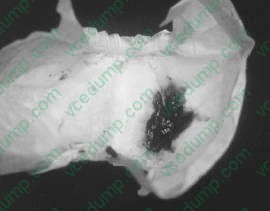
Which of the following is the most likely diagnosis?
A. gastroenteritis
B. intussusception
C. midgut volvulus
D. Meckel's diverticulum
E. juvenile rectal polyp
Tips on How to Prepare for the Exams
Nowadays, the certification exams become more and more important and required by more and more enterprises when applying for a job. But how to prepare for the exam effectively? How to prepare for the exam in a short time with less efforts? How to get a ideal result and how to find the most reliable resources? Here on Vcedump.com, you will find all the answers. Vcedump.com provide not only USMLE exam questions, answers and explanations but also complete assistance on your exam preparation and certification application. If you are confused on your USMLE-STEP-2 exam preparations and USMLE certification application, do not hesitate to visit our Vcedump.com to find your solutions here.