USMLE USMLE-STEP-2 Online Practice
Questions and Exam Preparation
USMLE-STEP-2 Exam Details
Exam Code
:USMLE-STEP-2
Exam Name
:United States Medical Licensing Step 2
Certification
:USMLE Certifications
Vendor
:USMLE
Total Questions
:738 Q&As
Last Updated
:May 25, 2026
USMLE USMLE-STEP-2 Online Questions &
Answers
Question 191:
Identify the most likely diagnosis with the case descriptions below.
A55-year-old man requests "some kind of pain medication that really works!" to relieve the "extreme" pain in his foot. He walks with a cane. He angrily claims that his previous employer did not care about what happened to him in an accident 1 year earlier in which his foot was struck by an iron rod. No fracture was found. He claims his doctor said he had a "severe contusion" and then states "the doctor didn't know anything."
A. body dysmorphic disorder B. conversion disorder C. factitious disorder D. hypochondriasis E. malingering F. pain disorder G. panic disorder H. somatization disorder
E. malingering
Explanation
Complaints involving both psychological and medical conditions are difficult to diagnose and treat. At times, medically identifiable causes are present, but the psychological factors contributing to the discomfort complicate the diagnosis and treatment and lead to frustration in both physician and patient. At other times, no identifiable cause for pain or other physical symptoms can be found; nevertheless, the patient still has the symptoms. Questions arise:
Is the patient lying? Is there some deep psychological problem? Could there be a medical disorder in the early stages of development that gives rise to physical symptoms but no clear physical signs to make the diagnosis? One group of psychiatric disorders addresses some of these issues--the somatoform disorders. Somatization disorder is an axis I psychiatric disorder where a patient complains of multiple somatic complaints involving multiple organ systems, but which cannot be explained by physical and/ or laboratory findings. Conversion disorder is another axis I disorder where there is a disturbance of bodily function that does not conform to anatomic or neurologic concepts, and it is due to psychological factors. Body dysmorphic disorder is a pervasive subjective feeling/belief that some aspect of the patient's appearance is ugly or deformed.
Hypochondriasis is a persistent belief in the presence of one or two serious physical diseases despite medical assurance that one does not have the disease/illness. Pain disorder (somatoform pain disorder) is a disorder with the presence of severe, distressing and persistent pain which cannot be explained adequately by evidence of a physiologic process or physical disorder. Panic disorder is a kind of anxiety disorder. Discrete periods of extreme sympathetic nervous system symptoms occur, including tachycardia, sweating, shortness of breath, and others, during which time a person experiences extreme fear. Malingering is the deliberate manufacture of false or exaggerated symptoms for financial gain or to avoid an unpleasant situation such as jail time or military duty. In a factitious disorder, there is the deliberate production of signs and symptoms of illness in order to assume the sick role.
Question 192:
A4-month-old child presents with a 2-day history of vomiting and intermittent irritability. On examination, "currant jelly" stool is noted in the diaper, and a sausage-shaped mass is palpated in the right upper quadrant of the abdomen. Which of the following conditions is most likely to cause this?
A. appendicitis B. diaphragmatic hernia C. giardiasis D. intussusception E. rotavirus gastroenteritis
D. intussusception
Explanation
Intussusception, or telescoping of the bowel into a more distal section of bowel, is the most common cause of intestinal obstruction in infants aged 312 months. The case presented represents the classic presentation. Giardiasis presents less acutely and would not be associated with a mass. In gastroenteritis, frequent loose stools without blood would be the major symptom. Diaphragmatic hernia occurs in newborns, and the major symptom is respiratory distress. Although appendicitis can occur in infants, it is very unusual.
Question 193:
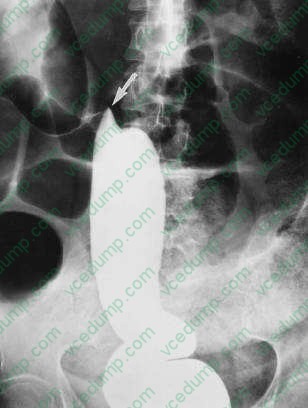
A 75-year-old woman is brought to the emergency department from a nursing home for abdominal pain, distention, and obstipation over the last 2 days. Past history is pertinent for stroke, diabetes, atrial fibrillation, and chronic constipation. Examination reveals a temperature of 98.6°F, pulse rate 90/min and irregularly irregular, and BP 160/90 mmHg. Heart examination reveals irregularly irregular rhythm with no murmurs; lung examination reveals few bibasilar rales; and abdominal examination reveals a distended, tympanic abdomen with mild tenderness and no rebound tenderness. Plain abdominal x-rays reveal dilated loops of bowel, and a barium enema is obtained and shown in the figure below.
Which of the following is the most appropriate next step in management following NG tube decompression and resuscitation?
A. urgent sigmoid resection B. nonoperative reduction by proctoscopy and rectal tube C. proximal colostomy D. urgent operative detorsion E. nonoperative reduction by passage of well-lubricated rectal tube
B. nonoperative reduction by proctoscopy and rectal tube
Explanation
The diagnosis of sigmoid volvulus is based on the history, examination, and radiographs. Acute onset of abdominal pain, distention, and obstipation is suggestive of volvulus. Barium enema is diagnostic of sigmoid volvulus showing the characteristic tapering to a "bird's beak" pointing to the site of obstruction. Cecal volvulus would show complete filling of the left colon. Stricture as a result of ischemic colitis would show a long, narrowed segment of colon. Diverticulitis would be suggested by a different clinical presentation including fever, sepsis, and pain localized to the left lower quadrant. Obstruction from colon cancer would show an irregular narrowing of the colon segment rather than a smooth tapering. In patients who have no signs of bowel wall ischemia (e.g., rebound tenderness, sepsis, and so forth), nonoperative reduction should be attempted and would be expected to be successful in 7080% of patients. The most widely used method of reduction is proctoscopy and rectal tube placement under direct vision. Blind passage of a rectal tube may lead to perforation and is contraindicated. Operation is indicated if nonoperative reduction is unsuccessful, with operative reduction preferred, followed by delayed resection and primary anastomosis rather than sigmoid resection. Operative reduction by detorsion alone is unacceptable because of the high recurrence rate and is, therefore, combined with sigmoidopexy or sigmoidostomy. Proximal colostomy alone is contraindicated, because strangulation of the sigmoid or recurrent volvulus is not prevented.
Question 194:
A27-year-old woman has used oral contraceptives (OCs) without problems for 5 years. However, she just read an article about complications of OCs in a popular women's magazine and asks you about the risks and hazards of taking OCs.
You correctly tell her which of the following?
A. The risk of developing ovarian cancer is increased. B. The risk of developing pelvic inflammatory disease (PID) is increased. C. The risk of developing endometrial cancer is decreased. D. The risk of bearing a child with major congenital anomalies is increased if taken while pregnant. E. The risk of ectopic pregnancy is increased.
C. The risk of developing endometrial cancer is decreased.
Explanation
The incidence of ovarian cancer in OC users is 50% less than that found in nonusers. The incidence of PID is also decreased by 50% in OC users. The risk of endometrial cancer is decreased by 50% after 1 year of OC use, and the protective effect seems to persist after stopping the OC. In well-controlled studies, there is no increase in the risk of having a child with a major malformation, cardiac malformation, or limb abnormality. The risk of ectopic pregnancy is reduced by 90%, perhaps because the risk of any pregnancy approaches zero when the OC is taken correctly.
Question 195:
A20-year-old female presents to the office complaining that her right eye has been itchy and watery. The patient reports that the onset was abrupt. The patient is noted to be afebrile with normal vital signs. Examination discloses a red eye with watery discharge. Minimal preauricular adenopathy is also found on examination. Tonometry is normal. Profuse tearing is noted. Which of the following is the most likely diagnosis?
A. viral conjunctivitis B. bacterial conjunctivitis C. foreign body reaction D. allergic conjunctivitis E. acute open-angle glaucoma
A. viral conjunctivitis
Explanation
Viral (follicular) conjunctivitis most often presents with minimal discharge and itching as compared to the moderate-to-profuse discharge of bacterial conjunctivitis. While mild pain and photophobia may be noted in viral, bacterial, fungal, and allergic conjunctivitis, preauricular adenopathy is common in viral and fungal conjunctivitis only. Allergic conjunctivitis presents with minimal discharge and marked itching. The patient's young age and normal eye pressure (tonometry) helps to rule out glaucoma.
Question 196:
A 12-year-old girl presents with chest pain when she plays basketball. The pain is substernal, is associated with dyspnea, and occurs after she has been playing vigorously. The pain does not radiate. The pain and dyspnea resolve with rest. She does not have palpitations or any lightheadedness associated with the pain. She does not have pain or dyspnea at other times. There is no history of early cardiac deaths or unexplained deaths of young people in her family. Her physical examination is normal, except
for a grade 2/6 systolic vibratory murmur heard at the left lower sternal border.
Which of the following is the most likely cause of her symptoms?
A. angina B. asthma C. costochondritis D. esophagitis E. mitral valve prolapse
B. asthma
Explanation
Chest pain in adolescents is a common problem. It is rarely associated with serious illness. In this patient, the onset with exercise, resolution with rest, and a family history of asthma, exercise-induced asthma is the most likely cause. Angina is a rare cause of chest pain in adolescents, and with a normal cardiac examination and no family history of cardiac disease, this is unlikely. Costochondritis is a common cause of chest pain but typically has an insidious onset and does not resolve with rest. Esophagitis is a common cause of chest pain but is typically impacted by eating, not exercise. Mitral valve prolapse can cause chest pain, although most pediatric patients with mitral valve prolapse are asymptomatic. On examination, they often have a systolic click.
Question 197:
Both a SSRI and serotonin type 2 (5-HT2) receptor blockade. Match the antidepressants below with the effect described.
A. amitriptyline B. nefazodone C. citalopram D. phenelzine E. duloxetine
B. nefazodone
Explanation
The drugs listed in this question are examples of the various classes of antidepressants. These classes include the tricyclics, the SSRIs, the MAOIs, the triazolopyridines, and the serotonin-norepinephrine reuptake inhibitors. Understanding the site of action, neurotransmitter( s) involved, and side effects characteristic of these classes is helpful in selecting an antidepressant for a particular patient. SSRIs that are comparable in their antidepressant effects to the older tricyclics but significantly safer when taken in larger doses, as in suicidal overdose, are frequently used as the first choice in the treatment of depression. An example here is citalopram. Drugs that both inhibit serotonin reuptake and block 5-HT2 receptors are characteristic of the triazolopyridines. The overall effect of these actions is believed to decrease both depression and anxiety in patients. There are two drugs in this class: trazodone and nefazodone. Strong sedation caused by histaminergic and anticholinergic activity is seen in the older antidepressants--the tricyclics. These also have both serotonin and norepinephrine effects that are important in decreasing depression. Amitriptyline is the drug example listed here.
Drugs demonstrating little sedation and significant serotonin, norepinephrine, and dopamine effects are more characteristic of the serotoninnorepinephrine reuptake inhibitors. They are effective in managing depression because there is no antihistaminergic activity and little sedation is seen. Duloxetine and Venlafaxine are examples. MAOIs increase the concentrations of serotonin, norepinephrine, and dopamine by inhibiting their degradation. The MAOIs, although effective as antidepressants, are used relatively infrequently because of the potential development of a hypertensive crisis induced by consuming tyramine- containing foods while on the MAOI. An example here is phenelzine.
Question 198:
A 30-year-old woman is visiting you in your primary care office as a new patient. Overall, she is healthy. On taking a family history, you learn that her mother was diagnosed with colorectal cancer at the age of 50. When should this patient start being screened for colorectal cancer?
A. there is no proven benefit for colorectal cancer screening B. at age 40 C. at age 50 D. at age 60 E. at age 30
B. at age 40
Explanation
Screening should begin approximately 10 years before the age of diagnosis of colorectal cancer in a first- degree (parent or sibling) relative. Given that this patient's mother was diagnosed at age 50, this patient should start screening at age 40. The natural history of a colon polyp to develop into cancer is thought to be 10 years. Colorectal cancer screening has proven mortality benefit.
Question 199:
A26-year-old man presents with a hard, painless testicular mass. At operation, frozen section reveals testicular cancer. Which of the following is a risk factor?
What serum marker can be used to monitor therapy?
A. carcinoembryonic antigen (CEA) B. human chorionic gonadotropin (hCG) C. sedimentation rate D. lactic dehydrogenase (LDH) E. prostate-specific antigen (PSA)
B. human chorionic gonadotropin (hCG)
Explanation
Testicular cancer is the most common cancer in men between the ages of 20 and 40. Predisposing factors include cryptorchidism, hernias, and testicular atrophy. Abdominal testes are at higher risk than inguinal cryptorchid testes. Family history of testicular or prostate cancer, radiation exposure, or maternal DES seems to play no role. Testicular cancers are divided into nonseminoma and seminoma subtypes. Seminoma represents about 50% of all tumors and generally follows a more indolent course. The primary tumor is treated by inguinal orchiectomy regardless of cell type. Pure seminomas do not require retroperitoneal lymph node dissection, because radiation is usually adequate therapy. Nonseminomatous testicular tumors (embryonal cell, teratocarcinoma, choriocarcinoma, endodermal sinus) are usually treated by retroperitoneal dissection. Serum alpha-fetoprotein (AFP) and hCG levels are markers that are important for diagnosis and as prognostic indicators and are used to monitor therapy. Serum LDH level is often elevated with bulky tumors but is not as specific as either AFP or hCG. CEA is a nonspecific marker elaborated by many adenocarcinomas. PSA is a marker associated with prostate cancer
Question 200:
In a 6-month-old previously healthy male infant, an abnormality is revealed during a routine diaper change, as illustrated in Figure. The parents have noted this finding on and off on several occasions over the last month. On each occasion, the child has been feeding well, and is content and playful.
Which of the following is the most appropriate management at this time?
A. antibiotics B. reassurance to the parents that the abnormality will resolve without intervention C. referral to the emergency department for immediate surgical consultation D. referral for elective surgical repair E. scrotal support
D. referral for elective surgical repair
Explanation
This patient has an inguinoscrotal mass from an indirect inguinal hernia. His initial presentation is one of a reducible inguinal hernia. Repair is indicated because of the risk of incarceration. He should be referred for early elective surgery. The second presentation several weeks later is at the time of incarceration of the hernia. This has resulted in pain, irritability, and reflex vomiting. Prolonged incarceration increases the risk of bowel ischemia. The appropriate management is sedation with manual reduction, admission with observation in hospital, and surgical repair within 2448 hours. Delaying repair after an initial episode of incarceration increases the risk of further episodes of incarceration, with potential bowel or testicular compromise. Failure to reduce an incarcerated hernia successfully mandates urgent surgical intervention. Testicular torsion is uncommon in this age group and presents with a tender, high-riding testicle. When suspected, urgent surgical exploration is indicated. Inguinal adenitis may be the result of an inflammatory focus in the diaper area, with resultant adenopathy, and secondary infection of the inguinal nodes with a gram-positive organism. The infant is usually febrile, with a tender inguinal mass. Therapy includes systemic antibiotics. An undescended testicle may present as an inguinal mass, with an empty hemiscrotum. It is usually asymptomatic. Management is elective orchiopexy at approximately 1 year of age. A noncommunicating hydrocele presents as an asymptomatic, fluctuant scrotal mass that transilluminates. Surgical intervention is not required, because most will resolve spontaneously by 1 year of age
Nowadays, the certification exams become more and more important and required by more and more
enterprises when applying for a job. But how to prepare for the exam effectively? How to prepare
for the exam in a short time with less efforts? How to get a ideal result and how to find the
most reliable resources? Here on Vcedump.com, you will find all the answers.
Vcedump.com provide not only USMLE exam questions,
answers and explanations but also complete assistance on your exam preparation and certification
application. If you are confused on your USMLE-STEP-2 exam preparations
and USMLE certification application, do not hesitate to visit our
Vcedump.com to find your solutions here.