USMLE USMLE-STEP-2 Online Practice
Questions and Exam Preparation
USMLE-STEP-2 Exam Details
Exam Code
:USMLE-STEP-2
Exam Name
:United States Medical Licensing Step 2
Certification
:USMLE Certifications
Vendor
:USMLE
Total Questions
:738 Q&As
Last Updated
:May 25, 2026
USMLE USMLE-STEP-2 Online Questions &
Answers
Question 141:
At a follow-up routine prenatal visit, the uterine fundus of a healthy 23-year-old pregnant woman is palpated halfway between her symphysis pubis and umbilicus. Which of the following is the most appropriate test to order at this stage of her pregnancy?
A. serum human immunodeficiency virus (HIV) titer B. glucose tolerance test C. amniocentesis D. maternal serum alpha-fetoprotein (MSAFP) E. cervical culture for group B Streptococcus (GBS)
D. maternal serum alpha-fetoprotein (MSAFP)
Explanation
The fundal height corresponds to 16 gestational weeks. Between 15 and 20 weeks, screening for open neural tube defects should be offered. In addition to MSAFP, the American College of Obstetricians and Gynecologists recommends hCG and unconjugated estriol to screen for Down syndrome and trisomy 18 as well. This triad of tests is called a triple screen or triple marker screen. Reported sensitivity of the triple screen is between 57 and 67% and the false positive rate is 5%. An abnormal result must be evaluated further by ultrasonography to identify the presence or absence of open neural tube defects or abdominal wall defects (increased MSAFP) or trisomy disorder (decreased MSAFP and unconjugated estriol, increased hCG). In skilled hands, an ultrasound reduces the risk of such an anomaly by 95%. If the diagnosis is still uncertain, the woman should be offered amniocentesis for measurement of alpha- fetoprotein (AFP) and acetylcholinesterase activity (increased in neural tube defects) and karyotype of fetal skin cells. Although testing for HIV can be done any time, it is most appropriate at the first prenatal visit, because earlier onset of prophylaxis with acquired immune deficiency syndrome (AIDS) drugs reduces the risk of transmission to the fetus significantly. Routine culture for GBS is not recommended because of the high recurrence rate after treatment and the low attack rate to the fetus. Amniocentesis is not a screening procedure and is reserved for those women with a specific indication, such as elevated MSAFP, low MSAFP (risk of Down syndrome), advanced maternal age, and others. A glucose tolerance test may be appropriate if there is a clinical indication for diabetes mellitus: previous macrosomic infant or stillbirth, strong family history of diabetes mellitus, persistent glycosuria, previous gestational diabetes, or elevated random serum glucose concentration.
Question 142:
A group of male workers between the ages of 20 and 39 years are being screened for lung disease by spirometry. Nine subjects are examined. Their forced expiratory volume in 1 second (FEV1) divided by forced vital capacity (FEV1/ FVC %) results are 80, 76, 73, 61, 64, 79, 64, 64, and 78. What is the range?
A. 17 B. 18 C. 19 D. 20 E. 21
C. 19
Explanation
The range is the difference between the highest and lowest readings in a group of observations. The lowest reading is subtracted from the highest. Only one of these two readings is included in the range. If both were to be included, the range would be 20, as there are 20 possible values included in the limits of the data presented in the question. For simplicity, the first method is generally accepted. One disadvantage of the concept of range is that it may increase as the number of observations increases.
Question 143:
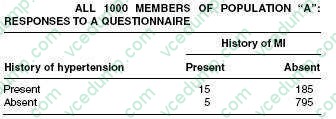
You are examining the relationship between hypertension and myocardial infarction (MI) in your community. In order to do so, you send a questionnaire to the whole population in your community (1000 persons). All 1000 persons responded. The results obtained from that questionnaire are presented below in table.
If we compare the population sample examined with the whole population that responded to the questionnaire, which of the following statements accurately describes the available information?
A. The sample group confirms the findings of the questionnaire. B. As expected, there is a higher "real" incidence of hypertension than reported. C. As expected, there is a higher "real" incidence of MI than reported. D. There is a statistical test that could be applied to assess the significance of the differences. E. The data as presented are not really adequate for further statistical examination.
E. The data as presented are not really adequate for further statistical examination.
Explanation
In a questionnaire relating to history, patients' knowledge as to whether or not they have hypertension or have had an MI might be sufficiently accurate to allow further statistical analysis. The data provided in this questionnaire are not adequate for more detailed statistical analysis. The questionnaire responses rely on memory recall, which at best is questionable, for comparison with an actual examination. Criteria for establishing a diagnosis of MI and, if possible, actual blood pressure readings, as well as a definition of hypertension, are required. The crux of epidemiologic analysis is a detailed criterion for establishing a diagnosis. With this additional information, relevant statistical tests could be applied. In the absence of this information, any further statistical analysis is likely to lead to misleading results.
Question 144:
A 59-year-old woman had a left modified radical mastectomy for intraductal carcinoma 2 years previously. She presents with confusion, lethargy, and thigh pain. X-rays reveal a lytic lesion in the shaft of the femur.
Which of the following is the most appropriate initial therapy?
A. radiotherapy to the femur B. vigorous saline infusion C. tamoxifen D. chemotherapy E. glucocorticoids
B. vigorous saline infusion
Explanation
Hypercalcemia is a common complication of malignancy. Mechanisms include bone metastases, humoral secretion (e.g., osteoclast-activating factor), prostaglandin, or ectopic parathormone production and immobilization. Hypercalcemia is often manifested by confusion and lethargy. The other metabolic abnormalities usually are not associated with confusion. Therapy is directed at increasing renal calcium clearance and inhibiting further bone resorption. Saline infusion raises the glomerular filtration rate and decreases calcium reabsorption in the proximal tubule. Under life-threatening circumstances, the infusion may need to be aggressive, as much as 6 L of saline daily plus furosemide. Radiotherapy will do nothing for the calcium. Tamoxifen is an antiestrogen used in the treatment of breast carcinoma and other malignancies. When used in the presence of bone metastases, it may contribute to hypercalcemia. Chemotherapy will not decrease the calcium levels. Glucocorticoids have an antitumor effect and reduce tumor production of humoral mediators, but act slowly.
Question 145:
A 55-year-old man presents to the emergency department with left lower quadrant abdominal pain. The pain has been present for 1 week, but has increased in intensity over the last 2 days associated with nausea, constipation, and dysuria. Past history is unremarkable. Examination reveals a temperature of 101°F, pulse rate of 95/min, BP of 130/70 mmHg, and normal heart and lung examinations. Abdominal examination reveals fullness and marked tenderness in the left lower quadrant, with voluntary guarding and decreased bowel sounds. Laboratory tests reveal a WBC count of 18,000 with a left shift and 20 50 WBCs in the urinalysis. A CT scan of the abdomen reveals a thickened sigmoid colon with pericolonic inflammation. He is admitted to the hospital for treatment.
Which of the following is the most likely diagnosis?
A. colon cancer with contained perforation B. ischemic colitis C. pseudomembranous colitis D. diverticulitis E. pyelonephritis
D. diverticulitis
Explanation
The gradual onset of left lower quadrant pain over a number of days with left lower quadrant abdominal tenderness and CT scan showing sigmoid colon inflammatory changes is most consistent with diverticulitis. Acontained perforation, either due to the diverticulitis or colon cancer, should be noted on the CT scan. There is no history of antecedent antibiotic therapy to suggest the diagnosis of pseudomembranous colitis. Though WBCs were present in the urinalysis, a diagnosis of pyelonephritis cannot be made on this basis alone, because pericolonic inflammation may be responsible for the WBCs. CT scanning is very accurate in diagnosing diverticulitis, so there is no need for any additional test. Barium enema and colonoscopy should not be performed in patients with suspected acute diverticulitis. The increased intraluminal pressure from either of these examinations may lead to free rupture of a contained abscess or phlegmon, leading to emergency surgery. However, either examination, or both, should be performed after complete resolution of diverticulitis (e.g., in 6 weeks' time) to evaluate for extent of disease, complications, and carcinoma. IVP and angiography are not indicated for diverticulitis. The appropriate management in this patient with his first episode of diverticulitis is medical management with IV antibiotics for gram- negative and anaerobic bacteria. Colon resection, either immediate or elective, should not be undertaken unless the patient's condition deteriorates or recurs. Bowel preparation cannot be performed safely in patients with acute diverticulitis. Anticoagulation has no role in therapy. Metronidazole or vancomycin therapy would be appropriate for pseudomembranous colitis, but not for diverticulitis.
Question 146:
A 20-year-old student asks to have his vaccinations updated. You recommend that he be vaccinated for typhoid fever under which of the following circumstances?
A. Natural disasters destroy the local water and sewage systems. B. He takes a rural vacation in the southwestern United States. C. He travels in countries with endemic typhoid. D. He eats organic foods fertilized with raw cow manure. E. He lives in a community in which carriers are found.
C. He travels in countries with endemic typhoid.
Explanation
Vaccination against typhoid fever (caused by Salmonella typhi) is less effective than antibiotic treatment, with only 6575% effectiveness. Transmission is via fecal-oral route, with humans as the reservoir. Most cases (62%) are contracted as a result of overseas travel to certain areas of the world where the incidence remains high. It is in such endemic areas that vaccine is still advised. There has been no indication that immunization after earthquakes or other cataclysmic disasters is either necessary or effective.
Question 147:
A59-year-old woman who lives independently and had been healthy, presents to the emergency department with cough and fever. She related she was well until 2 days before when she noted onset of fever, chills, and cough productive of yellow sputum. On examination, you note a tired appearing woman with BP of 160/90, pulse of 105, and respiratory rate of 32. You start her on ceftriaxone and azithromycin and admit her to the hospital. Which of the following factors is a poor prognostic sign in community acquired pneumonia?
A. age less than 60 B. systolic BP = 160 mmHg C. leukocytosis = 15,000 D. respiratory rate = 32 E. mycoplasma pneumonia infected
D. respiratory rate = 32
Explanation
Respiratory rate >30 is a poor prognostic sign in community-acquired pneumonia. Other patient factors include age greater than 65 years, coexisting illness such as cancer, liver disease, congestive heart failure (CHF), renal disease, systolic BP less than 90 mmHg, temperature greater than 40°C. Laboratory finding s associated with poor prognosis include arterial pH <7.35, BUN >30, sodium less than 130, glucose >250, and hematocrit <30%. These factors are often used to calculate the PORT (Pneumonia Outcomes Research Team) pneumonia severity index score which can be an aid in making treatment decisions. S. pneumoniae, Legionella, and S. aureus are the pathogens associated with poor prognosis, not Mycoplasma.
Question 148:
A 17-year-old girl notes an enlarging lump in her neck. On examination, her thyroid gland is twice the normal size, firm to rubbery, multilobular, nontender, and freely mobile. There is no adenopathy. Family history is positive for both hypo- and hyperthyroidism. Her serum triiodothyronine (T3) and thyroxine (T4) levels are low normal, and serum thyroid-stimulating hormone (TSH) is high normal. Technetium scan shows nonuniform uptake. Serum and antithyroglobulin titer is strongly positive.
Which of the following is the most appropriate treatment for this patient?
A. corticosteroids B. antibiotics C. thyroid hormone D. radioactive iodine E. surgery
C. thyroid hormone
Explanation
The patient described in the question most likely has Hashimoto's thyroiditis, also called autoimmune or chronic lymphocytic thyroiditis. It is the most common cause of thyroiditis in the United States and is encountered more frequently in women than in men. Patients note progressive thyromegaly but are usually euthyroid at the outset. Hypothyroidism may appear years later, often heralded by an elevated serum TSH level. Diagnosis is based on the history, examination, heterogeneous uptake on thyroid scan, and the presence of antithyroid and antithyroglobulin antibodies. If the diagnosis is still in doubt, needle biopsy will demonstrate lymphocyte infiltration, sometimes in sheets or forming germinal centers. Subacute (de Quervain, granulomatous) thyroiditis will show polymorphonuclear cells, necrosis, and giant cells. Bacteria may not be present in acute suppurative thyroiditis. Thyroid infiltration and replacement by rock-hard, woody, fibrous tissue is typical of Riedel's struma. C-cell hyperplasia is associated with medullary thyroid carcinoma. Hashimoto's thyroiditis is treated with thyroid hormone. Lower doses (0.100.15 mg/day) of levothyroxine are used to treat hypothyroidism alone; whereas, higher doses (0.150.30 mg/day) suppress TSH release and diminish goiter size. Partial resection may result in enlargement of the remaining gland. Steroids, antibiotics, and radioiodine have no role in therapy.
Question 149:
Six hundred asymptomatic men with prostatic nodules are given a PSA test to screen for prostate cancer. With a cutoff of 5 ng/mL, the PSA results are positive in 200 cases. Of these, 100 persons are confirmed on biopsy and follow-up testing to have the disease; however, 50 of the individuals who had negative test results are also shown to have the disease based on biopsy. You have been asked to screen another similar group of 50 men using the PSA test.
What proportion of persons having prostatic cancers will you correctly identify in the new group?
A. 16.7% B. 22.2% C. 66.7% D. 77.8% E. 87.5%
C. 66.7%
Explanation
Several concepts are important in determining the sensitivity of tests. The percentage sensitivity is the percentage of individuals with the disease (true positives [TP]) detected by the tests. False negatives (FN) are those who have the disease, but who were not detected by the test. The percentage sensitivity is calculated as: TP/(TP + FN) . 100. In the example given in the question, the calculation is 100/(100 + 50) x 100 = 66.7%.
Question 150:
A13-year-old girl presents with lethargy, fever, severe headache, and a stiff neck. On examination, a unilateral fixed, dilated pupil and papilledema are noted. Which of the following is the most appropriate initial step in managing this patient?
A. administration of IV cefotaxime B. administration of IV mannitol C. CT of the head D. intubation and hyperventilation E. performance of a lumbar puncture
D. intubation and hyperventilation
Explanation
This case most likely represents an adolescent with meningitis who has developed increased intracranial pressure. Intubation and hyperventilation is indicated immediately. Hyperventilation is the most appropriate immediate, nonsurgical treatment of intracranial hypertension. By hyperventilating this patient, you will decrease the PCO2, resulting in vasoconstriction in the CNS. Decreasing the PCO2 510 mmHg will decrease intracranial pressure 2530%. Administering antibiotics, preferably after blood cultures are obtained, is appropriate. Obtaining a CT scan of the head may reveal intracranial lesions which require additional therapy. Mannitol given intravenously also is a highly effective means for lowering intracranial pressure. Mannitol does not cross the blood-brain barrier. It remains in the capillaries and creates an osmotic gradient, causing fluid to shift from intracellular spaces to the vasculature, thereby decreasing intracranial pressure. Although a lumbar puncture may be necessary eventually, it is contraindicated as initial management because of the possibility of brain stem herniation
Nowadays, the certification exams become more and more important and required by more and more
enterprises when applying for a job. But how to prepare for the exam effectively? How to prepare
for the exam in a short time with less efforts? How to get a ideal result and how to find the
most reliable resources? Here on Vcedump.com, you will find all the answers.
Vcedump.com provide not only USMLE exam questions,
answers and explanations but also complete assistance on your exam preparation and certification
application. If you are confused on your USMLE-STEP-2 exam preparations
and USMLE certification application, do not hesitate to visit our
Vcedump.com to find your solutions here.