USMLE USMLE-STEP-1 Online Practice
Questions and Exam Preparation
USMLE-STEP-1 Exam Details
Exam Code
:USMLE-STEP-1
Exam Name
:United States Medical Licensing Step 1
Certification
:USMLE Certifications
Vendor
:USMLE
Total Questions
:847 Q&As
Last Updated
:Jun 02, 2026
USMLE USMLE-STEP-1 Online Questions &
Answers
Question 561:
A 79-year-old female patient was admitted to the hospital, presenting with fever, vomiting, dehydration, and distension of the abdomen. An X-ray reveals ileus and exploratory surgery reveals occlusion of vasa recta of the jejunum. Which of the following arteries supply branches to the involved vasa recta?
A. ileocolic artery B. inferior pancreaticoduodenal artery C. right colic artery D. right gastroepiploic artery E. superior mesenteric artery
E. superior mesenteric artery
Explanation
Section: Anatomy Ileus is obstruction of the intestine, in this case due to paralysis resulting from ischemia. The jejunum receives its vascular supply from jejunal branches arising from the superior mesenteric artery. The ileocolic artery (choice A) supplies the ileum, ileocolic junction, and the appendix. The inferior pancreaticoduodenal artery (choice B) provides vascular innervations to the pancreas and duodenum, and forms the anastomosis between the foregut and midgut. The right colic artery (choice C) supplies the ascending colon and the right gastroepiploic artery (choice D) the greater curvature of the stomach and greater omentum.
Question 562:
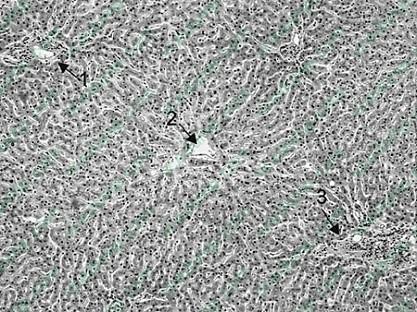
In following figure, arrow 2 points to which of the following specific structures
A. central vein B. hepatic lobule C. portal tract D. sinusoid E. Space of Disse
A. central vein
Explanation
Section: Anatomy Arrow 2 points to the central vein which defines the center of each hepatic lobule (choice B). Arrows 1 and 3 point to portal tracts (choice C), which are located at the angles of the margins of the hepatic lobule. The sinusoids (choice D) originate from the margins of the lobules and converge to the central vein by running between the plates of hepatocytes. The space of Disse (choice E) is found between the sinusoid lining cells and the surfaces of the hepatocytes. It is best seen in electron micrographs and not in a photomicrograph.
Question 563:
A newborn has a temperature of 103<pdf2txt-u>癋</pdf2txt-u>. Blood culture grows out gram-positive cocci in chains. Which of the following is the causative agent?
A. Group A Strep (S. pyogenes) B. Group B Strep (S. agalactae) C. N. meningitides D. Salmonella species E. S. pneumoniae
B. Group B Strep (S. agalactae)
Explanation
Section: Microbiology/Immunology The streptococci were divided into multiple groups based upon different soluble carbohydrates isolated from the cell walls. This CHO was antigenic, and R. Lancefield produced antibodies against each of them. She initially identified Groups AG. Almost 95% of streptococcal infections in humans are caused by Group A, S. pyogenes (choice A). S. agalactiae is a representative member of the Group B streptococcous (choice B). They are members of the normal flora of the female genital tract and an important cause of neonatal sepsis and meningitis. They produce beta (clear zone) hemolysis, like the Group A members. They can be identified as Group B on the basis of the CAMP test (positive) and monoclonal antibody screening tests. It is important to identify and treat such neonatal infections properly to avoid mortality of the small patients. While N. meningitidis (choice C) may affect infants, most cases of meningitis caused by the organism would be in 5-yearold to young adult patients. Salmonella species (choice D) is an inappropriate choice for thisage and disease. S. pneumoniae (choice E) can affect all age groups, but the highest incidence for meningitis is in the elderly population.
Question 564:
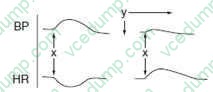
In a study of cardiovascular drugs, normal volunteers were given drug X in a small bolus dose while blood pressure and heart rate were recorded. After recovery, a long-acting blocking agent, Y, was administered. The direct effects of Y were not recorded. After drug Y had equilibrated with the tissues of the body, drug X was repeated in the same dosage. The results are shown in below figure.
Drug Y behaves most like which of the following?
A. atropine B. pralidoxime C. prazosin D. reserpine E. timolol
C. prazosin
Question 565:
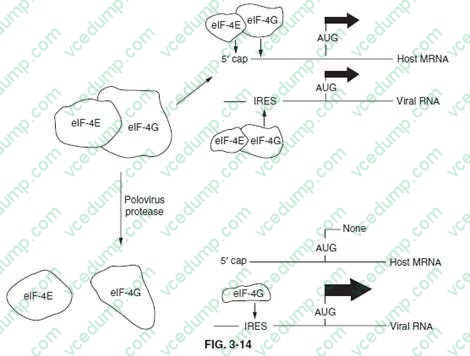
Some viruses, for example, poliovirus, contain a protease that cleaves one of the eukaryotic initiation factors allowing for cap-independent translational initiation of viral RNAs at internal ribosome entry site (IRES). Which of the following factors is the target of these viral proteases?
A. eIF-2 B. eIF-2B C. eIF-4A D. eIF-4E E. eIF-4G
E. eIF-4G
Explanation
Section: Biochemistry Eukaryotic viral RNAs are not capped and the host 40S ribosome interacts with these viral RNAs at an IRES. Capped eukaryotic mRNAs are recognized by the complex of eIF- 4E and eIF-4G, which in turn allows for interaction of the 40S ribosome with the mRNA (see below figure).
Initiation factor eIF-4E physically binds the cap structure in eukaryotic mRNAs and this function is facilitated by interaction of eIF-4E with eIF-4G. Thus, loss of the interaction of eIF-4E with the protease cleaved eIF- 4G results in loss of translational initiation from capped mRNAs. However, the binding of 40S ribosomes to viral RNAs does not require eIF-4E, only eIF-4G. The protease encoded by the poliovirus cleaves the eIF- 4E binding site on eIF-4G. None of the other translation factors (choices AC, E) are targets for poliovirus protease.
Question 566:
A newlywed 23-year-old woman and her 28-year-old husband are evaluated for infertility. They have been unable to conceive a child despite regular intercourse for the past 12 months. The first step of this couple's infertility workup is to determine whether ovulation occurs regularly. Which of the following hormones is directly responsible for ovulation?
A. estradiol B. estriol C. follicle-stimulating hormone (FSH) D. inhibin E. luteinizing hormone (LH)
E. luteinizing hormone (LH)
Explanation
Section: Physiology Although the early maturation of an ovarian follicle depends on the presence of FSH, ovulation is induced by a surge of LH. Although estrogens (choices A and B) usually have a negative feedback effect on LH and FSH secretion, the LH surge seems to be a response to elevated estrogen levels. In concert with FSH, LH induces rapid follicular swelling. LH also acts directly on the granulose cells, causing them to decrease estrogen production, as well as initiating production of small amounts of progesterone.
These changes lead to ovulation. FSH (choice C) causes follicle maturation, and is also required for Sertoli cells to mediate the development of spermatids into mature sperm cells. Inhibin (choice D) is a polypeptide secreted by the testes and ovaries that inhibits FSH secretion.
Question 567:
Alaboratory analysis of isolated mitochondria demonstrates that oxygen consumption is normal when succinate is added, but extremely low when pyruvate and malate are used. The mitchondria are subsequently shown to have normal cytochromes, but reduced iron content. The reduced pyruvate/malate oxidation is due to a defect in which of the following respiratory components?
A. cytochrome c B. cytochrome oxidase C. NADH-coenzyme Q reductase D. succinate dehydrogenase E. ubiquinone
C. NADH-coenzyme Q reductase
Question 568:
Horner syndrome is sometimes seen in patients diagnosed with the lateral medullary syndrome. Which of the following is a characteristic feature of Horner syndrome?
A. atrophy of tongue musculature B. mydriasis C. paralysis of muscles of facial expression D. profuse sweating E. red blushing of the skin in the affected area
E. red blushing of the skin in the affected area
Explanation
Section: Anatomy The skin in the affected area is red and dry (not moist as in choice D) due to diminished sympathetic activity. The pupil on the affected side is constricted (myosis) (not dilated as in choice B) due to unopposed activity of the sphincter pupillae muscle. Motor deficits such as atrophy of tongue musculature (choice A) or paralysis of facial expression muscles (choice C) are typically not part of Horner syndrome.
Question 569:
A 23-year-old man sees his physician to ask about the recent appearance of several large closely spaced bumps on his elbows. Suspecting that these are fatty eruptions, the physician tests the man's blood for lipid, cholesterol, and lipoprotein levels. Results show elevated cholesterol and triglycerides and the presence of a variant form of very low-density lipoprotein (VLDL) identified as beta-migrating VLDL (- VLDL). Amore careful analysis of the biochemical properties of the apoproteins associated with the beta- VLDL particles identifies a form of apo E that has a more negative charge than apo E from normal individuals. These results indicate the individual is afflicted with which of the following hyperlipoproteinemias?
A. type I (familial LPL deficiency) B. type II (FH) C. type III (dysbetalipoproteinemia) D. type IV (familial hypertriglycerolemia) E. Wolman disease
C. type III (dysbetalipoproteinemia)
Explanation
Section: Biochemistry Familial dysbetalipoproteinemia (type III hyperlipoproteinemia) results from a genetic variant in the apo E gene that causes poor interaction of chylomicron remnants and VLDLs with the apo E receptor. This results in the presence, in the serum, of beta-migrating VLDL (- VLDLs), which are cholesterol- rich remnants of both intestinal chylomicrons and hepatic VLDL. Diagnosis of type III hyperlipoproteinemia is indicated by elevated plasma cholesterol and triglyceride, xanthomas (fatty eruptions under the skin), and of course the presence of -VLDL. Type I hyperlipoproteinemia (choice A) results from defects in the activity or activation of LPL and results in the massive accumulation of chylomicrons in the plasma. The disease is usually detected in childhood following recurrent attacks of abdominal pain, hepatosplenomegaly, and pancreatitis. Familial hypercholesterolemia (choice B) is the result of defects in the LDL receptor. The defects lead to characteristic elevation in LDL, deposition of LDL-derived cholesterol in the tendons and skin and in the arteries. Individuals homozygous for defective LDL receptors have severe hypercholesterolemia (6501000 mg/dL) and coronary heart disease begins early in childhood with death caused by myocardial infarct before the age of 20. Type IV hyperlipoproteinemia (choice D) is associated with overproduction VLDLs. An associated glucose intolerance and hyperinsulinemia are also seen in this disorder. Wolman disease (choice E) is caused by a deficiency in lysosomal acid lipase and results in massive accumulation of cholesteryl esters and triglycerides in most tissues. The disease is almost always fatal before the age of 1 year.
Question 570:
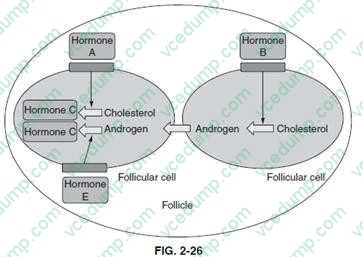
Below figure shows the conversions of cholesterol into the hormones C and D within follicular cells of the ovary (large arrows) and the regulation of these processes (small arrows) by pituitary hormones (A, B, E), when binding to their receptors on the cell surfaces (dark squares). Which of the letters in the figure best represents the hormone the concentration of which in serum changes in the following way?
A. A B. B C. C D. D E. E
D. D
Explanation
Section: Physiology It represents the estrogen estradiol, which is produced from androgen by granulosa cells of the ovaries and released into the capillaries. A woman's estradiol serum concentration roughly reflects the activities of her ovaries. Estradiol levels rise during the follicular phase of the menstrual cycle (days 0 13). They reach peak levels shortly before ovulation on day 1314, and drop back during the luteal phase (days 1428). They reach menstrual/follicular levels at the end of the luteal phase unless there is a pregnancy. After menopause, the ovaries atrophy and estradiol levels become very low. During reproductive cycles, androgens are the main substrate for estrogen synthesis in the granulosa cells. The androgen-estrogen conversion is under the influence of FSH (choice E). FSH concentrations are high after menopause compared to their premenopausal concentrations. The source of androgens is theca cells. They produce it from cholesterol under the influence of LH (choice B). LH concentrations, like FSH, are high postmenopausal. Both, FSH and LH levels are used as a diagnostic tool to determine menopause. Granulosa cells also produce progesterone (choice C) from cholesterol. Progesterone serum levels are low during follicular phase of the menstrual cycle and high during the luteal phase of the menstrual cycle. The transition of cholesterol to progesterone is under the influence of LH (choice A).
Nowadays, the certification exams become more and more important and required by more and more
enterprises when applying for a job. But how to prepare for the exam effectively? How to prepare
for the exam in a short time with less efforts? How to get a ideal result and how to find the
most reliable resources? Here on Vcedump.com, you will find all the answers.
Vcedump.com provide not only USMLE exam questions,
answers and explanations but also complete assistance on your exam preparation and certification
application. If you are confused on your USMLE-STEP-1 exam preparations
and USMLE certification application, do not hesitate to visit our
Vcedump.com to find your solutions here.