USMLE USMLE-STEP-1 Online Practice
Questions and Exam Preparation
USMLE-STEP-1 Exam Details
Exam Code
:USMLE-STEP-1
Exam Name
:United States Medical Licensing Step 1
Certification
:USMLE Certifications
Vendor
:USMLE
Total Questions
:847 Q&As
Last Updated
:Jun 02, 2026
USMLE USMLE-STEP-1 Online Questions &
Answers
Question 571:
A 67-year-old man complains of low back pain and generalized weakness, gradually worsening over the past 6 months. Physical examination reveals an individual in moderate discomfort due to the back pain. Laboratory examination reveals an anemia with rouleaux formation of the erythrocytes on the peripheral smear. Urinalysis demonstrates proteinuria and hypercalciuria. X-rays reveal diffuse osteoporosis of the spine and small lytic lesions in the ribs. Which of the following diagnoses most likely explains these findings?
A. fibrous dysplasia B. iron-deficiency anemia C. metastatic prostatic carcinoma D. multiple myeloma E. osteosarcoma
D. multiple myeloma
Explanation
Section: Pathology and Path physiology This is a patient with multiple myeloma and one of the earliest symptoms of the disease is back pain. These patients have increased levels of Ig in the blood (which produces an increased erythrocyte sedimentation rate and will be seen as rouleaux formation on the blood smear) and light chains (Bence- Jones protein) in the urine. Multiple myeloma causes multifocal osteolytic lesions throughout the skeletal system and these are apparent on x-rays and are also responsible for the hypercalcemia as the ongoing bone destruction releases calcium. Fibrous dysplasia (choice A) is a disorder of bone in children with progressive replacement of a localized area of bone by an abnormal proliferation of benign fibrous tissue and bony trabeculae composed of haphazardly arranged woven bone. It occurs as a monostotic and polyostotic form, but neither could account for the findings in this case. Iron- deficiency anemia (choice B) does not produce any of the findings in this case. Metastatic prostatic carcinoma (choice C) can spread quite easily to the lumbar-sacral spine and this causes back pain. However, these bone lesions are osteoblastic rather than osteolytic. Osteosarcoma (choice E) is typically found in teenagers or young adults. When seen in older individuals, it usually occurs in association with Paget disease of the bone.
Question 572:
Which of the following responses to sympathetic nerve discharge is mediated at the effector cell by acetylcholine?
A. decreased blood flow in the skin B. increased blood fatty acids C. increased blood glucose D. increased heart rate E. increased sweating
E. increased sweating
Explanation
Section: Pharmacology Thermoregulatory sweating is mediated by muscarinic receptors and is induced by the release of acetylcholine from cholinergic sympathetic nerve fibers. Therefore, sympathetic sweating can be mimicked by administration of muscarinic agonists such as bethanechol. Choices A through D are effects mediated by alpha- (choice A) or beta adrenoreceptors (choices B, C, D).
Question 573:
Lipoxygenase converts arachidonic acid to biologically active compounds called leukotrienes. Leukotrienes have been implicated in several disease entities, including allergic asthma, where they are presumed to mediate bronchoconstriction. Introducing leukotrienes into an airway would be expected to cause which of the following responses?
A. decreased airway resistance B. decreased dead space volume C. increased functional residual capacity (FRC) D. increased lung compliance E. increased total lung capacity
B. decreased dead space volume
Explanation
Section: Physiology Bronchiole volume contributes to dead space volume, so increasing bronchoconstriction would decrease bronchiolar volume and thus decrease dead space volume. Bronchoconstriction is a major determinant of airway resistance to air flow. Leukotrienes, by increasing airway constriction, would increase resistance to air flow (choice A). Lung elastic tissue and alveolar surface tension determine lung compliance (choice D), which should not be affected by airway leukotrienes exposure. FRC (choice C), the point of mechanical balance between chest wall and lung, is dependent on lung compliance and, similarly, would not be affected by leukotrienes exposure. Any bronchoconstriction would slightly decrease total lung capacity (choice E).
Question 574:
A 52-year-old man has a history of anginal pain that until recently was responsive to nitrates. He is now evaluated for possible angioplasty. The graph in below figure shows the ECG of this patient. Blood flow across the mitral valve is largest around which indicated point in this ECG tracing?
A. A B. B C. C D. D E. E
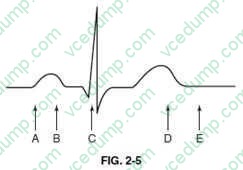
E. E
Explanation
Section: Physiology The most rapid filling of the ventricles occurs in early diastole, immediately after opening of the atrioventricular valves. This happens after the repolarization phase (T wave) and resulting relaxation of the cardiac ventricular muscle. Excitation of the atria (choice A) also results in increased blood flow into the ventricles, occurring around choice B. However, the flow at that time is less than during early diastole. Ventricular contraction begins with the QRS complex (choice C) and lasts until the end of the T wave (choice D). During this time, the mitral and tricuspid valves are closed.
Question 575:
A 12-year-old boy has suffered from chronic sinopulmonary disease including persistent infection of the airway with Pseudomonas aeruginosa. He has constant and chronic sputum production as a result of the airway infection. Additionally, he suffers from gastrointestinal (GI) and nutritional abnormalities that include biliary cirrhosis, meconium ileus, and pancreatic insufficency. The symptoms are classical for which of the following disorders?
A. congenital adrenal hyperplasia B. CF C. Renal Fanconi syndrome D. sickle cell anemia E. Tay-Sachs disease
B. CF
Question 576:
Regulation of iron homeostasis occurs by controlling the amount that circulates in the serum, as well as the amount contained within cells. One mechanism that plays a role in this homeostasis is iron- mediated control of the level of the intracellular iron-binding protein ferritin. Which of the following represents the mechanism of iron regulation of ferritin levels?
A. Binding of iron to ferritin leads to secretion of the complex from cells and subsequent excretion in the urine. B. Ferritin exists as a tetramer and when iron binds, the affitinity for additional iron atoms increases. C. Iron binds an additional protein that acts as a regulator of ferritin mRNA translation, high iron leads to increased translation and thus increased ironbinding capacity. D. When excess iron binds to ferritin, it decreases the half-life of the protein allowing the iron to be released to the plasma and excreted.
C. Iron binds an additional protein that acts as a regulator of ferritin mRNA translation, high iron leads to increased translation and thus increased ironbinding capacity.
Question 577:
The parents bring a 5-month-old baby to the emergency room. It is their first child and they are insecure. The boy vomits frequently, seems to be constantly constipated, and has difficulties in defecation. A barium enema study reveals a region in the bowel that is collapsed and an enlarged colon above this area. Abiopsy from the part of the bowel 1 in above the anus is sent to the laboratory and histological analysis reveals the absence of ganglia in this tissue. What is the most likely diagnosis?
A. cholecystitis B. gastroesophageal reflux disease C. hirschsprung disease D. polymyositis E. temporary problem with no treatment required
C. hirschsprung disease
Explanation
Section: Physiology Hirschsprung disease is a genetic disorder caused by the absence of enteric nerve cells in the wall of the sigmoid colon and/or rectum. The portion of the bowel wall without nerve ganglia (aganglionic) cannot relax in response to bowel content so that the stool builds up behind the obstruction. In some children the problems begin shortly after birth, other infants are not acutely ill, but develop chronic symptoms such as constipation or anemia. Cholecystitis (choice A), caused by inflammation of the gallbladder, gastroesophageal reflux disease GERD (choice B), and polymyositis (choice D), a disorder affecting esophageal skeletal muscle, do not affect the neuronal regulation of the large intestine. Hirschsprung disease is almost always treated by surgical removal of the affected bowel segment and then joining the healthy bowel segments (choice E). A GI motility disorder might improve on its own due to the ability of the enteric nervous system in healthy GI tract portions to learn new motility patterns. However, it takes a very long time and the success is not certain.
Question 578:
Judging from the graph in below figure
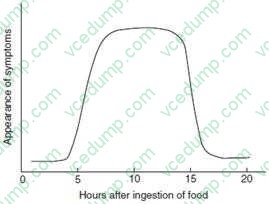
which microorganism is likely to be the causative agent of food poisoning characterized by diarrhea and severe vomiting related to heat-stable enterotoxins?
B. Salmonella typhimurium C. S. aureus D. Yersinia enterocolitica E. V. parahaemolyticus
C. S. aureus
Explanation
Section: Microbiology/Immunology The short incubation of 4 hours indicates staphylococcal food poisoning. This is a situation arising from the ingestion of preformed staphylococcal enterotoxin, which induces symptoms within 16 hours following consumption of contaminated food, including diarrhea, abdominal cramps, and severe vomiting. These symptoms last for 612 hours, and complete recovery usually occurs in less than 1 day. The incubation periods for S. typhimurium (choice B), V. parahaemolyticus (choice D),Y. enterocolitica (choice E), and C. jejuni (choice A) are 812, 2496, 2448, and 72168 hours, respectively. These longer incubation periods in comparison to the incubation period of staphylococcal food intoxication are due to the need for these bacteria to invade the human intestinal tract, and then multiply and form the toxins responsible for the infective form of food poisoning.
Question 579:
Which of the following correctly describes the actions of baclofen?
A. agonist at glutamate receptors B. antagonist at neuronal nicotinic receptors C. agonist at gamma-aminobutyric acid receptors D. agonist at glycine receptors E. antagonist at skeletal muscle ryanodine receptors
C. agonist at gamma-aminobutyric acid receptors
Question 580:
Fragile X syndrome is caused by expansion of a trinucleotide repeat in the fragile X mental retardation- 1 (FMR1) gene. This disorder is characterized by which of the following symptoms?
A. accumulation of copper leading to formation of Kayser-Fleischer rings in the eyes B. hypoketotic hypoglycemia and metabolic acidosis C. isovaleric acidemia, severe metabolic acidosis, and neonatal fatality D. mental retardation of severity linked to the level of trinucleotide repeat expansion E. very long-chain fatty acid accumulation and myelin defects
D. mental retardation of severity linked to the level of trinucleotide repeat expansion
Explanation
Section: Biochemistry Fragile X syndrome is the most common form of inherited mental retardation. The symptoms of this disoder are caused by a disruption in the FMR1 gene. The disruption occurs as a result of the expansion of a trinucleotide repeat sequence in the 5' untranslated region of the FMR1 gene. The severity of mental retardation in fragile X syndrome is proportional to the level of expansion of the trinucleotide repeat. Copper accumulation leading to Kayser-Fleisher rings in the eyes(choice A) is indicative of Wilson disease, which results from impaired biliary copper excretion. The symptoms of hypoketotic hypoglycemia and metabolic acidosis (choice B) are indicative of glutaric acidemia type II, which results from deficiencies in mitochondrial ubiquinone oxidoreductase. Isovaleric academia (choice C) is a severe neonatal disorder resulting from a deficiency in one of the enzymes of branched-chain amino acid metabolism, isovaleryl- CoA dehydrogenase. Accumulation of abnormally high levels of very long-chain fatty acids and defects in myelin formation (choice E) are symptoms associated with X-linked adrenoleukodystrophy (X-ALD).
Nowadays, the certification exams become more and more important and required by more and more
enterprises when applying for a job. But how to prepare for the exam effectively? How to prepare
for the exam in a short time with less efforts? How to get a ideal result and how to find the
most reliable resources? Here on Vcedump.com, you will find all the answers.
Vcedump.com provide not only USMLE exam questions,
answers and explanations but also complete assistance on your exam preparation and certification
application. If you are confused on your USMLE-STEP-1 exam preparations
and USMLE certification application, do not hesitate to visit our
Vcedump.com to find your solutions here.