USMLE USMLE-STEP-1 Online Practice
Questions and Exam Preparation
USMLE-STEP-1 Exam Details
Exam Code
:USMLE-STEP-1
Exam Name
:United States Medical Licensing Step 1
Certification
:USMLE Certifications
Vendor
:USMLE
Total Questions
:847 Q&As
Last Updated
:Jun 02, 2026
USMLE USMLE-STEP-1 Online Questions &
Answers
Question 511:
Which of the following conditions would likely be associated with decreased levels of circulating EPO?
A. chronic alkalosis B. chronic renal failure C. emphysema D. pernicious anemia E. pulmonary fibrosis
B. chronic renal failure
Explanation
Section: Physiology EPO is a glycoprotein produced primarily in the kidney, thus EPO levels tend to be depressed in chronic renal failure. EPO is a growth factor that stimulates the production of red blood cells. Its production by the kidney is triggered by low tissue oxygenation. Any condition that decreases the oxygen-carrying capacity of the blood (such as anemia, choice D) or that causes hypoxia by decreasing lung function (such as emphysema or pulmonary fibrosis, choices C and E) will produce elevated levels of circulating EPO. Alkalosis (choice A) increases hemoglobin's affinity for oxygen, making it more difficult for tissues to extract oxygen from the blood. In alkalosis, tissues thus tend to have lower oxygen content, with a resultant increase in circulating EPO levels.
Question 512:
A 29-year-old woman presents with weakness, fatigue, easy bruising, and nosebleeds. Analysis of her blood reveals a reciprocal translocation between chromosomes 22 and 9, and low leukocyte alkaline phosphatase levels. These findings confirm a diagnosis of which of the following?
A. acute lymphoblastic leukemia B. Burkitt lymphoma C. chronic myelogenous leukemia D. follicular lymphoma E. Hodgkin lymphoma
C. chronic myelogenous leukemia
Explanation
Section: Pathology and Path physiology Ninety percent of individuals with chronic myelogenous leukemia have an acquired Philadelphia chromosome abnormality consisting of a translocation between chromosomes 22 and 9. The translocation places the proto-oncogene c-abl from chromosome 9 next to the breakpoint cluster region (bcr) on chromosome 22. The unique gene sequence bcr-abl confers a growth advantage with subsequent clonal expansion. Acute lymphoblastic leukemia (choice A) does not have a known reproducible gross chromosomal derangement. Burkitt lymphoma (choice B) is associated with a translocation of the c-myc oncogene from chromosome 8 to chromosome 14. Follicular lymphoma (choice D) is associated with a translocation between chromosomes 14 and 18. Hodgkin lymphoma (choice E) is characterized by the presence of ReedSternberg cells and has a number of subtypes.
Question 513:
When the body becomes acidotic, the liver and the kidneys play central roles in reactions designed to reduce the proton level (i.e., increase the pH) of the circulation. Which of the following constitutes the hepatic reaction occuring during periods of acidosis?
A. ammonia incorporation into glutamateforming glutamine B. ammonia incorporation into alphaketoglutarate- forming glutamate C. glutamine conversion to glutamatereleasing ammonia D. glutamine conversion to alphaketoglutarate- releasing ammonia E. increased production of urea to dispose of ammonia
A. ammonia incorporation into glutamateforming glutamine
Question 514:
Lipoprotein lipase (LPL) is the endothelial cellassociated enzyme necessary for release of fatty acids from circulating lipoproteins. Which of the following apolipoproteins is required to activate LPL- mediated release of fatty acids from chylomicrons?
A. apo A B. apo C. apo D. apo CII E. apo E
D. apo CII
Question 515:
Which of the following thalamic nuclei subserves a motor function?
A. dorsomedial nucleus B. lateral geniculate nucleus C. medical geniculate nucleus D. ventral lateral nucleus E. ventral posterior medial nucleus
D. ventral lateral nucleus
Explanation
Section: Anatomy The ventral lateral nucleus of the thalamus receives projections from the deep cerebellar nuclei and, in turn, sends projections to the motor cortex. It is thus functionally defined as a thalamic motor nucleus. The dorsomedial nucleus (choice A) is considered a limbic nucleus of the thalamus as it receives projections from the amygdala and olfactory cortex, and projects to the prefrontal cortex and hypothalamus. The lateral (choice B) and medial geniculate (choice C) nuclei and the ventral posterior medial nucleus (choice D) are considered sensory nuclei as they receive information mediating vision, audition, and somatosensory signals from the face, respectively. In turn, these three brain areas project to the somatosensory cortex.
Question 516:
A 3-year-old child arrives at the hospital in severe respiratory distress. Periorbital edema is also noted. Blood analysis reveals decreased levels of C4 and decreased levels of C1 inhibitor. This complement deficiency is likely to lead to which of the following conditions?
A. angioedema B. an increased susceptibility to pyogenic infections C. bacteremia D. decreased production of anaphylatoxins E. enhancement of antibody production
A. angioedema
Explanation
Section: Microbiology/Immunology Deficiency in the inhibitor of the first component of complement (C1) is associated with angioedema, because this condition leads to the production of anaphylatoxins C3a, C4a, and C5a. These anaphylatoxins act on mast cells, which release large amounts of histamine. Production of histamine increases capillary permeability resulting in edema. Enhanced susceptibility to pyogenic infections has been attributed to C3 and C5C8 components of complement. Bacteremia is a term used to indicate the presence of bacteria in the blood. Thus it has nothing to do with the first component of complement (choice C). Inherited deficiencies of C3 and C5C8 have been associated with increased susceptibility to pyogenic infections, but not the first component of complement (choice B). Complement can act synergistically with antibody to modify its action, but not its production (choice E). The conversions of the third (C3) and fifth (C5) components of complementby the C3 and C5 convertases to C3a and C5a anaphylatoxins lead to the increased production of anaphylatoxins (choice D) seen with C1 inhibitor deficiency.
Question 517:
A gang member is rushed to the emergency room suffering from multiple stab wounds made by an ice pick. Athird-year medical student rotating through emergency medicine is puzzled by the sight of a milky white substance exuding from a stab wound just superior to the right sternoclavicular joint. Which of the following structures is possibly injured at this location?
A. the common carotid artery B. the cupola of the right lung C. the internal jugular vein D. the right lymphatic trunk E. the thoracic duct
D. the right lymphatic trunk
Explanation
Section: Anatomy The right lymphatic trunk is ruptured and chyle is exuding from the wound. Blood would flow from a wound involving the common carotid artery (choice A) or internal jugular vein (choice C). Astabbing lesion of the cupola of the right lung (choice B) would result in pneumothorax. The thoracic duct (choice E) does carry chyle. However, the thoracic duct drains into the bifurcation of the internal jugular and subclavian veins on the left side, above the left sternoclavicular joint.
Question 518:
A 37-year-old man presents with tophaceous deposits within the articular cartilage, synovium, tendons, tendon sheaths, pinnae, and the soft tissue on the extensor surface of the forearms. These clinical observations suggest the patient is suffering from which of the following disorders?
A. ADA deficiency B. gout C. Lesch-Nyhan syndrome D. purine nucleoside phosphorylase(PNP) deficiency E. von Gierke disease
B. gout
Explanation
Section: Biochemistry Gout is characterized by elevated levels of uric acid in the blood and urine. Uric acid is the end-product of purine catabolism and excess production results from a variety of metabolic abnormalities that lead to overproduction of purines via the de novo pathway. Uric acid is very insoluble and when generated in large amounts will precipitate as uric acid crystals in the joints of the extremities and in renal interstitial tissue. These deposits are gritty or sandy in nature and thus are termed tophaceous deposits.
ADA (choice A) and PNP (choice D) deficiencies result in various degrees of immune dysfunction and are not associated with gouty episodes. Lesch-Nyhan disease (choice C) is due to loss of HGPRT activity. Characteristic symptoms include severe mental retardation and self-mutilation. A much less severe symptom associated with Lesch-Nyhan disease is hyperuricemia, which leads to gouty episodes. However, other symptoms are of such severity that patients die very early in life. Deficiency in glucose-6- phosphatase results in von Gierke disease (choice E). Clinical symptoms of von Gierke disease include fasting hypoglycemia, lactic acidemia, and mild gouty episodes. The hyperuricemia of von Gierke disease is seldom severe enough to lead to the level of gouty deposits observed in this patient.
Question 519:
AIP is the major autosomal-dominant acute hepatic porphyria. This disease is caused by a deficiency in porphobilinogen (PBG) deaminase, an enzyme of heme biosynthesis. Patients afflicted with this disease would be expected to excrete excess amounts of which of the following?
A. delta-aminolevulinic acid (ALA) B. coproporphyrinogen III C. hydroxymethylbilane D. protoporphyrin IX E. type III uroporphyrinogen
A. delta-aminolevulinic acid (ALA)
Explanation
Section: Biochemistry PBG deaminase (also called hydroxymethylbilane synthase) catalyzes the heme biosynthesis reaction involving the head-to-tail condensation of four molecules of PBG to produce the linear tetrapyrrole intermediate, hydroxymethylbilane. Hydroxymethylbilane can nonenzymatically cyclize into uroporphyrinogen I, which is why PBG deaminase is also known as uroporphyrinogen I synthase. ALA is the precursor for PBG, thus a defect in PBG deaminase would lead to excess ALA excretion. The compounds in choices BE all represent products of reactions that are downstream of PBG deaminase in the heme biosynthetic pathway and thus would not be excreted in high amounts in someone with AIP.
Question 520:
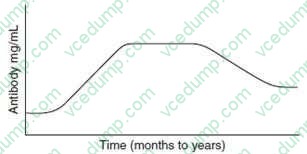
A medical student has been immunized with hepatitis B virus (HBV) recombinant vaccine. The curve in below figure represents the production of protective antibodies to the viral component present in the recombinant vaccine. Which of the following is the known viral component of the HBV vaccine?
A. nucleocapsid proteins of HBV B. RNA genome of HBV C. viral core antigen (HBcAg) D. viral e antigen (HBeAg) E. viral surface antigen (HBsAg)
E. viral surface antigen (HBsAg)
Explanation
Section: Microbiology/Immunology The envelope of hepatitis B virus contains an antigen known as HBsAg (hepatitis B surface antigen). This antigen is of importance because production of antibodies to HBsAg indicates immunity against hepatitis B virus, which resulted either from infection or vaccination with HBsAg. Treatment of HBV with a nonionic detergent removes the envelope and produces the viral core, which contains the hepatitis B core antigen (HBcAg). Antibodies to HBcAg are not protective (choice C). Treatment of the viral core with strong detergents results in the release of a soluble core antigen called hepatitis virus antigen e (HBeAg). Production of antibody to HBeAg signals active disease during which the patient is infectious (choice D). The DNA genome (choice B), or the nucleocapsid proteins of HBV (choice A) are not protective.
Nowadays, the certification exams become more and more important and required by more and more
enterprises when applying for a job. But how to prepare for the exam effectively? How to prepare
for the exam in a short time with less efforts? How to get a ideal result and how to find the
most reliable resources? Here on Vcedump.com, you will find all the answers.
Vcedump.com provide not only USMLE exam questions,
answers and explanations but also complete assistance on your exam preparation and certification
application. If you are confused on your USMLE-STEP-1 exam preparations
and USMLE certification application, do not hesitate to visit our
Vcedump.com to find your solutions here.