USMLE USMLE-STEP-1 Online Practice
Questions and Exam Preparation
USMLE-STEP-1 Exam Details
Exam Code
:USMLE-STEP-1
Exam Name
:United States Medical Licensing Step 1
Certification
:USMLE Certifications
Vendor
:USMLE
Total Questions
:847 Q&As
Last Updated
:Jun 02, 2026
USMLE USMLE-STEP-1 Online Questions &
Answers
Question 531:
Secretion of pulmonary surfactant is a function of which of the following?
A. alveolar dust cells B. endothelial cells of capillaries in the alveolar septum C. small granule cells D. type I pneumocytes (squamous alveolar cells) E. type II pneumocytes (greater alveolar cells)
E. type II pneumocytes (greater alveolar cells)
Explanation
Section: Anatomy All the listed cell types are components of the respiratory system. Type II pneumocytes are the source of pulmonary surfactant. Alveolar dust cells (choice A) are macrophages. Endothelial cells (choice B) and type I pneumocytes (choice D) are components of the blood-air barrier. Small granule cells (choice C), which are members of the diffuse neuroendocrine system, function in paracrine and endocrine signaling.
Question 532:
Although most cases of hypertension are "essential," meaning the underlying disorder is unknown, about 10% of cases are "secondary hypertension" due to a specific, usually treatable cause. Which of the following alternatives can lead to secondary hypertension?
A. adrenal insufficiency B. estrogen deficiency C. hyperparathyroidism D. renal artery stenosis E. volume depletion
D. renal artery stenosis
Explanation
Section: Physiology A fixed lesion of the renal artery results in impaired perfusion. When the kidney is poorly perfused, it increases renin secretion, which increases blood pressure and thus improves renal blood flow. Hence the appropriate treatment is surgical correction of the renal artery lesion. Adrenal insufficiency (choice A), estrogen deficiency (choice B), and volume depletion (choice E) are situations that tend to diminish blood pressure. There is no clear relationship between hyperparathyroidism (choice C) and hypertension.
Question 533:
A 73-year-old woman complains of difficulty sleeping, exercise fatigue, and shortness of breath. Examination reveals mental confusion, swollen ankles, pulmonary rales, and dyspnea while supine.
46. Chronic treatment of this patient with an angiotensin-converting enzyme (ACE) inhibitor such as captopril may be beneficial because ACE inhibitors (in addition to other effects) are known to exert which of the following responses?
A. decrease both ventricular preload and afterload B. increase coronary perfusion C. increase efficiency of oxygen extraction by cardiac and skeletal muscle D. produce a positive inotropic effect and negative chronotropic effect E. promote ventricular remodeling and compensatory enlargement
A. decrease both ventricular preload and afterload
Explanation
Section: Pharmacology ACE inhibitors decrease ventricular preload and afterload through the inhibition of ACE and the consequent decrease in production of the pressor peptide angiotensin II, along with prolongation of the actions of the vasodilator peptide bradykinin (which is normally degraded by ACE). ACE inhibition also reduces angiotensin II-dependent augmentation of sympathetic nervous system activity. Choice B is incorrect in that ACE inhibitors exert no direct effects on coronary perfusion. Choice C is incorrect because efficiency of oxygen extraction by muscle is unaffected by ACE inhibitors. Choice D is incorrect because ACE inhibitors exert no direct effects on cardiac force or rate. Use of ACE inhibitors reduces ventricular remodeling and compensatory enlargement (choice E), a very valuable effect in heart failure.
Question 534:
A 48-year-old woman comes to the doctor complaining of vague pains in the abdomen, legs, and thighs. On physical examination, the only positive findings are varicose veins of 20 years' duration. The patient, upon being told of this, insists on being operated on for the varicose veins immediately. Which of the following is most likely to underlie this wish for immediate surgery?
A. anxiety B. depression C. drug dependence D. psychosis
A. anxiety
Explanation
Section: Behavioral Science and Biostatics Anxiety or concomitant stress is a common trigger for help-seeking behavior, especially if the symptom or sign is of long duration. Although depression (choice B) can cause vague discomfort and precipitate help seeking, insisting on an operation immediately seems to indicate anxiety rather than depression, which is more likely to cause indecision or inaction. A drug-dependent person (choice C) is more likely to insist on drugs. There is no evidence of psychosis (choice D).
Question 535:
A motor vehicle accident caused complete pituitary stalk transection. Secretion of all pituitary hormones is lost except for one, the blood level of which actually increases. Which one of the following pituitary hormones is distinctive in that its primary control is by inhibition rather than stimulation by the hypothalamus?
A. gonadotropin-releasing hormone B. growth hormone C. prolactin D. proopiomelanocortin E. thyroid-stimulating hormone
C. prolactin
Explanation
Section: Physiology The primary control over prolactin secretion is inhibition by hypothalamic dopamine; all other anterior pituitary hormones are primarily controlled by hypothalamic hormone stimulation. Hence, with stalk transection, loss of connection of the hypothalamus to the pituitary is associated with decreased secretion of all pituitary hormones except prolactin, the secretion of which increases in the absence of dopamine. Secretion of growth hormone (choice B), proopiomelanocortin (choice D), and thyroid- stimulating hormone (choice E) all decrease. Gonadotropinreleasing hormone (choice A) is a hypothalamic hormone, and is not made in the pituitary gland.
Question 536:
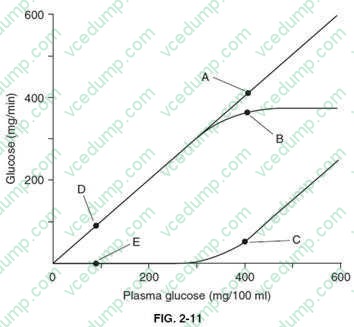
In below figure, which point depicts the excreted glucose in a 31-year-old woman with untreated nephrogenic diabetes insipidus?
A. A B. B C. C D. D E. E
E. E
Explanation
Section: Physiology Nephrogenic diabetes insipidus is a condition in which the kidney is insensitive to the normal action of ADH, which is to cause a concentrated urine by promoting water reabsorption in the collecting duct. In such a person, plasma glucose will be normal--around 80 mg/ 100 mL and excreted glucose will be zero, since the tubular maximum for glucose has not been exceeded and all the filtered glucose is normally reabsorbed. Choices A, B, and C depict the filtered, reabsorbed, and excreted glucose in a hyperglycemic state which might occur during diabetes mellitus. Choice D depicts the filtered and reabsorbed glucose in a fasting, normoglycemic state.
Question 537:
Gluconeogenesis is an extremely important reaction carried out in hepatocytes allowing for glucose homeostasis in the blood. The primary positive control of hepatic gluconeogenesis is exerted by which of the following?
A. high acetylcoenzyme A (acetyl-CoA) levels B. high adenosine triphosphate (ATP) levels C. high citrate levels D. low ATP levels E. low citrate levels
A. high acetylcoenzyme A (acetyl-CoA) levels
Explanation
Section: Biochemistry The first step in gluconeogenesis is the formation of oxaloacetate from pyruvate. The enzyme controlling this step is pyruvate carboxylase, an allosteric enzyme that does not function in the absence of its primary effector, acetyl-CoA, or closely related acyl-CoA. Thus, a high level of acetyl-CoA signals the need for more oxaloacetate. If there is a surplus of ATP, oxaloacetate will be used for gluconeogenesis. Under conditions of low ATP, oxaloacetate will be consumed in the citric acid cycle. Citrate is the primary negative effector of glycolysis and the primary positive effector of fatty acid synthesis. High levels of citrate (choice C), but not low levels (choice E), do positively affect the activity of fructose-1,6-bisphosphatase, one of the bypass enzymes of gluconeogenesis, but this is not the primary site of control, since the carbon atoms must first go through the pyruvate carboxylase reaction. Low ATP levels (choice D) would be reflected in an elevation in ADP levels, and ADP negatively affects the activity of pyruvate carboxylase. High ATP levels (choice B) are necessary in order for gluconeogenesis to proceed, and will negatively affect glycolysis at the level of PFK-1, allowing for an increased net flow of carbon into glucose. However, increased levels of ATP do not directly regulate the enzymes of gluconeogenesis.
Question 538:
A 40-year-old woman complains of chronic fatigue, aching muscles, and general weakness. Physical examination reveals a modest weight gain, dry skin, and slow reflexes. Laboratory findings include TSH:
>10 mU/L (normal range 0.55 mU/L), free T4: low to normal. With of the following is the most likely explanation?
A. hyperthyroidism due to autoimmune thyroid disease B. hyperthyroidism due to iodine excess C. hyperthyroidism secondary to a hypothalamic-pituitary defect D. hypothyroidism due to autoimmune thyroid disease E. hypothyroidism secondary to a hypothalamic-pituitary defect
D. hypothyroidism due to autoimmune thyroid disease
Explanation
Section: Physiology The described symptoms are typical for hypothyroidism. Aprimary thyroid gland deficiency leads to low T4 levels and high TSH levels. The most common cause of thyroid gland failure is called autoimmune thyroiditis or Hashimoto thyroiditis. It develops slowly due to persistent inflammation of the thyroid caused by the patient's own immune system. Middle-aged women are most commonly affected. The measurement of elevated TSH levels in blood is of high diagnostic value, since it helps determine even minor degrees of hypothyroidism. Correct diagnosis is critical because treatment usually continues for life, and stopping of the treatment and reevaluating the original diagnosis is often difficult. Opposite to hypothyroidism, hyperthyroidism (choices A, B, and C) presents with symptoms such as weight loss, warm moist skin, nervousness, and trembling hands. Secondary hypothyroidism (choice E) is caused by reduced TSH levels due to hypothalamic or pituitary insufficiency.
Question 539:
Many effective anticancer drugs function as such by interfering with processes of DNA replication. The drug, doxorubicin, is useful in the treatment of lymphomas and breast cancers because of its ability to interfere with which of the following enzyme activities?
A. DNA ligase B. DNA polymerase-alpha C. primase D. topoisomerase II E. uracil N-glycosylase
D. topoisomerase II
Explanation
Section: Biochemistry Doxorubicin is a drug of the class that functions by interfering with topoisomerases. In particular, doxorubicin inhibits topoisomerase II. During the process of DNA replication ,the two strands of the DNA helix are separated. As the replication fork progresses toward sites of chromosomal attachment to the scaffold, there is an increase in the torsional stress on the helix due to supercoiling. These torsional stresses are relieved by the action of topoisomerases that introduce nicks into the DNA, which allows the strands to unwind the supercoils. Topoisomerase I introduces single-strand nicks, whereas topoisomerase II introduces double-strand nicks. Interference with the action of topoisomerases would thus impair the rate of DNA replication and this would be detrimental for rapidly proliferating cells such as cancer. Doxorubicin does not affect the activity of any of the other enzymes (choices AC, E).
Question 540:
A 62-year-old woman has had atrial fibrillation since experiencing a myocardial infarction (MI) 7 months prior. Two weeks ago she was hospitalized following a car accident in which she suffered a compound fracture of her left femur and several severe contusions. She now returns to the emergency room with right flank pain, hematuria, and left-sided paralysis. These newly developing problems are most likely the result of which of the following?
A. air embolism from the compound fracture B. bone marrow embolus from the fractured femur C. fat embolism from the fractured femur D. systemic thromboemboli from the left atrium E. venous thromboemboli from the deep leg veins
D. systemic thromboemboli from the left atrium
Explanation
Section: Pathology and Path physiology Atrial fibrillation produces turbulence that is conducive to the formation of thrombi which can then embolize throughout the systemic circulation. In this patient the right flank pain and hematuria and left- sided paralysis suggest that thromboemboli traveled to the right kidney and the brain, respectively. Embolism of air (choice A) has variable effects, although small amounts are typically inconsequential. Larger volumes (~ >100 mL) can obstruct arteries and lead to ischemia and necrosis; an air embolism that lodges in the right heart may lead to sudden death. However, air embolism is rare and is not the most likely event in this patient. Bone marrow embolism (choice B) can occur following a broken bone or cardiac resuscitation, but typically will have no clinical consequences. However, fat embolism (choice C) from a broken long bone or traumatized areas of adipose tissue can, when severe, produce clinical manifestations. These follow the trauma by about 13 days and usually include dyspnea, skin rash, and acute neurologic changes. In a few cases this has been fatal. Venous thromboemboli from deep leg veins (choice E) could not get past the lungs (with the unusual exception of paradoxical embolism in a person with a septal defect) so could not reach the kidneys or brain to cause the effects reported for this patient.
Nowadays, the certification exams become more and more important and required by more and more
enterprises when applying for a job. But how to prepare for the exam effectively? How to prepare
for the exam in a short time with less efforts? How to get a ideal result and how to find the
most reliable resources? Here on Vcedump.com, you will find all the answers.
Vcedump.com provide not only USMLE exam questions,
answers and explanations but also complete assistance on your exam preparation and certification
application. If you are confused on your USMLE-STEP-1 exam preparations
and USMLE certification application, do not hesitate to visit our
Vcedump.com to find your solutions here.