USMLE USMLE-STEP-1 Online Practice
Questions and Exam Preparation
USMLE-STEP-1 Exam Details
Exam Code
:USMLE-STEP-1
Exam Name
:United States Medical Licensing Step 1
Certification
:USMLE Certifications
Vendor
:USMLE
Total Questions
:847 Q&As
Last Updated
:May 25, 2026
USMLE USMLE-STEP-1 Online Questions &
Answers
Question 381:
Your patient confides in you that she has been losing weight with loss of appetite, has been unable to concentrate, and has had difficulty sleeping through the night. She has also been thinking of the means of killing herself. Which of the following is the most likely diagnosis?
A. borderline personality disorder B. factitious disorder C. generalized anxiety disorder D. hypochondriasis E. major depression
E. major depression
Explanation
Section: Behavioral Science and Biostatics Depression is often accompanied by vague physical symptoms. When a depressed patient presents to a primary physician, it is important that the presence of depression be ascertained by careful history; depressed patients are often suicidal, and about 70% of successful suicides have seen their physician in the previous month. Choices A, B, C, and D are not supported by the signs presented.
Question 382:
A 52-year- oldwoman has had rheumatoid arthritis for many years. She now comes to you complaining of the development in the past few months of redness, burning, and itching of her eyes and a dry mouth, making swallowing difficult. This newly developing condition gives the patient a greatly increased risk for which of the following?
A. esophageal carcinoma B. leukemia C. lymphoma D. melanoma E. pleomorphic adenoma
C. lymphoma
Explanation
Sjögren syndrome is an autoimmune disease in which there is immune-mediated destruction of lacrimal and salivary gland epithelium leading to diminished secretion by these organs. This disease may occur as a primary disorder or more commonly secondary to another autoimmune disorder, such as rheumatoid arthritis, as seen in this patient. One of the long-term risks for Sjögren syndrome is a 40- fold increase in malignant lymphoma. The development of esophageal carcinoma (choice A) is associated with alcohol use, smoking, Barrett metaplasia, and Epstein-Barr virus infections. Chronic Sjögren syndrome is not known to cause an increased incidence of leukemia (choice B). Melanoma (choice D) is a malignancy of melanocytes unrelated to Sjögren syndrome. Pleomorphic adenoma (choice E) is a benign salivary gland tumor composed of both neoplastic epithelium and stroma. Its occurrence is not associated with Sjögren syndrome.
Question 383:
The ability of the liver to regulate the level of blood glucose is critical for survival. Anumber of sources of carbon atoms of nonhepatic origin are used by the liver for gluconeogenesis. However, the net conversion of carbons from fat into carbons of glucose cannot occur in humans because of which of the following?
A. Fat oxidation occurs in the mitochondria and gluconeogenesis occurs in the cytosol. B. States of catabolism and anabolism are never concurrently active. C. Storage of fats occurs in adipose tissue and gluconeogenesis occurs in liver and kidney. D. The carbons of acetyl-CoA from fat oxidation are lost as C in the TCA cycle. E. The carbons of acetyl-CoA from fat oxidation inhibit conversion of pyruvate to oxaloacetate.
D. The carbons of acetyl-CoA from fat oxidation are lost as C in the TCA cycle.
Explanation
Section: Biochemistry When the carbons of fatty acids are oxidized for energy production, the by-product of that process is the two-carbon compound, acetyl-CoA. Acetyl-CoA can then enter the TCA cycle for complete oxidation. Although, several compounds of the TCA cycle can be directed into the gluconeogenic pathway of glucose synthesis, the carbons of acetyl-CoA cannot provide a net source of carbon in that latter pathway. This is due to the fact that, following entry of the two carbons of acetyl-CoA into the TCA cycle, two carbons are lost as CO2 during the subsequent reactions of the cycle. The subcellular compartmentalization of fat oxidation and gluconeogenesis (choice A) has no bearing on net carbon deposition into glucose. Anabolic and catabolic reactions (choice B) are always occuring concurrently in cells but at different rates dependent on cellular status. The site of fat storage (choice C) has no bearing on net incorporation of carbon into glucose. Acetyl-CoA does not inhibit conversion of pyruvate to oxaloacetate (choice E) but acts as an allosteric activator of pyruvate carboxylase, a gluconeogenic enzyme.
Question 384:
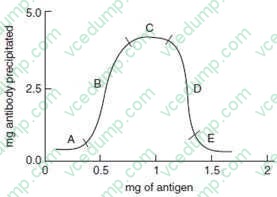
Below figure shows a quantitative precipitin curve of an antigen-antibody reaction, where the amount of antibody is kept constant throughout. According to the figure, which of the following statements is correct?
A. point A shows antigen excess B. point B shows that there is no antibody formation C. point C indicates that there is little, if any, free antigen and antibody in the reaction tube D. point D represents the area of antigen destruction E. point E indicates antibody excess
C. point C indicates that there is little, if any, free antigen and antibody in the reaction tube
Explanation
Section: Microbiology/Immunology Point C represents the zone of equivalence, that is, that point of the antigen-antibody reaction when optimal concentrations of antigen and antibody combine. Thus, there is little, if any, free antigen and antibody, and as a consequence maximal amounts of antigen and antibody will be found in the precipitate resulting from the antigen-antibody reaction. Points A and B represent areas in the antigen- antibody precipitin curve where there is an excess of antibody (choices A and B). Points D and E show areas in the precipitin curve where there is an antigen excess in the antigen-antibody reaction mixture (choices D and E).
Question 385:
Afailure of the truncoconal septum to follow a spiral course results in which of the following conditions?
A. common atrium B. persistent atrioventricular canal C. persistent truncus arteriosus D. Tetralogy of Fallot E. transposition of the great vessels
E. transposition of the great vessels
Explanation
Section: Anatomy Transposition of the great vessels occurs when the truncoconal ridges fail to spiral as they divide the outflow tract into two channels. This produces two totally independent circulatory loops with the right ventricle feeding into the aorta and the left ventricle feeding into the pulmonary artery. Common atrium (choice A) results from a complete failure of the septum primum and septum secundum to form. Persistent atrioventricular canal (choice B) results from a failure of the endocardial cushions to fuse and partition the atrioventricular canal into a right and left component. It is accompanied by defects of the atrial and ventricular septa. Persistent truncus arteriosus (choice C) results from a total failure of the truncoconal ridges to develop and partition the outflow tract of the developing heart. Tetralogy of Fallot (choice D) is a related group of defects with the primary malformation being an unequal division of the outflow tract, resulting in pulmonary stenosis. The other eatures of tetralogy are an interventricular septal defect, an overriding aorta, and right ventricular hypertrophy. Survival of the infant depends on the maintenance of a patent ductus arteriosus.
Question 386:
An 8-month old boy presents to the emergency room in respiratory distress from a recurrent upper respiratory tract bacterial infection. Labs reveal low levels of IgA, IgD, IgE, IgG, and IgM. Suspecting animmune deficiency disorder, genetic testing reveals a defect in a tyrosine kinase gene. Which of the following would be seen in patients with this immune deficiency disorder?
A. particular susceptibility to viral and fungal infections B. profound deficiencies of cell-mediated immunity C. depletion of lymphocytes in the paracortical areas of lymph nodes D. normal numbers of B lymphocytes E. very low quantities of immunoglobulin in their serum
E. very low quantities of immunoglobulin in their serum
Explanation
Section: Microbiology/Immunology Bruton hypogammaglobulinemia is a B-cell immunodeficiency disorder that is X-linked recessive and thus only affects males (boys). Affected patients are deficient in B cells in the peripheral blood and in B- dependent areas of lymph nodes and spleen. Most of the serum immunoglobulins are absent, and the IgG level is <200 mg/L. Recurrent pyogenic infections usually begin to occur at 56 months of age, when maternal IgG has been depleted. Individuals with Bruton syndrome have normal T-cell-mediated immune responses (choice B). Patients suffering from X-linked hypogammaglobulinemia do not have normal numbers of B lymphocytes, because the pre-B cells from which B cells are produced fail to differentiate into B cells. This is due to a gene mutation in pre-B cells, which does not allow pre-B cells to form tyrosine kinase (choice D). The number of lymphocytes in the paracortical areas of lymph nodes of patients with Bruton syndrome is normal (choice C). Individuals with X-linked hypogammaglobulinemia have normally functioning T cells, and thus are not particularly susceptible to viral or fungal infections, which are dependent on proper T-cellmediated immune responses (choice A).
Question 387:
Gamma-aminobutyric acid (GABA) is an amino acid that functions as a neurotransmitter in the central nervous system. GABA typically causes increased chloride conductance and functions as an inhibitory transmitter. Assume that the equilibrium potential for chloride (ECl-) in a particular cell is -80 mV and that application of GABA inhibits the cell without any change in resting membrane potential. What is the resting membrane potential of the cell?
A. +80 mV B. 0 mV C. -70 mV D. -80 mV E. -90 mV
D. -80 mV
Explanation
Section: Physiology This problem addresses two issues: (1) the mechanism of action of inhibitory neurotransmitters and (2) the relationship of equilibrium potential and membrane potential. First, an inhibitory neurotransmitter acts by increasing conductance of an ion the equilibrium potential of which is either equal to or more negative than the cell resting membrane potential. If the equilibrium potential of the ion is more negative than the resting membrane potential, increasing the conductance of that ion will hyperpolarize the membrane--will generate an inhibitory postsynaptic potential (IPSP). Second, if the equilibrium potential of the ion is equal to resting membrane potential, increasing the conductance of that ion will "clamp" the membrane potential more tightly at its resting level--this will make the cell less excitable. In this problem, the membrane potential must equal -80 mV D.. If, and only if, the resting membrane potential equals the equilibrium potential for an ion, will an increase in the conductance to that ion not cause a change in membrane potential.
Question 388:
A 35-year-old weight lifter, who has been injecting testosterone for muscle mass augmentation, is evaluated for sterility and found to have an extremely low sperm count. Which of the following is an effect of testosterone and contributes to the mentioned sterility?
A. activation of inhibin B. feedback activation of leptin C. feedback inhibition of GnRH D. inhibition of seminal prostaglandins E. lowered core temperature
C. feedback inhibition of GnRH
Explanation
Section: Physiology Testosterone directly inhibits the secretion of GnRH from the hypothalamus, which affects secretion of LH and FSH and consequently secretion of testosterone. To initiate spermatogenesis, both FSH and testosterone are necessary. To maintain spermatogenesis after puberty, extremely high concentrations of testosterone seem to be required. Systemically administered testosterone does not raise the androgen level in the testes to as great a degree and it additionally inhibits LH secretion. Consequently, the net effect is generally a decrease in sperm count. There are two forms of inhibin (choice A) that are produced by Sertoli cells in males. They are activated by FSH, not testosterone, and inhibit FSH secretion by a direct action on the pituitary. Testosterone has been shown to have a suppressive, not activating (choice B) effect on leptin production. Prostaglandins (choice D) are produced by seminal vesicles and found in large quantities in semen. They are not known to play a role in spermatogenesis. They are believed to aid fertilization by reacting with female cervical mucus and to support smooth muscle movements in the uterus and fallopian tubes. Testosterone stimulates basic metabolic rate and can raise, not lower body core temperature (choice E). Excessive temperature of the testes can temporarily cause sterility.
Question 389:
In a medial medullary syndrome that involves a left-sided branch of the anterior spinal artery, which of the following deficits is seen?
A. deviation of the tongue to the left, hemiplegia of arm and leg on the left B. deviation of the tongue to the right, hemiplegia of arm and leg on the right C. loss of conscious proprioception and precise tactile discrimination over the right side of the body exclusive of the face D. only deviation of the tongue to the left E. only hemiplegia on the right
C. loss of conscious proprioception and precise tactile discrimination over the right side of the body exclusive of the face
Explanation
Section: Anatomy A vascular lesion affecting the left caudal medulla involves the left medial lemniscus, left hypoglossal nerve fibers, and the left medullary pyramid. Involvement of the left medial lemniscus produces somatosensory deficits involving the right side of the body. Damage to the left hypoglossal nerve would result in deviation of the protruded tongue to the left (and other lower motoneuron signs), and damage to the left pyramid results in right hemiplegia (choices A and B involve incorrect combinations) along with other upper motoneuron signs. Choices D and E are incorrect because they fail to combine involvement of the tongue and contralateral hemiplegia.
Question 390:
The initial reaction of the de novo synthesis pathway for pyrimidine nucleotides begins with glutamine and C and is complete with the formation of uridine monophosphate. Which of the following
represents the ratelimiting enzyme in this pathway?
A. aspartate transcarbamoylase B. orotate monophosphate decarboxylase C. phosphoribosylpyrophosphate (PRPP) amido transferase D. PRPP synthetase E. ribonucleotide reductase
A. aspartate transcarbamoylase
Explanation
Section: Biochemistry The first reaction of de novo pyrimidine biosynthesis is catalyzed by ATC. This reaction is also the rate- limiting step in this pathway. OMP decarboxylase (choice B) catalyzes the decarboxylation of OMP, yielding UMP. PRPP amido transferase (choice C) is an enzyme of the de novo purine biosynthesis pathway. PRPP synthetase (choice D) catalyzes the production of PRPP (used in the synthesis of purines and pyrimidines) from ribose-5-phosphate and ATP. Ribonucleotide reductase (choice E) is required
for the reduction of ribonucleotides to deoxyribonucleotides.
Nowadays, the certification exams become more and more important and required by more and more
enterprises when applying for a job. But how to prepare for the exam effectively? How to prepare
for the exam in a short time with less efforts? How to get a ideal result and how to find the
most reliable resources? Here on Vcedump.com, you will find all the answers.
Vcedump.com provide not only USMLE exam questions,
answers and explanations but also complete assistance on your exam preparation and certification
application. If you are confused on your USMLE-STEP-1 exam preparations
and USMLE certification application, do not hesitate to visit our
Vcedump.com to find your solutions here.