USMLE USMLE-STEP-1 Online Practice
Questions and Exam Preparation
USMLE-STEP-1 Exam Details
Exam Code
:USMLE-STEP-1
Exam Name
:United States Medical Licensing Step 1
Certification
:USMLE Certifications
Vendor
:USMLE
Total Questions
:847 Q&As
Last Updated
:May 25, 2026
USMLE USMLE-STEP-1 Online Questions &
Answers
Question 371:
I-cell disease (also identified as mucolipidosis type II) is characterized by the presence of inclusion bodies in fibroblasts (hence the derivation of the term I-cell), severe psychomotor retardation, corneal clouding, and dystosis multiplex. These symptoms arise from a defect in the targeting of lysosomal enzymes due to an inability to carry out which of the following processes?
A. produce mannose-6-phosphate modifications in lysosomal enzymes B. recycle the lysosomal receptor for mannose-6-phosphate present on lysosomal enzymes C. remove mannose-6-phosphates from lysosomal enzymes prior to their transport to the lysosomes D. synthesize the mannose-6-phosphate receptor found in lysosomes E. transport mannose-6-phosphate receptors to lysosomes
A. produce mannose-6-phosphate modifications in lysosomal enzymes
Explanation
Section: Biochemistry Enzymes that are destined for the lysosomes (lysosomal enzymes) are directed there by a specific carbohydrate modification. During transit through the Golgi apparatus a residue of Nacetylglucosamine- 1- phosphate is added to carbon 6 of one or more specific mannose residues that have been incorporated into these enzymes. The N-acetylglucosamine is activated by coupling to UDP and is transferred by an Nacetylglucosamine phosphotransferase yielding N-acetylglucosamine-1- phosphate-6- mannoseprotein. A second reaction removes the Nacetylglucosamine leaving mannose residues phosphorylated in the sixth position. Aspecific mannose-6-phosphate receptor is present in the membranes of the Golgi apparatus. Binding of mannose-6-phosphate to this receptor targets proteins to the lysosomes. Defects in the proper targeting of glycoproteins to the lysosomes can also lead to clinical complications. Deficiencies in N- acetylglucosamine phosphotransferase lead to the formation of dense inclusion bodies in fibroblasts. Two disorders related to deficiencies in the targeting of lysosomal enzymes are termed I-cell disease (mucolipidosis II) and pseudo-Hurler polydystrophy (mucolipidosis III). I-cell disease is characterized by severe psychomotor retardation, skeletal abnormalities, coarse facial features, painful restricted joint movement, and early mortality. Pseudo- Hurler polydystrophy is less severe; it progresses more slowly, and afflicted individuals live to adulthood. Each of the other choices (B, C, D, and E) represent other potential pathways that are not affected in the processing, delivery, or presentation of lysosomal enzymes or the receptors that recognize the properly processed enzymes.
Question 372:
A 2-year-old boy who has not been vaccinated against any germ is experiencing severe spasms in the muscles of the jaw and face. These spasms do not allow the child to open his mouth. Laboratory tests established that a bacterial toxin was responsible for this boy's symptoms. The toxin involved was most likely produced by which of the following organisms?
C. diphtheria E. V. cholerae
C. diphtheria
Explanation
Section: Microbiology/Immunology Tetanus toxin produced by C. tetani is a protease that often first affects the masseter muscles. Patients so affected cannot open their mouths and have what is called trismus. Trismus provides an explanation for the term lockjaw used to describe tetanus. Cholera toxin (choice E--V. cholerae) causes fluid and electrolyte loss that leads to severe diarrhea. The clostridial alpha toxin (choice B--C. perfringens) kills cells and produces necrosis. Diphtheria toxin (choice D--C. diphtheriae) is an inhibitor of protein synthesis affecting heart, kidney, and other cells. Protein synthesis is inhibited because diphtheria exotoxin catalyzes the polyADP-ribosylation of eukaryotic elongation factor 2 (eEF2). Botulinum toxin (choice A) cleaves the proteins involved in the release of acetylcholine. This leads to aralysis of ocular, pharyngeal, and respiratory muscles.
Question 373:
Nancy was tending the goose eggs when they hatched. The young goslings started following Nancy, even when the mother was calling them. Which of the following phenomenon is this an example of?
A. cognitive map B. imprinting C. instinctual behavior D. maternal bonding E. operant conditioning
B. imprinting
Explanation
Section: Behavioral Science and Biostatics Imprinting is an ethologic term that indicates a critical period in a newborn animal's life. For example, if goslings are exposed to humans rather than geese shortly after hatching, they will follow humans rather than their own mother.
Question 374:
Which of the following descriptions best describes the molecular mechanism underlying the therapeutic actions of the statins such as atorvastatin?
A. binding to peroxisome proliferatoractivated receptor-alpha (PPAR-alpha) resulting in stimulation of lipoprotein lipase activity B. increased fecal excretion of bile acid resulting in increased conversion of cholesterol to bile acid C. inhibition of hepatic cholesterol synthesis resulting in increased expression of LDL receptors D. inhibition of hepatic VLDL secretion resulting in reduced production of IDL and LDL E. inhibition of lecithin:cholesterol acyltransferase activity resulting in decreased conversion of IDL to LDL
C. inhibition of hepatic cholesterol synthesis resulting in increased expression of LDL receptors
Explanation
Section: Pharmacology Hepatic intracellular cholesterol levels are tightly controlled through regulation of endocytotic uptake of cholesterol within LDL particles, de novo synthesis of cholesterol, incorporation into VLDL particles, and loss due to conversion to bile acids. Inhibition of cholesterol biosynthesis through statin inhibition of the enzyme 3-hydroxymethylglutaryl- CoA reductase (HMG-CoA reductase) lowers intracellular cholesterol levels. This lowering results in increased expression of the genes for the LDL receptor and HMG-CoA reductase. Increased expression of LDL receptors leads to increased endocytic uptake of LDL particles from the blood and consequent reduction of circulating levels of LDL cholesterol. Choice D is incorrect because the statins do not affect hepatic VLDL secretion. Inhibition of VLDL secretion is probably the mechanism of action for nicotinic acid in lowering VLDL and LDL. Choice E is incorrect because the statins do not affect lecithin:cholesterol acyltransferase (LCAT) activity. Binding to PPAR- alpha and activation of lipoprotein lipase (choice A) appears to be the mechanism for lowering elevated VLDL levels by the fibric acids such as gemfibrozil. Bile acid- binding resins such as cholestyramine promote increased fecal excretion of bile acids (choice B) and ultimately lead to increased expression of hepatic LDL receptors.
Question 375:
A 46-year-old obese woman has had symptoms of vulvovaginitis for the past 9 months that is found to be caused by Candida. Laboratory tests reveal proteinuria and glucosuria, and increased serum glucose, BUN and creatinine. If a renal biopsy were performed, which of the following would be the most likely light and electron microscopic findings, respectively, in the glomeruli?
A. hypercellularity with thickened basement membranes (GBM); duplication of GBM B. hypercellularity with PMNs; subepithelial deposits C. normocellularity with thickened GBM; subepithelial deposits D. normal morphology; loss of epithelial foot processes E. thickened GBM; no deposits
E. thickened GBM; no deposits
Explanation
Section: Pathology and Path physiology An obese woman presenting with chronic candidal vulvovaginitis should certainly be suspected of having diabetes, and the laboratory results confirm this diagnosis. A renal biopsy of this patient would be expected to show glomerular basement membrane thickening and focal and diffuse glomerulosclerosis by light microscopy, but electron microscopy would not show any electron-dense deposits since antigen-antibody complexes are not formed in diabetes. Hypercellular glomeruli with thickened and duplicated basement membranes (tram tracks; train tracks) (choice A) is found in membranoproliferative glomerulonephritis type 1. Hypercellular glomeruli with PMNs and subepithelial deposits (humps) (choice B) are an indication for postinfectious (poststreptococcal) glomerulonephritis. Normocellular glomeruli with thickened basement membranes and subepithelial deposits (spikes) (choice C) are found in membranous glomerulopathy. Normal morphology by light microscopy with loss of epithelial foot processes by electron microscopy is a classic finding of nil disease.
Question 376:
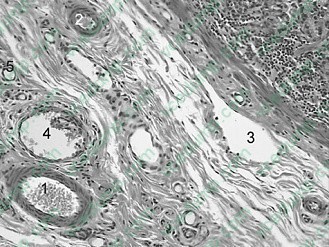
Clinical edema results when lymphatic vessels are blocked or when the volume of extracellular fluid exceeds the drainage capacity of the lymphatic vessels. Which of the following numbered structures in following figure is a lymphatic vessel?
A. 1 B. 2 C. 3 D. 4 E. 5
C. 3
Explanation
Section: Anatomy An irregular outline, a thin wall, and the lack of erythrocytes in the lumen characterize lymphatic vessel. Arterioles (choices A and B) have thicker walls and contain erythrocytes. Venules (choice D) are thin-walled but they contain erythrocytes. Capillaries (choice E) are small in diameter and they contain erythrocytes.
Question 377:
Infiltrating or invasive ductal cancer is the most common breast cancer histological type, comprising 7080% of all cases. Invasive breast cancers usually are epithelial tumors of ductal or lobular origin. Which of the following epithelia line the lactiferous ducts?
A. pseudostratified B. simple squamous C. stratified cuboidal D. stratified squamous E. transitional
C. stratified cuboidal
Explanation
Section: Anatomy The lactiferous duct is lined by a two-cell layered cuboidal epithelium. All other epithelial choices are not found in the breast tissue and are thus incorrect.
Question 378:
A 68-year-old woman presents with sleep disturbances and memory loss. After careful analysis, she is diagnosed with early stages of Alzheimer's disease. Her pharmacological treatment plan includes acetylcholine esterase inhibitors. One week after starting treatment, the woman's daughter calls in, reporting that her mom has developed new symptoms that might be related to her new medicine. Which of the following is a likely side effect of the drug?
A. dry mouth B. forgetting to urinate C. muscle weakness D. nausea and diarrhea E. vertigo
D. nausea and diarrhea
Explanation
Section: Physiology Increasing the lifetime of acetylcholine by inhibiting its enzymatic breakdown might help existing brain cells to work better. Studies found that Alzheimer patients at early stages might benefit from cholinergic therapy by small improvements in cognitive abilities and a delay in the progression of the disease. However, the side effects of acetylcholine therapy may outweigh the benefits of it. The increased concentration of acetylcholine at postsynaptic nerve endings of the parasympathetic nervous system can result in excessive stimulation of peripheral organ muscarinic and nicotinic receptors. Increased GI motility may occur resulting in nausea and diarrhea. For the same reason, increased salivation, not decreased as in choice A, and increased micturition, and not decreased as in choice B, are expected. Less common side effects include muscle cramps, not muscle weakness as in choice C, due to overstimulation of the cholinergic neuromuscular junction. Acetylcholine overdosing for an extensive time might eventually lead to muscle weakness due to desensitization of postsynaptic acetylcholine receptors, but this is not the best choice in this case. Vertigo (choice E) is the sensation that the room is spinning. Although neurological problems can always lead to kinetoses, there is no direct connection between acetylcholine esterase inhibitors and vertigo.
Question 379:
A 26-year-old man is found dead in his apartment. A neighbor, who had seen him the previous day, said that he appeared to be perfectly healthy at that time. The coroner performs an autopsy and the only significant finding is hyperinflation of the lungs with areas of atelectasis and thick mucus in the bronchioles. Microscopically, there is thickening of the bronchial epithelial basement membranes, hyperplasia of submucosal mucous glands and bronchial smooth muscle, and infiltration by eosinophils. All of these findings are consistent with which of the following diagnoses?
A. adult respiratory distress syndrome B. bronchiolitis obliterans--organizing pneumonia C. chronic bronchitis D. emphysema E. status asthmaticus
E. status asthmaticus
Explanation
Section: Pathology and Path physiology Characteristic microscopic findings in asthma are thickened basement membranes, hyperplasia of bronchial smooth muscle, hyperplasia of submucosal mucous glands, and the presence of eosinophils, all of which were seen in this case. The hyperinflation of the lungs and mucous plugging are common gross findings in someone dying in status asthmaticus. The principal microscopic finding in adult respiratory distress syndrome (choice A) is the formation of hyaline membranes rather than the changes described above. Idiopathic bronchiolitis obliterans with organizing pneumonia (BOOP) (choice B) is often a difficult clinical diagnosis to make and may require a lung biopsy which will show connective tissue forming in alveoli and distal bronchioles. Chronic bronchitis (choice C) shows hyperplasia of the bronchial mucous glands and fibrosis of bronchial walls. Emphysema (choice D) is marked by the loss of alveolar walls, leaving large irregular air spaces.
Question 380:
A 39-year-old woman reports headaches, weakness and fatigue, and frequent urination over the past several weeks. Physical examination reveals diastolic hypertension. Laboratory findings include hypokalemia and reduced rennin levels. Which of the following is the most likely cause of these various findings?
A. Conn syndrome B. diabetes insipidus C. diabetes mellitus D. pheochromocytoma E. polycystic renal disease
A. Conn syndrome
Explanation
Section: Pathology and Path physiology Primary aldosteronism caused by an aldosterone-secreting adrenal neoplasm is known as Conn syndrome. Excess aldosterone production leads to increased sodium retention and reciprocal potassium depletion in the renal distal tubule; polyuria results from impairment in urinary concentrating ability. Increased sodium reabsorption and associated extracellular fluid expansion lead to diastolic hypertension and suppression of the reninangiotensin pathway. Muscle weakness and fatigue are a consequence of hypokalemia, which may be severe in some cases. Diabetes insipidus (choice B) is marked by the fairly sudden onset of extreme polyuria and (for the central type) is due to decreased activity of antidiuretic hormone typically associated with an intracranial lesion or trauma. In diabetes mellitus (choice C), glucose levels exceed renal reabsorption capacity, leading to glycosuria and a consequent osmotic diuresis, hypovolemia, and pseudohyponatremia. Pheochromocytomas (choice D) are unilateral, solitary neoplasms most commonly arising from chromaffin cells in the adrenal medulla. Although biologically benign, excessive secretion of catecholamines causes paroxysmal systolic and diastolic hypertension that may reach life-threatening pressures. The adult form of polycystic renal disease (choice E) is an autosomal-dominant condition characterized by grossly enlarged bilateral kidneys containing numerous, and variably-sized expansile cysts. Hematuria, pyelonephritis, hypertension, and polyuria are common symptoms.
Nowadays, the certification exams become more and more important and required by more and more
enterprises when applying for a job. But how to prepare for the exam effectively? How to prepare
for the exam in a short time with less efforts? How to get a ideal result and how to find the
most reliable resources? Here on Vcedump.com, you will find all the answers.
Vcedump.com provide not only USMLE exam questions,
answers and explanations but also complete assistance on your exam preparation and certification
application. If you are confused on your USMLE-STEP-1 exam preparations
and USMLE certification application, do not hesitate to visit our
Vcedump.com to find your solutions here.