USMLE USMLE-STEP-1 Online Practice
Questions and Exam Preparation
USMLE-STEP-1 Exam Details
Exam Code
:USMLE-STEP-1
Exam Name
:United States Medical Licensing Step 1
Certification
:USMLE Certifications
Vendor
:USMLE
Total Questions
:847 Q&As
Last Updated
:May 25, 2026
USMLE USMLE-STEP-1 Online Questions &
Answers
Question 401:
A 45-year-old female patient develops Parinauds syndrome (vertical gaze palsy) and an MRI shows a large tumor of her pineal gland. The tumor is not only compressing her tectum, causing the vertical gaze palsy, but also obstructing the underlying cerebrospinal fluid pathway causing progressive noncommunicating hydrocephalus. The obstruction causes immediate accumulation of cerebrospinal fluid in which of the following?
A. cerebral aqueduct of Sylvius B. fourth ventricle C. lateral ventricle D. subarachnoid space E. third ventricle
E. third ventricle
Explanation
Section: Anatomy In this situation, the cerebrospinal fluid will accumulate immediately in the third ventricle and cause hydrocephalus. The flow of cerebrospinal fluid is normally from the lateral ventricles (choice C) to the third ventricle and then by way of the cerebral aqueduct of Sylvius (choice A) to the fourth ventricle (choice B). From there the cerebrospinal fluid flows out of the brain into the subarachnoid space (choice D). A blockage of the cerebral aqueduct will result in immediate accumulation of cerebrospinal fluid in the third ventricle. Because the cerebrospinal fluid no longer flows from the ventricular system to the subarachnoid space, the resulting hydrocephalus is termed noncommunicating.
Question 402:
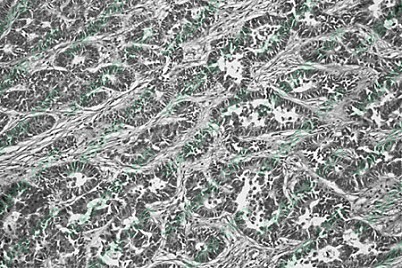
A 67-year-old woman notices a lump in her left supraclavicular area. The lesion is excised and a section of it is shown in below figure. The microscopic appearance is most consistent with which of the following diagnoses?
A. adenocarcinoma B. carcinoid C. fibroadenoma D. fibrosarcoma E. malignant fibrous histiocytoma
A. adenocarcinoma
Explanation
Section: Pathology and Path physiology The finding of an enlarged left supraclavicular lymph node (Virchow or signal node) should raise the question of an underlying GI malignancy. This is confirmed in the above case by the microscopic findings in figure. The pleomorphism of these cells and the fact that they are located in a lymph node indicate that these are malignant cells. Additionally, the glandular appearance identifies this as an adenocarcinoma metastatic to a lymph node. Carcinoid tumors (choice B) arise from neuroendocrine cells present in the mucosa throughout the GI tract. About 40% are found in the appendix, where they are benign in 99% of cases. Another 25% are found in the ileum. Of these, about 60% are malignant. If they metastasize to the liver, they can give rise to the carcinoid syndrome. Fibroadenoma (choice C) is the most common benign tumor of the female breast. Fibrosarcoma (choice D) and malignant fibrous histiocytoma (choice E) are both fibroblastic sarcomas; the photomicrograph clearly indicates a malignancy of epithelial (glandular) origin.
Question 403:
A 48-year-old woman comes to the doctor complaining of vague pains in the abdomen, legs, and thighs. Physical examination reveals no obvious signs of injury or trauma to account for the reported symptoms. If the woman told the doctor, "In spite of what you say, doctor, I know that I have a serious illness, probably cancer," which of the following would be the most appropriate next step in treatment?
A. ask why she thinks she has cancerB. tell her that she does not have cancer B. tell her that she has anxiety C. tell her that she has depression D. tell her to see a psychiatrist
A. ask why she thinks she has cancerB. tell her that she does not have cancer
Explanation
Section: Behavioral Science and Biostatics When a patient presents with a conviction that she has a serious illness, it is important to find out more about why the patient has the notion, because in the process the doctor may be able to diagnose emotional distress in the form of anxiety, depression, or simple misperception, as well as hypochondriasis. All the other choices (B, C, D, and E) bring about a premature closure.
Question 404:
A 60-year-old male patient is brought to the hospital following sudden onset of weakness and sensory loss in the right face and upper limb. The right lower limb is unaffected. An MRI scan would reveal signs of a stroke in which of the following areas?
A. in the territory of the left anterior cerebral artery B. in the territory of the left middle cerebral artery C. in the territory of the left posterior cerebral artery D. in the territory of the right middle cerebral artery E. in the territory of the right posterior cerebral artery
B. in the territory of the left middle cerebral artery
Explanation
Section: Anatomy Because the right side of the patient is affected, the stroke is in the territory of the left middle cerebral artery. This artery supplies the lateral aspect of the cerebral hemisphere, including portions of the pre- and postcentral gyri corresponding to the head, upper limb, and trunk on the primary motor (area 4 of Brodmann) and primary sensory (area 3,1,2 of Brodmann) cortical strips. These cortical control areas for the right lower limb are supplied by branches of the left anterior cerebral rtery (choice A), which is uninvolved in this case since the lower limb is intact. The left posterior cerebral artery (choice C) supplies the occipital and temporal lobes and is unaffected in this case. Since the right side of the brain controls the left side of the body and the patient is intact on the left side, none of the right side cerebral arteries (choices D and E) are involved.
Question 405:
What would be the appearance of invasives C. albicans in a Gram-stained abnormal vaginal smear?
A. arthrospores-alternating filled and empty B. branching mycelia C. budding yeast cells and hyphae D. endosporulating spherules E. single yeast cells
C. budding yeast cells and hyphae
Explanation
Section: Microbiology/Immunology Candida species are considered to be opportunistic microorganisms. They are normal or usual members of the skin, mucus membranes, and the GI tract. The risk of endogenous opportunistic infection is ever- present. In culture or tissue, candida species grow as oval, budding yeast cells (36 m) which stain blue in the Gram-stain procedure. They also form pseudohyphae when the buds grow, but fail to detach. C. albicans is dimorphic, being also able to produce true hyphae. Diagnostically, C. albicans will begin to form true hyphae (germ tubes) in serum at 37°C in the la boratory. With these characteristics in mind, choice C is correct. Alternating filled and empty arthrospores (choice A) is characteristic of coccidioides. Branching mycelia (choice B) is a general characteristic seen in any mold colony on agar and is not specific for candida. Endosporulating spherules (choice D) are also seen in tissue with coccidioides. Single yeast cells (choice E) may be occasionally seen with candida, but most candida spores will be associated with buds and pseudohyphae.
Question 406:
A 20-year-old man suffers a broken arm in a bicycle accident. After a cast is applied, he is to be discharged from the emergency department with a prescription for an analgesic to be used if over-the- counter acetaminophen or nonsteroidal anti-inflammatory drugs (NSAIDs) are not effective in providing pain relief. Which of the following is the best choice for prescription pain relief in this case?
A. codeine B. diphenoxylate C. meperidine D. methadone E. morphine
A. codeine
Explanation
Section: Pharmacology Excellent analgesia and significant addictive properties are associated with drugs that act at mu-type opioid receptors. Of the analgesics listed, codeine is a weak agonist at mureceptors, whereas the other opioid analgesics listed (choices C, D, and E) are full agonists. Therefore codeine (choice A) is less efficacious but also has the lowest addiction and abuse liability; it is therefore the agent of choice within this list. Diphenoxylate (choice B) is a congener of meperidine (and the primary component of Lomotil) that is used to control GI motility in diarrhea. At therapeutic dose levels, neither analgesia nor addiction is observed. Meperidine (choice C) is a synthetic mu-opioid receptor agonist with high- addiction liability. Methadone (choice D) is a mu-opioid receptor agonist with good oral efficacy and a long plasma half-life (1540 h). It is used in the treatment of opioid addiction and for severe cancer pain. Morphine (choice E) is the prototype muopioid receptor agonist and possesses highaddiction liability.
Question 407:
During surgery at the root of the neck, an attending surgeon cautions her resident to locate important structures which need to be protected. One of these is the phrenic nerve, responsible for the innervation of the diaphragm and thus, respiration. The phrenic nerve can be positively identified by which of the following anatomical relationships?
A. It is found immediately between the common carotid artery and the internal jugular vein. B. It lies immediately between the esophagus and the trachea. C. It lies on the scalenus medius muscle. D. It wraps around the right subclavian artery. E. The suprascapular and transverse cervical arteries cross over it anteriorly.
D. It wraps around the right subclavian artery.
Explanation
Section: Anatomy At the root of the neck, the phrenic nerve (C3, C4, C5) lies on the scalenus anterior muscle, not the scalenus medius (choice C). The transverse cervical and suprascapular arteries course over it. The vagus (tenth cranial) nerve, not the phrenic nerve is located between the common carotid artery and the internal jugular vein (choice A). The recurrent laryngeal branch from the vagus nerve wraps around the right subclavian artery (choice D), and courses cranially between the esophagus and the trachea (choice B).
Question 408:
A healthy 17-year-old male tells his doctor during a normal check-up visit that "his muscles gave out" when he recently attempted to lift a heavy load. On questioning, he answers that he did not experience any other neuromuscular problems after this experience. What is the most likely mechanism responsible for the abrupt cessation of skeletal muscle contraction?
A. activation of alpha motor neurons B. activation of gamma motor neurons C. activation of Golgi tendon organs D. activation of muscle spindles E. skeletal muscle ischemia
C. activation of Golgi tendon organs
Explanation
Section: Physiology When there is danger of damage to the tendons or bones to which the muscles are attached, Golgi tendon organs are activated and elicit rapid responses through neural connections located within the spinal cord that result in muscle relaxation. Golgi tendon organs are muscle proprioceptors that are found close to the junction between tendon and muscle fibers. They are in series with the muscle fibers and respond to the stretch of tendons which accompanies muscle tension. The threshold for activating them in this manner is high and it is therefore believed that they play an important role in the reflex response of a muscle after excessive force ("muscles give out"). In the spinal reflex pathways, the Ib afferent axons from the Golgi tendon organ synapse on inhibitory spinal cord interneurons, which then inhibit, not activate, alpha motor neuron activity serving the same muscles (choice A). Gamma motor neurons (choice B) innervate muscle spindles. These neurons control the sensitivity of the spindle by maintaining the proportions between spindle and muscle length and by dampening the function of the spindle, regardless of change in muscle length. This is important for normal movements. Muscle spindles (choice D) continuously signal information about the length of a muscle and the rate of change in length. They are important for conscious appreciation of the body's position, for planning and execution of controlled movements. Low oxygenation of the muscle or ischemia (choice E) is not the primary trigger for spinal reflexes, and will occur gradually, not suddenly as described in the question.
Question 409:
In an enzyme with a critical Glu residue in the active site, which of the following amino acid substitutions would be expected to have the least effect on enzyme activity?
A. Arg B. Asp C. Lys D. Ser E. Tyr
B. Asp
Explanation
Section: Biochemistry Glutamic acid is an acidic amino acid at physiologic pH and therefore, substitution for another acidic amino acid, such as aspartic acid, would be expected to have minimal effect on the activity of the enzyme. Arginine (choice A) and lysine (choice C) are both basic amino acids at physiologic pH and would not be able to substitute for an acidic amino acid. Serine (choice D) and tyrosine (choice E) both have ionizable hydroxyl groups but the pKa values of those hydroxyl groups would not favor substitution for an acidic amino acid.
Question 410:
A 14-year-old female presenting with polyuria is subsequently diagnosed with Type I diabetes mellitus. The polyuria results from an osmotic diuresis that involves primarily which part of the renal tubule?
A. collecting duct B. glomerulus C. juxtaglomerular apparatus D. proximal tubule E. thick ascending limb of the loop of Henle
Nowadays, the certification exams become more and more important and required by more and more
enterprises when applying for a job. But how to prepare for the exam effectively? How to prepare
for the exam in a short time with less efforts? How to get a ideal result and how to find the
most reliable resources? Here on Vcedump.com, you will find all the answers.
Vcedump.com provide not only USMLE exam questions,
answers and explanations but also complete assistance on your exam preparation and certification
application. If you are confused on your USMLE-STEP-1 exam preparations
and USMLE certification application, do not hesitate to visit our
Vcedump.com to find your solutions here.