USMLE USMLE-STEP-1 Online Practice
Questions and Exam Preparation
USMLE-STEP-1 Exam Details
Exam Code
:USMLE-STEP-1
Exam Name
:United States Medical Licensing Step 1
Certification
:USMLE Certifications
Vendor
:USMLE
Total Questions
:847 Q&As
Last Updated
:May 25, 2026
USMLE USMLE-STEP-1 Online Questions &
Answers
Question 311:
A 20-year-old woman with generally normal health and immune capacity visited her doctor complaining of 2 weeks of fever, sore throat, and cough. She had recently seen bloodstreaked sputum and had noticeable chest pain. X-rays showed only a moderate amount of pulmonary consolidation, while a cold agglutinin titer of 1:256 was reported. Which organism listed below is the most likely etiological agent?
A. Chlamydia pneunoniae B. Coxiella burnetii C. Legionella pneumophila D. Mycoplasma pneumonia E. Pneumocystis carinii
D. Mycoplasma pneumonia
Explanation
Section: Microbiology/Immunology "Walking" primary atypical pneumonia caused by M. pneumoniae can lead to formation of IgM antibodies called cold agglutinins, because they agglutinate type O human erythrocytes at 4°C. L. pneumophila (choice C), C. burnetii (choice B), P. carinii (choice E), and C. pneumoniae (choice A) may produce symptoms of pneumonia similar to those induced by M. pneumoniae, but normally these microbes are not associated with cold agglutinin formation.
Question 312:
A 75-year-old man has prostate cancer that has metastasized to bone. He is receiving hormonal therapy to slow progression of the neoplasm and codeine by mouth for pain when it is absolutely required, but still complains of severe pain. What should be given to this patient to address his symptom?
A. a strong NSAID such as naproxen as needed to supplement his codeine therapy B. additional codeine when he complains C. aspirin, and he should be told that additional narcotics cannot be used because he would become tolerant of their analgesic action D. morphine in a long-acting oral preparation on a regular schedule and parenteral morphine when pain breaks through E. parenteral morphine when pain requires it
D. morphine in a long-acting oral preparation on a regular schedule and parenteral morphine when pain breaks through
Explanation
Section: Pharmacology Pain of malignancy is still a badly undertreated condition, due to misunderstanding of the nature of opioid tolerance and addiction and an unwillingness to deal with the complications of prescribing controlled substances. Codeine has limited maximum efficacy, so additional doses of this drug (choice B) are unlikely to control this patient's pain. It was previously thought that regular use of strong opioids for any purpose inevitably led to tolerance and a loss of analgesic effect, as well as addiction (choice C).
However, excellent clinical studies have shown that this is not the case. Regular use as opposed to as-needed use) of small to moderate doses of opioids effectively controls pain in most cases without causing tolerance or addiction. In fact, restricting opioids to use only when absolutely needed results in larger total analgesia requirements and greater toxicity. Use of NSAIDs (choice A) should be started early, when pain is mild and supplemented with oral opioids, such as codeine, as soon as it becomes necessary. NSAIDs are not adequate at this stage of this patient's disease. Parenteral morphine, given when necessary (choice E), is as not as effective as regularly scheduled morphine and leads to greater drug toxicity.
Question 313:
Apatient presents with long-standing emphysema. Which of the following would you expect to see in this individual?
A. decreased physiological dead space B. increased FEV1/FVC C. increased FRC D. increased FVC E. increased lung elastic recoil
C. increased FRC
Explanation
Section: Physiology Destruction of lung tissue is a hallmark of emphysema. Due to this loss of elastic tissue, lung elastic recoil is decreased. Decreased elastic recoil (not increased, choice E) shifts the mechanical balance point between chest wall and lung to a higher volume--FRC is, therefore, increased. The barrel chest is characteristic of emphysema. Destruction of alveolar walls impairs gas exchange, causing an increase in physiological dead space (choice A). Tissue loss also causes a loss of radial traction with an increase in airway resistance--FVC is decreased (choice D). Emphysema is one type of chronic obstructive pulmonary disease. A decrease in the FEV1/FVC is characteristic of an obstructive disease (choice B).
Question 314:
Over the past few months, a 5-year-old boy has developed changes suggestive of puberty. Physical examination reveals the presence of secondary sex characteristics including pubic hair and penile enlargement. Laboratory studies reveal increased levels of ACTH. If you were able to examine his adrenals, which of the following would you most likely find?
A. bilateral atrophy of the cortex B. bilateral atrophy of the medulla C. bilateral cortical hyperplasia D. bilateral medullary hyperplasia E. nodule in the cortex F. nodule in the medulla
C. bilateral cortical hyperplasia
Explanation
Section: Pathology and Path physiology This child has one of a group of unusual diseases (congenital adrenal hyperplasia) in which there is an inherited deficiency of an enzyme in the biosynthetic pathway for the corticosteroids; most of these cases are due to a partial deficiency of 21-hydroxylase. The decreased feedback inhibition to the pituitary results in increased production of ACTH, resulting in bilateral adrenal cortical hyperplasia. Impairment of corticosteroid synthesis shunts more substrate into the sex steroid pathway, leading to increased production of androgens (resulting in precocious puberty or virilism in a female child). Bilateral atrophy of the cortex (choice A) has a number of causes. Primary causes are unusual and tend to affect both glucocorticoid and mineralocorticoid production; however, secondary causes (e.g., exogenous steroids) are more common and tend to affect only glucocorticoid production. Precocious puberty is not seen. Bilateral atrophy of the medulla (choice B) with a normal cortex would be extremely unusual and would not be expected to produce precocious puberty. Bilateral medullary hyperplasia (choice D) has been reported but is very unusual and would also not produce precocious puberty. Anodule in the cortex (choice E) could be either a hyperplastic nodule or an adenoma. The former is asymptomatic and the latter is most unlikely to produce precocious puberty but, if it did, would probably also demonstrate hypercortisolism, which is not seen in this patient. A nodule in the medulla (choice F) could be a small, early pheochromocytoma but this would not produce precocious puberty.
Question 315:
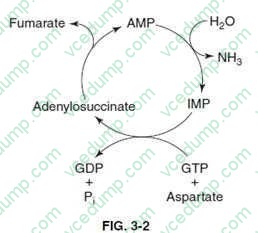
The metabolic pathway depicted in below figure is critically important as a means of energy production in skeletal muscle cells. Which of the following correctly identifies this pathway?
A. ADA cycle B. hypoxanthine-guanine phosphoribosyltransferase (HGPRT) cycle C. nonoxidative cycle in pentose phosphate pathway D. purine nucleotide cycle E. urea cycle
D. purine nucleotide cycle
Explanation
Section: Biochemistry The synthesis of AMP from IMP and the salvage of IMP via AMP catabolism have the net effect of deaminating aspartate to fumarate. This process has been termed the purine nucleotide cycle. This cycle is very important in muscle cells. Increases in muscle activity create a demand for an increase in the TCA cycle, to generate more NADH for the production of ATP. However, muscle lacks most of the enzymes of the major anapleurotic reactions. Muscle replenishes TCA cycle intermediates in the form of fumarate generated by the purine nucleotide cycle. There is no HGPRT or ADA cycle and hence, choices Aand B do not represent valid options. Choices C and E constitute pathways that do not involve nucleotides.
Question 316:
Which of the following is the most characteristic element of managed care?
A. Capitated payment. B. That it emphasizes prevention and health promotion. C. That it is a fee-for-service system. D. That it provides primary care. E. That physicians may be salaried.
A. Capitated payment.
Explanation
Section: Behavioral Science and Biostatics Managed care involves an entity (company, state, organization) managing health care through a capitated (head count) payment system. Within the managed care system, there are various models including specialized care and fee for service in addition to capitation.
Question 317:
Apatient calls 911 because of severe substernal crushing pain that has not responded to three nitroglycerin tablets taken sublingually. The paramedic team suspects that the patient has suffered an acute myocardial infarction. His blood pressure is 110/70 and his heart rate is 70, with occasional premature extra beats. After initial treatment in the hospital, the patient. is found to be suffering from more severe hypotension (his blood pressure is now 70/40) and reduction of cardiac function with reduced left ventricular ejection fraction. His urine output is low and he has mental clouding. Which of the following is the pharmacologic treatment of choice for this condition in this patient?
A. atenolol B. digoxin C. dopamine D. norepinephrine E. procainamide
C. dopamine
Explanation
Section: Pharmacology The description of the patient's reduced cardiac function and elevated left ventricular filling pressure, with reduced peripheral perfusion (clouded mentation, reduced urine output) indicates cardiogenic shock, decreased blood pressure due to decreased cardiac output. In cardiogenic shock, a drug is needed that increases myocardial contractility without increasing heart rate and peripheral resistance. In addition, renal artery dilation is desirable to prevent renal shutdown. Dopamine (choice C), an agonist at dopamine, beta-, and alphaadrenoceptors, increases myocardial contractility with little increase in peripheral resistance and lower renal arterial resistance. Atenolol (choice A), a beta-1-selective blocker, is inappropriate in the setting of reduced cardiac function, although it may be quite appropriate later when the patient's condition is stabilized. Digoxin (choice B), a cardiac glycoside, may increase cardiac contractility but has a slow onset of action and may exacerbate arrhythmias. Norepinephrine (choice D) increases myocardial contractility but also greatly increases peripheral resistance, a situation that must be avoided in cardiogenic shock. Procainamide (choice E), a group IA antiarrhythmic agent, is not indicated because the patient does not have an arrhythmia.
Question 318:
Following a relatively normal early developmental period, a 6-month-old boy becomes pale and lethargic and begins to show signs of deteriorating motor skills. The infant has severe megaloblastic anemia; however, serum measurements of iron, folate, vitamins and demonstrate they are
within normal range. Urine samples were clear when fresh, but when left to stand for several hours showed an abundant white precipitate that was composed of fine needle-shaped crystals. Analysis of the crystals identified them as orotic acid. Significant improvement is observed in the infant following oral administration of a nucleoside. Which of the following is most likely the nucleoside used?
A. adenosine B. cytidine C. guanosine D. thymidine E. uridine
E. uridine
Explanation
Section: Biochemistry Hereditary orotic aciduria results from a defect in the de novo synthesis of pyrimidines. The defect is in the bifunctional enzyme that catalyzes the last two steps in the de novo pathway, conversion of orotic acid to OMP and OMP to UMP. Administration of uridine allows afflicted individuals to produce sufficient levels of cytidine nucleotides via the salvage pathways. Treatment with uridine leads to a return of normal blood hemoglobin levels, and bone marrow will become normoblastic. Treatment with cytidine (choice B) has some limited ability to ameliorate symptoms of the disease, but not to the extent of uridine administration. None of the other nucleosides (choices A, C, and D) can be salvaged into cytidine or uridine nucleotides, and are therefore of no clinical value in the treatment of hereditary orotic aciduria.
Question 319:
The level of iron in the body must be tightly regulated due to the severe toxicity associated with elevated levels in the circulation and within cells. Which of the following proteins is primarily responsible for iron homeostasis?
A. ceruloplasmin B. ferritin C. haptoglobin D. metallothionein E. transferrin
E. transferrin
Question 320:
A 27-year-old man was treated with penicillin for gonorrhea. Thirty-five days later he was reinfected with the same germ, and his physician administered an intramuscular dose of penicillin. Two minutes following the injection of penicillin, the patient experienced hypotension and shock and became unconscious. This reaction was most likely mediated by which of the following?
A. activation of the alternate complement pathway B. activation of the classical complement C. IgD D. IgE E. IgG
D. IgE
Explanation
Section: Microbiology/Immunology Anaphylaxis triggered by penicillin is an immediate hypersensitivity reaction, which is typically mediated by IgE antibodies. IgE antibodies bind to specific Fc receptors on the surface of mast cells and basophils. Upon cross-linking of the IgE antibodies with their specific antigen (penicillin in this case), mast cells and basophils release histamine within minutes along with other pharmacologically active shock mediators which produce the characteristic symptoms of anaphylaxis. Activation of either the classical (choice B) or the alternate complement pathway (choice A) does not play any meaningful role in anaphylaxis. IgD (choice C) and IgG (choice E) are not involved in anaphylactic reactions.
Nowadays, the certification exams become more and more important and required by more and more
enterprises when applying for a job. But how to prepare for the exam effectively? How to prepare
for the exam in a short time with less efforts? How to get a ideal result and how to find the
most reliable resources? Here on Vcedump.com, you will find all the answers.
Vcedump.com provide not only USMLE exam questions,
answers and explanations but also complete assistance on your exam preparation and certification
application. If you are confused on your USMLE-STEP-1 exam preparations
and USMLE certification application, do not hesitate to visit our
Vcedump.com to find your solutions here.