USMLE USMLE-STEP-1 Online Practice
Questions and Exam Preparation
USMLE-STEP-1 Exam Details
Exam Code
:USMLE-STEP-1
Exam Name
:United States Medical Licensing Step 1
Certification
:USMLE Certifications
Vendor
:USMLE
Total Questions
:847 Q&As
Last Updated
:May 25, 2026
USMLE USMLE-STEP-1 Online Questions &
Answers
Question 301:
Exhibit:
Please refer to the exhibit.
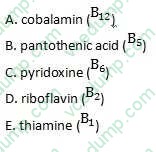
When fatty acids with odd numbers of carbon atoms are oxidized in the beta-oxidation pathway the final product is 1 mole of acetyl- CoA and 1 mole of the 3-carbon molecule, propionyl-CoA. In order to use the propionyl carbons, the molecule is carboxylated and converted ultimately to succinyl-CoA and fed into the TCA cycle. Which of the following represents the vitamin cofactor required in one of the steps of this conversion?
A. A B. B C. C D. D E. E
A. A
Explanation
Section: Biochemistry Propionyl-CoA is converted to succinyl- CoAin a series of reactions using three different enzymes. It is first carboxylated in an ATPdependent reaction catalyzed by propionyl- CoA carboxylase, an enzyme that requires biotin as a cofactor. The product of the first reaction, d-methylmalonyl-CoA is then converted to l- methylmalonyl-CoA by methylmalonyl-CoA racemase. Finally, methylmalonyl-CoA is converted to succinyl- CoA by the cobalaminrequiring enzyme, methylmalonyl-CoA mutase. None of the other vitamins (choice B, C, D, and E) are required in this pathway.
Question 302:
A 57-year-old woman had her last menstrual period at the age of 46. However, for the past 4 months she has experienced intermittent vaginal hemorrhage. A right ovarian mass is identified. Which of the following is the most likely diagnosis?
A. arrhenoblastoma B. Brenner tumor C. dysgerminoma D. granulosa cell tumor E. Sertoli-Leydig cell tumor F. teratoma
D. granulosa cell tumor
Explanation
Section: Pathology and Path physiology An ovarian mass raises the possibility of a tumor and vaginal hemorrhage in a postmenopausal woman and suggests an estrogenproducing tumor. One of the first estrogenproducing tumors to consider is granulosa cell tumor. Arrhenoblastoma (Sertoli-Leydig cell tumor) (choice A) secretes androgens, not estrogens. Brenner tumor (choice B) is an uncommon ovarian neoplasm without hormonal activity. Dysgerminoma (choice C) is the female counterpart of the male seminoma and does not produce hormones. Sertoli-Leydig cell tumor (choice E) is a synonym for arrhenoblastoma (choice A).
Teratoma (choice F) is also hormonally inactive.
Question 303:
Your patient presents in your office complaining of hoarseness. During your examination, you find that one vocal fold has deviated toward the midline and does not abduct during deep inspiration or vocalization. You also observe that touch sensation in the vestibule of the larynx appears to be intact. Which laryngeal muscle is most important in abduction of the vocal folds?
A. cricothyroid B. lateral cricoarytenoid C. posterior cricoarytenoid D. thyroarytenoid E. transverse arytenoid
C. posterior cricoarytenoid
Explanation
Section: Anatomy The vocal folds are abducted and the rima glottidis is widened by the posterior cricoarytenoid muscles that rotate the arytenoid cartilages laterally. The cricothyroid muscles (choice A) tense and lengthen the vocal ligament by tilting the thyroid cartilage forward. The lateral cricoarytenoid muscles (choice B) adduct the vocal folds by medially rotating the arytenoid cartilages. The thyroarytenoid muscles (choice D) decrease the tension and length of the vocal ligaments by tilting the thyroid cartilages posteriorly.
The transverse arytenoids muscle (choice E) adducts the vocal folds by pulling the arytenoid cartilages together.
Question 304:
A 33-year-old male who practices veterinary medicine in Fresno (central California) is seen in the emergency room with chills, high fever, persistent unproductive cough, and generalized malaise. Physical examination reveals no evidence of pharyngitis, sinusitis, or otitis media. The patient does not have a rash and vehemently proclaims that he has not been bitten by any vectors. On his 10-acre farm, he raises sheep, chickens, turkeys, ostriches, and emus. Acomplement fixation assay for Coxiella is negative. Given the PE and history, which of the following is the most likely etiologic agent?
C. trachomatis D. Ehrlichia canis E. Rickettsia typhi
B
Explanation
Section: Microbiology/Immunology The term "psittacosis" is applied to the human disease acquired from contact with birds. "Ornithosis" is applied to infections associated with all types of domestic and free-living birds. In humans, C. psittaci (choice B) produces a range of clinical manifestations ranging from severe pneumonia and sepsis to mild, inapparent infection. A sudden onset of illness taking the form of influenza or nonbacterial pneumonia in a person exposed to birds is suggestive of psittocosis/ornithosis. Such infections will respond to tetracycline treatment. C. trachomatis (choice C) is transmitted person to person and is associated with ocular, genital, and some respiratory infections. C. pneumonia (choice A) is the newest chlamydia species which usually presents with asymptomatic or mild illnesses. Ehrlichiae (choice D) are small, gram-negative bacilli (similar to rickettsiae) that cause nonspecific disease symptoms, fever, chills, headache, vomiting, weight loss, with few reports of respiratory problems. R. typhi (choice E) causes endemic typhus with symptoms similar to those of choice D. Rickettsiae are usually transmitted by insect vectors.
Question 305:
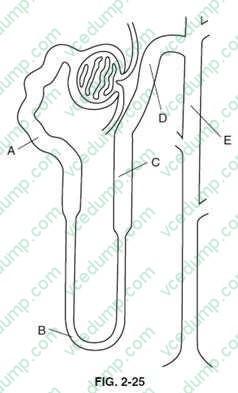
A 68-year-old postmenopausal female with a history of osteoprosis and essential hypertension is placed on the thiazide diuretic chlorothiazide, which has a beneficial action toward both conditions. Which letter in below figure depicts the tubular location of epithelial cells containing a / cotransport
protein inhibited by thiazide diuretics?
A. A B. B C. C D. D E. E
D. D
Question 306:
A 3-year-old girl develops gastroenteritis and a number of other children at the day care nursery that she attends are also affected. This was most likely caused by which of the following agents?
A. Balantidium coli B. Cryptosporidium parvum C. Entamoeba histolytica D. Giardia lamblia E. rotavirus
E. rotavirus
Explanation
Section: Pathology and Path physiology Rotavirus is the most common cause of severe diarrhea worldwide and is most widespread in very young children. It is passed readily to others and can result in outbreaks such as described here. B. coli (choice A) is a ciliated intestinal protozoal parasite that is found mostly in the tropics. It is a rare cause of diarrhea in the United States. C. parvum (choice B) is a spore-forming protozoan that can cause severe diarrhea in immunocompromised individuals. E. histolytica (choice C) is another protozoan parasite. It infests the colon forming flask-shaped ulcers (i.e., having narrow neck and a wide base that undermines the adjacent mucosa). These organisms can also be carried in the portal circulation to the liver where they form characteristic "anchovy paste" abscesses. G. lamblia (choice D) is an intestinal flagellate that infests the upper small intestine. It is very common worldwide and is the most common intestinal protozoan parasite in the Western world. The majority of infected individuals remain asymptomatic but it can cause diarrhea that is usually mild but can be severe.
Question 307:
An elderly patient was hospitalized with severe flu. An enveloped virus was isolated from this patient. Which of the following pertains to this RNA virus with a segmented, negative-sense genome?
A. can have direct viral genome and host cell ribosome interaction B. cannot possess a lipid envelope C. must contain a DNA-dependent RNA polymerase D. must contain an RNA-dependent DNA polymerase E. must contain an RNA-dependent RNA polymerase
E. must contain an RNA-dependent RNA polymerase
Explanation
Section: Microbiology/Immunology The patient was hospitalized due to severe influenza symptoms, and an influenza virus was isolated from clinical specimen. Isolation of the etiologic virus would not change the way medical care was being given to the individual. Influenza viruses have an RNA genome comprising of eight segments, each coding for one or more viral components. Influenza viral genomes are also negative-sense, meaning that within the virus particle, there must be an RNA-dependent RNA polymerase to allow the virus growth cycle to make viral mRNA and viral genomic RNA (choice E). There would be no use for a DNA-dependent RNA polymerase (choice C) or an RNA-dependent DNA polymerase (choice D). Since the influenza virus uses the host cell as a factory to produce new viral progeny, host cell ribosomes would be utilized for viral protein production (choice A) but by definition, negative-sense RNA cannot act as mRNA. Therefore, RNA from the virion could not directly interact with host cell ribosomes. Influenza viruses possess a well-defined lipid envelope (choice B), where the HA and NAglycoproteins are found.
Question 308:
A 38-year-old man has been treated for myasthenia gravis with pyridostigmine and propantheline for 8 years. He has had the "flu" for 10 days and his wife calls reporting that he now has serious muscle weakness. What should be administered after admitting this patient to the emergency department?
A. atropine to reverse the effects of an overdose B. a test dose of edrophonium C. pralidoxime on the assumption that he inadvertently overdosed D. the daily dose of pyridostigmine on the assumption that he forgot to take his medication E. tubocurarine
B. a test dose of edrophonium
Explanation
Section: Pharmacology Myasthenia gravis is an autoimmune disease attributable to an impairment of nicotinic receptor function at the neuromuscular junction by antireceptor antibodies. Treatment consists of increasing the junctional concentration of acetylcholine with a carbamate anticholinesterase such as pyridostigmine. Infections such as influenza may change the anticholinesterase dose requirement in myasthenia either up or down. As in this patient, the problem is to distinguish whether the muscle weakness is attributable to myasthenic crisis (too little medication) or cholinergic crisis (too much medication); both conditions cause muscle weakness. The safest definitive method is to administer a small dose of the short-acting anticholinesterase edrophonium (choice B). If the patient is in myasthenic crisis, an immediate improvement in muscle function should be evident. If the patient is in cholinergic crisis, the patient's condition may worsen, but because the duration of action for edrophonium is only 510 min, this test provides less risk than other alternatives. Parenteral atropine should be available to treat excess parasympathetic activity. Atropine for symptoms of parasympathetic overdose (choice A) is inappropriate because this patient is being treated with the muscarinic antagonist propantheline and atropine will have no effect on his muscle weakness. Administration of pralidoxime (choice C) is incorrect because pralidoxime is useful for reactivation of cholinesterase only in the case of recent organophosphate intoxication.
Administration of pyridostigmine (choice D) is unwise because a patient in cholinergic crisis is put at risk of exacerbation and extension of the toxic episode for a significant period of time. Administration of a test dose of a long-acting agent such as tubocurarine (choice E) to elicit muscle weakness is a provocative test that is dangerous and does not provide definitive evidence for diagnosis.
Question 309:
Acollege freshman exhibits symptoms of fever, malaise, sore throat, and fatigue. She also has enlarged lymph nodes and spleen and large, atypical T-lymphocytes. Which of the following tests can be used to confirm which virus is the etiologic agent?
A. antibody that reacts with Epstein-Barr virus (EBV)-associated nuclear antigen B. antibody to hemagglutinin C. antibody to neuraminidase (NA) D. heterophile antibody that reacts with antigens on sheep erythrocytes E. nucleic acid hybridization assays for the presence of Epstein-Barr viral nucleic acid
E. nucleic acid hybridization assays for the presence of Epstein-Barr viral nucleic acid
Explanation
Section: Microbiology/Immunology Infectious mononucleosis is caused by EBV, which is a member of the herpesviruses. Nucleic acid hybridization assays for EBV DNAare the most sensitive means of diagnosing infectious mononucleosis. Hemagglutinins (choice B) and NAs (choice C) are associated with orthomyxoviruses and paramyxoviruses. The majority of infectious mononucleosis patients develop what is known as an heterophile antibody, antibodies that cross-react with unrelated antigens, such as those found on sheep and horse erythrocytes. The heterophile antibody test (choice D) is used for the diagnosis of infectious mononucleosis, but since it is not a very specific test, it is not as good as the nucleic acid hybridization assays for the presence of Epstein-Barr viral nucleic acid. Important antigens that also may be used, but which are less sensitive for diagnostic purposes, include the viral capsid protein (VCA), the early proteins (EA), and the EBV-associated nuclear antigen (EBNA). Infectious mononucleosis patients develop antibody titers exceeding 1:320 and 1:20 against VCA and EA, respectively, during the acute phase of infectious mononucleosis. Antibodies to EBNA develop 12 months after acute infection (choice A).
Question 310:
A 37-year-old rural female patient developed pain in the lower abdomen and pelvic regions. Her physician suspects a ruptured ectopic pregnancy. However, because of the isolation of the rural community, no medical imaging or laboratory procedure is available and the physician decides to perform a culdocentesis. In the latter procedure, the needle will aspirate from which of the following spaces?
A. ovarian fossa B. rectouterine pouch C. uterine body D. uterine cervix E. vesicouterine pouchAnswer:
B. rectouterine pouch
Explanation
Section: Anatomy In culdocentesis, the needle is inserted through the posterior fornix of the vagina and fluid is aspirated from the rectouterine pouch. If nonclotting blood is collected then the likelihood of a ruptured ectopic pregnancy is high. This procedure is rapid and inexpensive, however, serum progesterone level assay or ultrasonography are preferred methods. The ovarian fossa (choice A) or vesicouterine pouch (choice E) are not used in culdocentesis. The uterine body (choice C) and cervix (choice D) would not reveal blood from a ruptured ectopic pregnancy and thus are also not used in culdocentesis.
Nowadays, the certification exams become more and more important and required by more and more
enterprises when applying for a job. But how to prepare for the exam effectively? How to prepare
for the exam in a short time with less efforts? How to get a ideal result and how to find the
most reliable resources? Here on Vcedump.com, you will find all the answers.
Vcedump.com provide not only USMLE exam questions,
answers and explanations but also complete assistance on your exam preparation and certification
application. If you are confused on your USMLE-STEP-1 exam preparations
and USMLE certification application, do not hesitate to visit our
Vcedump.com to find your solutions here.