USMLE-STEP-1 Exam Details
-
Exam Code
:USMLE-STEP-1 -
Exam Name
:United States Medical Licensing Step 1 -
Certification
:USMLE Certifications -
Vendor
:USMLE -
Total Questions
:847 Q&As -
Last Updated
:May 25, 2026
USMLE USMLE-STEP-1 Online Questions & Answers
-
Question 331:
Creatinine clearance is often used to evaluate glomerular function. Which of the curves in below figure best represents the relationship between plasma creatinine concentration and creatinine clearance in a normal healthy person?
A. A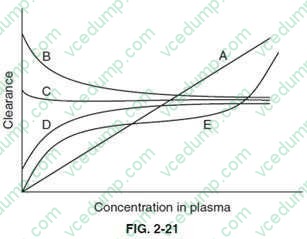
B. B
C. C
D. D
E. E -
Question 332:
Which of the following will be observed in a person who is deficient in interleukin-1 synthesis?
A. difficulty with immunoglobulin isotypic switching
B. dependence on endotoxin for the induction of febrile responses
C. effective mediation of acute phase responses
D. effective regulation of vascular shock
E. tendency to develop intense inflammatory reactions -
Question 333:
A 32-year-old male cyclist is struck at night by a hit-and-run motorist. He is unconscious and severely injured and is not discovered until a pedestrian walks by 2 or 3 hours later. When he arrives at the emergency room, he is in shock and his BP is 80/30 mm Hg. He is transfused and a large wound on his right leg is cleaned and sutured. However, by the next day his urine output has decreased to less than 20 mL/h. Which of the following microscopic descriptions best describes his kidneys at this time?
A. acute PMN infiltration of tubules and interstitium
B. fibrinoid necrosis of arterioles
C. focal tubular necrosis with pigmented cellular casts
D. interstitial mononuclear infiltrate with "thyroidization"
E. wedge-shaped areas of coagulative necrosis -
Question 334:
The hands and nails of a 45-year-old woman show the discolorations indicated in below figure. The woman states that she had pulmonary tuberculosis about 10 years ago. The clinician prescribes cortisol, but counsels her that as a side effect it might lead to thin skin and thinning of her limbs because of an increase in which of the following?
A. adrenocorticotropic hormone (ACTH) secretion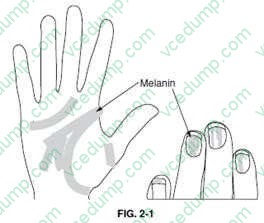
B. corticotrophin-releasing hormone (CRH) secretion
C. insulin sensitivity in muscle
D. protein degradation
E. wound healing -
Question 335:
Exhibit: *missing* In below figure, which point depicts the renal filtered glucose in an 11-year-old male with untreated Type I diabetes mellitus?
A. A
B. B
C. C
D. D
E. E -
Question 336:
A 21-year-old woman presents with a 6-hour history of left-sided lower abdominal pain and is found to be hypotensive. A hemorrhagicmass is discovered in her left fallopian tube during laparoscopy. The tube is surgically excised. A photomicrograph of the tubal contents is displayed in below figure. Which of the following is the most likely diagnosis?
A. chorioadenoma destruens
B. choriocarcinoma
C. ectopic tubal pregnancy
D. granular cell tumor
E. leiomyoma -
Question 337:
Which of the following chemotherapeutic agents' mechanisms of action involve inhibition of thymidylate synthase and incorporation into RNA?
A. anastrozole
B. cytarabine
C. doxorubicin
D. 5-fluorouracil
E. imatinib -
Question 338:
According to Piaget, in which of the following do children of middle teenage years typically engage?
A. abstract thinking
B. circular reactions
C. cognitive map
D. concrete operations
E. preoperational activities -
Question 339:
A patient with untreated diabetes mellitus is admitted to the hospital for treatment. Laboratory findings include a blood pH below 7.2. Which of the following is likely to directly result from this level of acidemia?
A. arteriolar constriction
B. decreased catabolism
C. hyperkalemia
D. hypoventilation
E. insulin sensitivity -
Question 340:
Achild born and raised in Chicago planned to spend the summer on a relative's fruit farm and help with the harvest. The summer passed uneventfully, but several days after the harvest began the child became jaundiced and very sick. On admission to the hospital the following clinical findings were recorded: in addition to the expected hyperbilirubinemia, the patient was hypoglycemic, had a markedly elevated rise in blood fructose concentration, and was hyperlactic acidemic. Further history taking revealed that during the harvest it was customary for the family to indulge in fruit-filled meals and to snack freely on fruit while carrying out the harvest. The following conclusions were reached. The elevated blood fructose was due to which of the following?
A. an allergic reaction to constituents in the fruit diet
B. defective hepatic fructokinase
C. defective hepatic glucokinase
D. defective hepatic fructose-1-phosphate aldolase (aldolase B)
E. defective hepatic fructose-1,6-bisphosphate aldolase (aldolase A)
Tips on How to Prepare for the Exams
Nowadays, the certification exams become more and more important and required by more and more enterprises when applying for a job. But how to prepare for the exam effectively? How to prepare for the exam in a short time with less efforts? How to get a ideal result and how to find the most reliable resources? Here on Vcedump.com, you will find all the answers. Vcedump.com provide not only USMLE exam questions, answers and explanations but also complete assistance on your exam preparation and certification application. If you are confused on your USMLE-STEP-1 exam preparations and USMLE certification application, do not hesitate to visit our Vcedump.com to find your solutions here.