USMLE USMLE-STEP-1 Online Practice
Questions and Exam Preparation
USMLE-STEP-1 Exam Details
Exam Code
:USMLE-STEP-1
Exam Name
:United States Medical Licensing Step 1
Certification
:USMLE Certifications
Vendor
:USMLE
Total Questions
:847 Q&As
Last Updated
:May 25, 2026
USMLE USMLE-STEP-1 Online Questions &
Answers
Question 281:
A 6-year-old child has a long history of a hereditary bleeding disorder characterized by spontaneous nontraumatic hemorrhages into joint spaces, skeletal muscle, and mucous membranes. Laboratory studies reveal a normal prothrombin time, elevated partial thromboplastin time, very low factor VIII, normal factor X, normal factor XI, and normal platelet aggregation studies with ristocetin. Which of the following is the most likely diagnosis?
A. Christmas disease B. hemophilia A C. hemophilia B D. Rosenthal syndrome E. von Willebrand disease
B. hemophilia A
Explanation
Section: Pathology and Path physiology Hemophilia A is a genetic disorder characterized by very low levels of factor VIII, elevated partial thromboplastin time, normal prothrombin time, normal platelet aggregation with ristocetin, and spontaneous hemorrhages into joints, soft tissues, and mucosal surfaces. Christmas disease (choice A) is an alternative term for hemophilia B. Hemophilia B (choice C) is a hereditary coagulopathy due to a very low level of factor IX. Rosenthal syndrome (choice D) defines a deficiency of factor XI. von Willebrand disease (choice E) is characterized by a mild hereditary bleeding diathesis and abnormal platelet aggregation with ristocetin.
Question 282:
Following a minor respiratory illness, a seemingly healthy, developmentally normal 15-month-old boy exhibited repeated episodes of severe lethargy and vomiting following periods of fasting, such as during the middle of the night. The parents brought the infant to the emergency room following a seizure. The child was hypoglycemic and was administered 10% dextrose, but remained lethargic. Blood ammonia was high, liver function tests were slightly elevated, and his serum contained an accumulation of dicarboxylic acids. Only low levels of ketones were detecteable in the urine. This infant suffers from which of the following disorders?
A. glutaric acidemia type II B. Lesch-Nyhan syndrome C. MCAD deficiency D. pyruvate dehydrogenase (PDH) deficiency E. type III (Cori) glycogen storage disease
C. MCAD deficiency
Explanation
Section: Biochemistry Deficiency in MCAD is the most common inherited defect in the pathways of mitochondrial fatty acid oxidation. The most common presentation of infants with this disorder is episodic hypoketotic hypoglycemia following periods of fasting. Although the first episode may be fatal, and incorrectly ascribed to sudden infant death syndrome, patients with MCAD deficiency are normal between episodes and are treated by avoidance of fasting and treatment of acute episodes with intravenous glucose. Accumulation of acylcarnitines (dicarboxylic acids) is diagnostic, in particular octanoylcarnitine. Glutaric acidemia type II (choice A) results from a defect in electron transfer flavoproteinubiquinone oxidoreductase and presents with symptoms of hypoketotic hypoglycemia as in the case of MCAD deficiency. However, this disorder manifests within the first 2448 h after birth and is frequently associated with congenital anomalies. Lesch- Nyhan syndrome (choice B) results from a defect in HGPRT--an enzyme involved in nucleotide metabolism. Symptoms of Lesch-Nyhan syndrome include hyperuricemia, bizarre neurobehavioral manifestations, growth retardation, and anemia. Deficiency in PDH (choice D) results in lactic acidemia, which can be quite severe at birth leading to neonatal fatality. Milder deficiency results in lactic acidemia associated with profound psychmotor retardation. Cori disease (choice E) results from a defect in the glycogen debranching enzymes. Clinical features include hepatomegaly, hypoglycemia, skeletal myopathy and short stature, and cardiomyopathy.
Question 283:
A 26-year-old management consultant has recently eaten raw oysters on three occasions. The patient has always been healthy, but suddenly developed fatigue, loss of appetite, nausea, vomiting, abdominal pain, and fever. Following a careful evaluation, his doctor informed him that he is suffering from a viral infection. This infection was caused by a small (2030 nm), non-enveloped, single-stranded RNA virus. This virus is most likely which of the following?
A. adenovirus B. hepatitis A virus C. hepatitis B virus D. rhinovirus E. rotavirus
B. hepatitis A virus
Explanation
Section: Microbiology/Immunology Hepatitis virus A is a small (2030 nm), non-enveloped, single-stranded RNA virus. The virus is transmitted via the fecaloral route, usually by eating contaminated foods, such as oysters grown in polluted waters. The symptoms of hepatitis A infection include fatigue, loss of appetite, nausea, vomiting, abdominal pain, fever, and jaundice. The urine excreted from patients with jaundice may be dark and the feces pale. Adenovirus is a non-enveloped, double-stranded, linear DNA virus. It is transmitted by respiratory secretions, and it causes pharyngitis, conjunctivitis, keratoconjunctivitis, pneumonia, and gastroenteritis (choice A). Hepatitis B is an enveloped, partially doublestranded DNA virus with a circular genome. It is transmitted by infected blood or blood products, sexually, or congenitally (choice C). Rhinoviruses are members of the picornaviruses. Rhinoviruses cause the common cold, and are isolated from people with mild upper respiratory tract infections (choice D). Rotavirus is a member of the reoviruses. Its genome is quite unusual in that it is composed of double- stranded RNA consisting of 10 segments. Rotavirus causes diarrhea in children mostly under the age of 6 (choice E).
Question 284:
Which of the following factors of blood coagulation is the major inhibitor of the extrinsic clotting cascade?
A. antithrombin III B. high molecular weight kininogen C. lipoprotein-associated coagulation factor D. alpha-2-macroglobulin E. protein C
C. lipoprotein-associated coagulation factor
Explanation
Section: Biochemistry The major mechanism for the inhibition of the extrinsic pathway occurs at the tissue factor--factor VIIa-Ca2 +-Xa--complex. The protein, lipoprotein-associated coagulation inhibitor (LACI, formerly named anticonvertin), specifically binds to this complex. LACI is composed of three tandem protease inhibitor domains. Domain 1 binds to factor Xa and domain 2 binds to factor VIIa only in the presence of factor Xa. Antithrombin III (choice A) is the most important of four thrombin regulatory proteins. This is because antithrombin III can also inhibit the activities of factors IXa, Xa, XIa, and XIIa. The activity of antithrombin III is potentiated in the presence of heparin. Heparin binds to a specific site on antithrombin III, producing an altered conformation of the protein, and the new conformation has a higher affinity for thrombin as well as its other substrates. This effect of heparin is the basis for its clinical use as an anticoagulant. The naturally occurring heparin activator of antithrombin III is present as heparan and heparan sulfate on the surface of vessel endothelial cells. It is this feature that controls the activation of the intrinsic coagulation cascade. HMWK (choice B) is important for initiation of the intrinsic pathway. When prekallikrein, HMWK, factor XI, and factor XII are exposed to a negatively charged surface, they become active. This is termed the contact phase. Exposure of collagen to a vessel surface is the primary stimulus for the contact phase. In addition to antithrombin III, thrombin activity is also inhibited by alpha-2-macroglobulin (choice D). Protein C (choice E) is activated by thrombin when thrombin is bound to thrombomodulin. Active protein C functions with its cofactor, protein S, to degrade factors VIIIa and Xa.
Question 285:
Resistance to Type I diabetes has been shown to be associated with a specific polymorphic allele.
Which of the following loci represents this allele?
A. a VNTR in the 5' region of the insulin gene B. glutamic acid decarboxylase (GAD) C. HLA-B27 D. HLA-DQ E. HLA-DR3
D. HLA-DQ
Explanation
Section: Biochemistry Class I and class II genes of the major histocompatibility locus (MHC), which comprise the HLA genes, are highly polymorphic and express hundreds of different alleles in humans. Many of these polymorphic loci are associated, either positively or negatively, with autoimmune-related disorders. Inheritance of the class II HLA-DQ allele has been highly correlated to resistance to development of Type I diabetes. Conversely, the DR3 allele (choice E) is positively correlated with development of Type I diabetes.
Autoantibodies to GAD (choice B) are found in over 80% of patients with Type I diabetes. Different VNTR structure present in the promoter region of the insulin gene (choice A) has been shown to indicate susceptibility to Type I diabetes. The HLA-B27 allele (choice C) is correlated with ankylosing spondylitis.
Question 286:
A 38-year-old sexually-active woman developed symptoms of lower abdominal pain with adjacent tenderness. No gram-negative cocci were observed or isolated. The obligate intracellular organism causing the infection is unable to perform which of the following metabolic functions?
A. form ATP B. form the intracellular, metabolically active, reticulate body C. produce polypeptides D. reproduce by binary fission E. synthesize DNA gyrase
A. form ATP
Explanation
Section: Microbiology/Immunology Chlamydae are obligate intracellular parasites because they cannot synthesize ATP. They are classified as bacteria because they divide by binary fission (choice D), form polypeptides (choice C), produce RNA, DNA, and DNA gyrase (choice E). Finally, they synthesize two unique morphological forms. That is, the extracellular infective, metabolically inert elementary body, and the intracellular, metabolically active reticulate body (choice B).
Question 287:
An observation that has been made over the past several decades is that certain dominantly inherited disorders exhibit earlier age of onset along with increasing severity in successive generations. This phenomenon is referred to as anticipation. Amost striking example of this genetic trait is characterized by muscle wasting beginning with the face, neck, and hands gradually becoming generalized and by the inability of muscles to relax after contraction. These symptoms and the phenomenon of anticipation are associated with which of the following diseases?
A. becker muscular dystrophy (BMD) B. DMD C. Marfan syndrome D. myotonic dystrophy E. osteogenesis imperfecta
D. myotonic dystrophy
Explanation
Section: Biochemistry Myotonic dystrophy is the most common muscular dystrophy affecting adults. Apart from the clinical manifestations of the disease described in the question, myotonic dystrophy affects cardiac and smooth muscles, is associated with immune disorder, minor mental retardation, and cataracts. Myotonic dystrophy results from defects in the myotonin gene. These defects are associated with the expansion of a trinucleotide repeat sequence in the 3'- untranslated region of the gene. BMD (choice A) and DMD (choice B) both result from mutations in the DMD gene, but the symptoms of BMD are milder than those of DMD. Transmission of these two diseases is X-linked. Marfan syndrome (choice C) and osteogenesis imperfect are disorders of connective tissue. Marfan syndrome results from defects in the fibrillin gene and osteogenesis imperfecta from defects in collagen. None of the other four diseases exhibit the inheritance phenomenon of anticipation.
Question 288:
A 45-year-old man was admitted to the hospital because of fever, shortness of breath, and weight loss with edema in the lower limbs. Examination revealed cardiomegaly and arrhythmias, and a diagnosis of myocarditis was made. Bacterial blood cultures were negative. Which of the following organisms is most likely responsible for this illness?
A. adenovirus B. coxsackie group A virus C. coxsackie group B virus D. mumps virus E. rhinovirus
C. coxsackie group B virus
Explanation
Section: Microbiology/Immunology Myocarditis is most commonly caused by Coxsackie group B viruses, and may be preceded by gastrointestinal or respiratory symptoms. The mumps virus (choice D), coronaviruses (choice B), adenovirus (choice A), and rhinovirus (choice E) may be associated with influenza like, or gastrointestinal symptoms, but they are not common causes of myocarditis.
Question 289:
On a routine, employment-related chest x-ray, a 26-year-old woman is found to have a solitary rib lesion appearing as a well-demarcated, radiolucent area with a ground glass appearance and cortical thinning. When questioned, the patient states that she has never experienced any pain and does not recall ever sustaining trauma to the area. Which of the following is the most likely diagnosis?
A. chondrosarcoma B. Ewing sarcoma C. fibrous dysplasia D. osteogenesis imperfect E. osteomalacia
C. fibrous dysplasia
Explanation
Section: Pathology and Path physiology This woman's findings are consistent with a diagnosis of monostotic fibrous dysplasia (FD), variably considered to be either a benign tumor or a developmental disorder in which an abnormal proliferation of mesenchymal cells replaces normal cancellous bone with immature woven bone and fibrous tissue. In 70% of cases, a single bone is affected (monostotic FD), most frequently involving the ribs, long bones, or jawbones. Patients tend to be asymptomatic and are typically diagnosed between 2030 years of age by incidental radiograph findings (as described). Multiple bone involvement occurs in 30% of cases (polyostotic FD), often affecting shoulder and pelvic girdles and craniofacial bones. These patients tend to be younger (<10) and have a more severe course, often with pain, recurrent pathological fractures, and permanent skeletal deformity. Chondrosarcoma (choice A) has a peak incidence in the fourth to sixth decades and typically involves the flat bones of the pelvic and shoulder girdles. The histological classification of these tumors is complex. The majority of the tumors (~75%) fall into the "conventional" hyaline/ myxoid category; however, some of the minority classifications such as "mesenchymal" and "clear cell" may occur in much younger individuals. Most patients with Ewing sarcoma (choice B) are 1020 years of age. Although the femur and pelvic flat bones are common sites, similar to fibrous dysplasia, these tumors present as painful enlarging masses, which frequently are warm, swollen, and tender on examination. The x-ray appearance is also quite different, demonstrating an irregular destructive lesion extending into the surrounding soft tissues and a periosteal reaction layered in an "onion-peel" fashion. Osteogenesis imperfecta (choice D) results from a deficiency in the synthesis of type I collagen. The result is a patient with very brittle bones who manifests numerous fractures during childhood. Osteomalacia (choice E) arises from a deficiency of vitamin D (comparable to rickets in children), causing inadequate mineralization and excessive production of bone matrix (osteoid) that results in deformities of weightbearing bones. There are no focal lesions as seen in this patient.
Question 290:
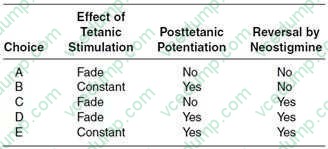
The table below provides several possible descriptions of the actions of nondepolarizing neuromuscular blockers such as tubocurarine. Which description is most accurate?
A. Option A B. Option B C. Option C D. Option D E. Option E
D. Option D
Explanation
Section: Pharmacology Nondepolarizing neuromuscular blockers are heavily used in anesthesia because they produce full surgical relaxation without causing significant cardiovascular depression. They act as nicotinic cholinoceptor blockers at the neuromuscular nicotinic receptor, with little or no ganglionic blockade. They have some effect on presynaptic cholinoceptors of motor nerves and it is believed that this site of action is the cause of alterations in the response of the motor nervemuscle system to rapid stimulation. A train of four stimulations, a form of titanic stimulation, is used by anesthesiologists to monitor the level of neuromuscular block in the anesthetized patient and consists of a brief period of stimulation. In the absence of drugs, as well as in the presence of a depolarizing blocker, the twitches during train of four are well maintained in strength. However, after a nondepolarizing blocker the contraction strength fades during the sequence (choices A, C, or D). In the absence of drugs, rapid tetanic stimulation results in moderate increase in contraction during the tetanus and a marked increase in strength of the muscle twitch following the end of the train due, at least in part, to a buildup of calcium in the motor nerve terminal. This posttetanic potentiation is enhanced by nondepolarizing blockers (choices B, D, or E). Finally, nondepolarizing blockade results from competitive blockade of cholinoceptors, so increasing the amount of acetylcholine in the synapse by means of a drug like neostigmine can reverse the blockade (choices C, D, or E). Thus, only choice D meets all three requirements.
Nowadays, the certification exams become more and more important and required by more and more
enterprises when applying for a job. But how to prepare for the exam effectively? How to prepare
for the exam in a short time with less efforts? How to get a ideal result and how to find the
most reliable resources? Here on Vcedump.com, you will find all the answers.
Vcedump.com provide not only USMLE exam questions,
answers and explanations but also complete assistance on your exam preparation and certification
application. If you are confused on your USMLE-STEP-1 exam preparations
and USMLE certification application, do not hesitate to visit our
Vcedump.com to find your solutions here.