USMLE-STEP-1 Exam Details
-
Exam Code
:USMLE-STEP-1 -
Exam Name
:United States Medical Licensing Step 1 -
Certification
:USMLE Certifications -
Vendor
:USMLE -
Total Questions
:847 Q&As -
Last Updated
:May 25, 2026
USMLE USMLE-STEP-1 Online Questions & Answers
-
Question 241:
Infants exhibiting profound metabolic ketoacidosis, muscular hypotonia, developmental retardation, and who have very large accumulations of methylmalonic acid in their blood and urine suffer from a disorder known as methylmalonic acidemia. This disorder results from a defect in which of the following enzymes?
A. alpha-keto acid dehydrogenase
B. homogentisic acid oxidase
C. methylmalonyl-CoA mutase
D. phenylalanine hydroxylase
E. tyrosine aminotransferase -
Question 242:
A 4-year-old patient is presented in the pediatric clinic with microcytic anemia. An analysis of his blood by nondenaturing electrophoresis reveals the following composition of hemoglobin isoforms:
HbF = 75%, HbA = 23%, HbA2 = 2%, and HbS = 0%. Using these data, is it possible to determine that the infant is most likely homozygous for which of the following?
A. complete deletion of the alpha-globin locus
B. complete deletion of the beta-globin locus
C. mutation in the promoter of the betaglobin genes
D. nonsense mutation in the alpha-globin genes
E. nonsense mutation in the beta-globin genes -
Question 243:
Ajudge has a fungal infection known as "Tinea cruris." Which one of the following statements concerning this infection is accurate?
A. It cannot be transmitted from person to person.
B. It involves a fungus that produces aflatoxins.
C. It is associated with athlete's foot.
D. It is caused by a fungus that forms tuberculate macroconidia.
E. It occurs primarily in immunocompromised individuals. -
Question 244:
Aphysician is treating a patient whom he suspects of factitious disorder. If the physician learns that the patient would have been incarcerated for a criminal offense if he had not been hospitalized, which of the following diagnoses becomes most likely?
A. antisocial personality disorder
B. borderline personality disorder
C. malingering
D. Munchausen syndrome
E. sick-role addiction -
Question 245:
Calcium- and aluminum-containing antacids should be avoided by patients taking which of the following antimicrobial drugs?
A. amoxicillin
B. erythromycin
C. isoniazid
D. minocycline
E. rifampin -
Question 246:
Viruses have various ways of entering the human body and producing disease. Which of the following descriptions accurately describe the route and mechanism for the virus indicated?
A. Coronaviruses enter the gastrointestinal tract through the mouth and move into the stomach, where they proliferate within mucosal cells to produce peptic ulcers.
B. Enteroviruses enter through the mouth, replicate in the pharynx and bowel, and move via the blood to distant target organs (central nervous system).
C. HIV is directly injected into the blood stream by insects requiring blood for egg development.
D. Influenza viruses enter through the respiratory tract, replicate within lymphocytes in the lung, and move via the lymphatic vessels to joints and the central nervous system to produce muscle aches, stiff joints, and fever.
E. Mumps virus enters through abraded skin in the genital area and moves into the testicles of males to produce swelling and sterility. -
Question 247:
A 53-year-old male patient has developed an abnormal hypersensitivity in the face area. He complains that he feels pain when he drives with the window down and from the wind blowing on his face. The pain is exacerbated by direct touch to the left side of his lower jaw. The patient is diagnosed with trigeminal neuralgia (tic douloureux). Where do pain fibers from the left side of his mandible project to?
A. mesencephalic trigeminal nucleus
B. motor trigeminal nucleus
C. principal sensory trigeminal nucleus
D. spinal (descending) trigeminal nucleus
E. trigeminal (gasserian) ganglion -
Question 248:
Aurease-positive, spiral-shaped gram-negative rod is found in gastric washings from a 29-year-old stressed-out medical student with gastritis. Which of the following is most likely to be this organism?
A. Campylobacter jejuni
B. Helicobacter pylori
C. Proteus mirabilis
D. Providencia rettgeri
E. Vibrio cholerae -
Question 249:
Referring to following figure what is the most likely source of this epithelium?
A. gall bladder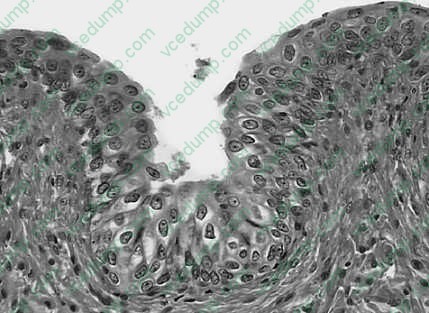
B. salivary duct
C. thick skin
D. trachea
E. urinary bladder -
Question 250:
Which of the following drugs inhibit osteoclastic activity more than osteoblastic activity and have been beneficial in osteoporosis, hypercalcemia of malignancy, and Paget disease?
A. alendronate
B. calcitonin
C. fluoride
D. parathyroid hormone
E. vitamin D
Tips on How to Prepare for the Exams
Nowadays, the certification exams become more and more important and required by more and more enterprises when applying for a job. But how to prepare for the exam effectively? How to prepare for the exam in a short time with less efforts? How to get a ideal result and how to find the most reliable resources? Here on Vcedump.com, you will find all the answers. Vcedump.com provide not only USMLE exam questions, answers and explanations but also complete assistance on your exam preparation and certification application. If you are confused on your USMLE-STEP-1 exam preparations and USMLE certification application, do not hesitate to visit our Vcedump.com to find your solutions here.