USMLE-STEP-1 Exam Details
-
Exam Code
:USMLE-STEP-1 -
Exam Name
:United States Medical Licensing Step 1 -
Certification
:USMLE Certifications -
Vendor
:USMLE -
Total Questions
:847 Q&As -
Last Updated
:May 25, 2026
USMLE USMLE-STEP-1 Online Questions & Answers
-
Question 231:
A 43-year-old woman with a long history of chronic allergies visits her primary care physician with a 2-week history of progressive left perinasal pain and nasal pressure, increasing episodes of yellowish- green nasal discharge, and a fever 1 day prior of 100.8<pdf2txt-u>癋</pdf2txt-u>. Sign ificant findings on physical examination include a temperature of 101.0<pdf2txt-u>癋</pdf2txt-u>, tenderness to palpation ove r the left maxillary sinus, and nasal speculum observation of obstruction of the left middle meatus by a large, pale, polypoid mass with a small focus of ulceration and a similar but smaller mass seen in the right middle meatus. A clinical diagnosis of left maxillary sinusitis is made and the patient is started on antibiotics. She is subsequently referred to an otolaryngologist who excises the bilateral masses to relieve the sinus obstruction. Which of the following findings would you expect the pathologist to see on microscopic examination of these masses?
A. hyperkeratotic squamous epithelium with a submucosal core of myxoid connective tissue, frequent blood vessels, mild fibrosis, and a mononuclear infiltrate
B. myofibroblastic proliferation in a dense fibrovascular stroma with numerous endothelial-lined channels
C. papillomatous proliferation of squamous epithelium extending downward through the submucosal connective tissue
D. respiratory epithelium containing an edematous, loose stroma and a mixed inflammatory infiltrate, with a prominence of neutrophils and eosinophils
E. undifferentiated large epithelial cells with round vesicular nuclei and prominent nucleoli in a syncytial arrangement with a marked lymphocytic infiltration -
Question 232:
A 50-year-old woman complains of a lump in her thyroid gland. Fine-needle aspiration of this lump is reported as medullary carcinoma. A test of her serum would most likely reveal an increased level of which of the following?
A. alpha-Fetoprotein
B. cancer antigen (CA) 125
C. CA 153
D. calcitonin
E. human chorionic gonadotropin -
Question 233:
Which of the following implies the multiaxial diagnostic system in psychiatric disorders?
A. All psychiatric disorders are personality disorders.
B. Psychiatric disorders and other diseases can coexist.
C. Psychiatric disorders are a subset of medical diseases.
D. Psychiatric disorders are complex. -
Question 234:
The great cerebral vein of Galen indicated by arrow 4 in following figure is formed by the union of two internal cerebral veins and drains into which of the following?
A. confluence of sinuses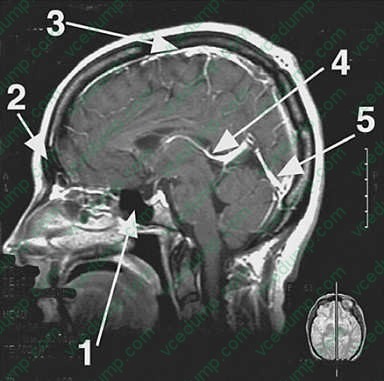
B. frontal sinus
C. sphenoid sinus
D. straight sinus
E. superior sagittal sinus -
Question 235:
Exhibit #1:
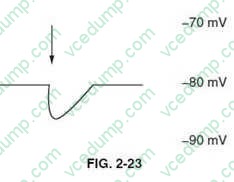
Exhibit #2:
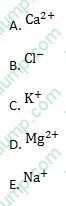
Below figure shows the change in the membrane potential of a postsynaptic neuron caused by addition, at the arrow, of a neurotransmitter. The resting membrane potential of this cell is -80 mV. Relevant equilibrium potentials for +, , +, , and are, respectively, +120 mV, +60 mV,

0 mV, -80 mV, and -90 mV. This neurotransmitter likely increases the conductance of which of the following ions?
A. A
B. B
C. C
D. D
E. E -
Question 236:
The graph in below figure shows the jugular vein pressure curve of this patient. If the first heart sound occurs between letters C and D, which part of the curve represents the atrial contraction?
A. peak A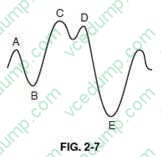
B. peak C
C. peak D
D. trough B
E. trough E -
Question 237:
An 8-year-old boy is referred to a neurologist by his family physician because he has developed progressive slow and clumsy walking. On examination, the patient has difficulty with standing and running. While standing, he adopts a wide-based gait with constant shifting of position to maintain his balance. Sitting or standing, he also displays a constant tremor of the head and trunk. When asked to walk, his feet strike the ground in an uneven and irregular rhythm; if he attempts to correct his imbalance, he displays wild and abrupt movements. A magnetic resonance image (MRI) reveals demyelination in the dorsal columns, corticospinal and spinocerebellar tracts. The child is diagnosed with Friedreich's ataxia, an autosomal recessive neurological disorder resulting from mutation of a gene locus on chromosome 9. Second-order neurons of the dorsal (posterior) spinocerebellar tracts are located in which of the following?
A. deep cerebellar nuclei
B. dorsal root ganglion
C. nucleus cuneatus
D. nucleus dorsalis (Clarke's column)
E. Rexed's lamina IX of the spinal cord -
Question 238:
Potassium supplementation is often necessary for patients taking large doses of which of the following drugs?
A. amiloride
B. captopril
C. hydrochlorothiazide
D. losartan
E. spironolactone -
Question 239:
Muscle membrane will depolarize in response to acetylcholine binding its receptors at the neuromuscular junction. Associated with this depolarization are changes in glycogen metabolism in skeletal muscle cells. Which of the following represents the correct changes in enzyme activity seen in response to acetylcholine binding?
A. decreased glycogen phosphorylase kinase activity due to an increase in calcium binding to its calmodulin subunit
B. decreased phosphorylation of, and inhibited activity of glycogen phosphorylase kinase
C. increased glycogen phosphorylase kinase activity due to an activation of phosphoprotein phosphatase
D. increased glycogen phosphorylase kinase activity due to an increase in calcium binding to its calmodulin subunit
E. increased phosphorylation of, and inhibited activity of glycogen phosphorylase kinase -
Question 240:
A newborn infant suffers from cyanotic heart disease caused by transposition of the great arteries (TGA). In this situation, the aorta arises from which of the following structures?
A. ductus arteriosus
B. left atrium
C. left ventricle
D. right atrium
E. right ventricle
Tips on How to Prepare for the Exams
Nowadays, the certification exams become more and more important and required by more and more enterprises when applying for a job. But how to prepare for the exam effectively? How to prepare for the exam in a short time with less efforts? How to get a ideal result and how to find the most reliable resources? Here on Vcedump.com, you will find all the answers. Vcedump.com provide not only USMLE exam questions, answers and explanations but also complete assistance on your exam preparation and certification application. If you are confused on your USMLE-STEP-1 exam preparations and USMLE certification application, do not hesitate to visit our Vcedump.com to find your solutions here.