USMLE-STEP-1 Exam Details
-
Exam Code
:USMLE-STEP-1 -
Exam Name
:United States Medical Licensing Step 1 -
Certification
:USMLE Certifications -
Vendor
:USMLE -
Total Questions
:847 Q&As -
Last Updated
:May 25, 2026
USMLE USMLE-STEP-1 Online Questions & Answers
-
Question 251:
Which of the following drugs binds to, and prevents disassembly of, microtubules?
A. busulfan
B. cisplatin
C. mercaptopurine
D. paclitaxel
E. vinblastine -
Question 252:
Aperilunate fracture dislocation is a devastating closed injury of the wrist. It usually results from a fall where the weight of the body is transferred onto the wrist. The hand is caught in the hyperextended and ulnar deviated position. The fracture dislocation involves rupture of interosseous ligaments, joints, and ultimately dislocation/fracture of the lunate bone. In the anatomical position, which carpal bone lies directly distal to the lunate?
A. capitates
B. hamate
C. scaphoid
D. trapezoid
E. triquetrum -
Question 253:
Hormone-secreting chromophils in the pars distalis of the adenohypophysis are classified into acidophils and basophils. Which of the following hormones is secreted by the acidophils?
A. adrenocorticotropin
B. follicle-stimulating hormone
C. luteinizing hormone
D. prolactin
E. thryrotropin (thyroid-stimulating hormone) -
Question 254:
As part of a neurological examination, a patient is placed in a chair that rotates to the right under the control of a computer so that the patient's head and body move in unison with the chair. How would a healthy person react immediately upon getting off the chair that turned for 1 minute?
A. behave the same as before the rotation
B. display post-rotational eye nystagmus to the right
C. experience a vertigo that would be diminished if he immediately got back in the rotating chair
D. experience "past pointing" to the left when asked to reach a target
E. fall to the left when asked to walk on a straight line -
Question 255:
Your patient presents in your office complaining of hoarseness. During your examination, you find that one vocal fold has deviated toward the midline and does not abduct during deep inspiration or vocalization. You also observe that touch sensation in the vestibule of the larynx appears to be intact.
You suspect that a nerve has been damaged, but which nerve is most likely involved?
A. external laryngeal
B. glossopharyngeal
C. inferior laryngeal
D. internal laryngeal
E. superior laryngeal -
Question 256:
Which of the following statements about the leukotrienes LT LT and LT is most correct?
A. Their biosynthesis is inhibited by aspirin.
B. They are chemotactic agents for polymorphonuclear leukocytes.
C. They are potent bronchoconstrictor substances.
D. They are synthesized and stored in platelet granules.
E. They have few cardiovascular effects. -
Question 257:
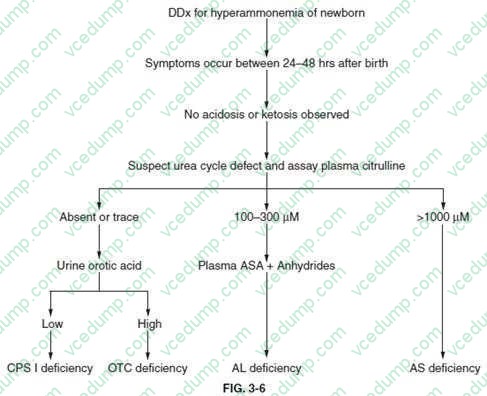
An individual harboring a mutation in ornithine transcarbamoylase (OTC) would be expected to exhibit which of the following measurable abnormalities?
A. citrullinemia
B. elevated urinary excretion of argininosuccinic acid
C. elevation in blood orotic acid
D. excess production of foam cells
E. uric acid deposition in the joints -
Question 258:
Lack of oxygen (hypoxia) will cause reflex vasoconstriction in the circulation supplying which of the following organs?
A. brain
B. heart muscle
C. kidney
D. lungs
E. skeletal muscle -
Question 259:
Which of the following drugs blocks the action of angiotensin II at the AT1 receptor?
A. bradykinin
B. enalapril
C. losartan
D. ondansetron
E. prazosin -
Question 260:
Which of the following persons will have a negative free-water clearance?
A. one who begins excreting large volumes of urine with an osmolality of 100 mosm/kg H2O after severe head injury
B. one who drinks 2 L of distilled water in 30 minutes
C. one who is receiving lithium treatment for depression, and who develops polyuria that is unresponsive to administration ADH
D. one with an oat cell carcinoma of the lung, who excretes urine with an osmolality of 1000 mosm/kg H2O
E. one with neurogenic diabetes insipidus
Tips on How to Prepare for the Exams
Nowadays, the certification exams become more and more important and required by more and more enterprises when applying for a job. But how to prepare for the exam effectively? How to prepare for the exam in a short time with less efforts? How to get a ideal result and how to find the most reliable resources? Here on Vcedump.com, you will find all the answers. Vcedump.com provide not only USMLE exam questions, answers and explanations but also complete assistance on your exam preparation and certification application. If you are confused on your USMLE-STEP-1 exam preparations and USMLE certification application, do not hesitate to visit our Vcedump.com to find your solutions here.