SBAC Exam Details
-
Exam Code
:SBAC -
Exam Name
:Smarter Balanced Assessment Consortium -
Certification
:Test Prep Certifications -
Vendor
:Test Prep -
Total Questions
:224 Q&As -
Last Updated
:Jul 08, 2026
Test Prep SBAC Online Questions & Answers
-
Question 181:
Which of these sentences does not use standard capitalization?
A. Although she was invited, Alana claimed she was "way too busy" to join us for coffee.
B. Sarah asked, "Where are we going tonight after the movie?"
C. Harry applied to start college in the spring, as he planned to take a "gap semester" in the fall after his high school graduation.
D. Traveling from Alaska to Argentina on a motorcycle: this was the trip he had waited his whole life to take. -
Question 182:
Aimee plans to open a lemonade stand. She wants to determine whether to sell an 8 ounce or 10 ounce cup of lemonade. Each 8-ounce cup costs 2 cents and 10 ounce cups are 3 cents each. The lemons to make a half-gallon of lemonade cost 5 dollars and the sugar for the half-gallon costs 85 cents. She already has all the materials needed to make the stand and she can use the location at no cost. Aimee notices that about 150 people pass by the location of her stand each day and thinks that 20 percent of these people will buy a cup of lemonade. You have made the 2 accompanying graphs to help Aimee make business decisions.
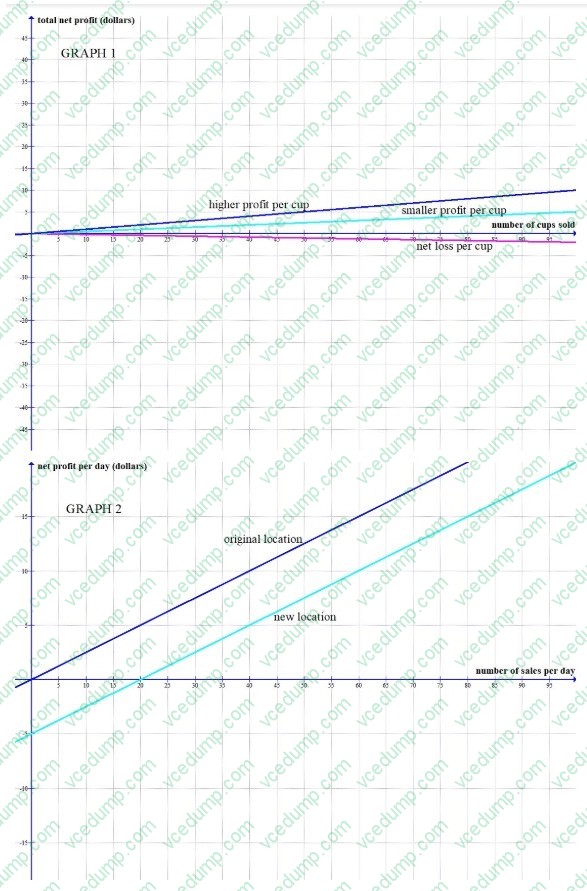
Read the attached passage and consult the attached graph. In graph 2, which point shows the sales Aimee needs to break even at the new location?
A. the y-intercept of the "new location" line
B. the point where the 2 lines intersect
C. the intercept of the "original location" line at (0,0)
D. the x-intercept of the "new location" line -
Question 183:
Read the text attached.
Study Suggests Today's US Students Are Less Efficient Readers
Do today's students perform better than their peers in 1960? Given the advances in education and technology, it would be natural to assume that the answer is a resounding "yes." But, when it comes to reading efficiency, new research
suggests that that's not the case. The research, published by the International Literacy Association, compares the comprehension-based silent reading efficiency of US students (grades 2?2) in 2011 with data collected in 1960. A key finding
was that students fall further behind as they advance through the grades, wrote Alexandra Spichtig, Ph.D., Chief Resource Officer of Reading Plus, and first author of the study. The study showed that today's second-grade students are
comparable to their peers of 50 years ago, but that by the end of high school, students' comprehension-based silent reading rates average 19 percent slower than the rates of their 1960 peers. "What we know ?and the data underscore this ?
is that for many students, the progression to efficient silent reading does not develop naturally. Many students need structured silent reading instruction," explains Mark Taylor, Chief Executive Officer of Reading Plus, a web-based silent
reading program for schools. Some of the benefits of implementing silent reading instruction at home or in school are: expanded vocabulary, improved comprehension, increased efficiency, enhanced reading enjoyment, [and] improved writing
skills. Experts agree that without extensive silent reading practices in the classroom or at home, students will continue to struggle and literacy rates will continue to fall short or fall behind. "Effective reading instruction must integrate fluency,
vocabulary, and comprehension practice tailored to meet each student's unique needs. This study demonstrates that as long as structured silent reading practice is neglected in this country, the literacy problem is likely to continue," Taylor
adds. While researchers can't pinpoint reasons for the decline in silent reading efficiency from that of 50 years ago, it stands to reason that those students who engage in structured silent reading practice become more efficient readers and
take with them a love of books that lasts far past their high school graduation.
Which two of these claims does the attached text not support?
Claim 1: The benefits of silent reading skills far outweigh the time and effort it may take to teach students how to do it effectively. Claim 2: Parents must spend more time instilling a love of literature and reading in their children by reading with
them from a young age.
Claim 3: Technology is distracting today's readers, making it more difficult for them to concentrate on silent reading activity.
Claim 4: Silent reading is a skill that mist be taught how to silent read effectively.
Claim 5: There is a decline in comprehension-based silent reading rates in today's students as compared with students in 1960.
A. claims 3 and 4
B. claims 1 and 5
C. claims 2 and 5
D. claims 2 and 3 -
Question 184:
Read the text attached.
Passage 1
Critical information needed in fight to save wildlife
With global temperatures rising, an international group of 22 top biologists is calling for a coordinated effort to gather important species information that is urgently needed to improve predictions for the impact of climate change on future biodiversity. Current predictions fail to account for important biological factors like species competition and movement that can have a profound influence on whether a plant or animal survives changes to its environment, the scientists say in the September 9 issue of the journal Science. While more sophisticated forecasting models exist, much of the detailed species information that is needed to improve predictions is lacking.
"Right now, we're treating a mouse the same way as an elephant or a fish or a tree. Yet we know that those are all very different organisms and they are going to respond to their environment in different ways," says University of Connecticut Ecologist Mark Urban, the Science article's lead author. "We need to pull on our boots, grab our binoculars, and go back into the field to gather more detailed information if we are going to make realistic predictions."
The 22 top biologists affiliated with the article identify six key types of biological information, including life history, physiology, genetic variation, species interactions, and dispersal, that will significantly improve prediction outcomes for individual species. Obtaining that information will not only help the scientific community better identify the most at-risk populations and ecosystems, the scientists say, it will also allow for a more targeted distribution of resources as global temperatures continue to rise at a record rate.
Current climate change predictions for biodiversity draw on broad statistical correlations and can vary widely, making it difficult for policymakers and others to respond accordingly. Many of those predictions tend not to hold up over time if they fail to account for the full range of biological factors that can influence an organism's survival rate: species demographics, competition from other organisms, species mobility, and the capacity to adapt and evolve.
"We haven't been able to sufficiently determine what species composition future ecosystems will have, and how their functions and services for mankind will change," says co-author Dr. Karin Johst of the Helmholtz Centre for Environmental Research and the German Centre for Integrative Biodiversity Research. "This is because current ecological models often do not include important biological processes and mechanisms: so far only 23 percent of the reviewed studies have taken into account biological mechanisms."
Generating more accurate predictions is essential for global conservation efforts. Many species are already moving to higher ground or toward the poles to seek cooler temperatures as global temperatures rise. But the capacity of different organisms to survive varies greatly. Some species of frog, for instance, can traverse their terrain for miles to remain in a habitable environment. Other species, such as some types of salamander, are less mobile and capable of moving only a few meters over generations.
"New Zealand's strong foundation in ecological research will help," explains study co-author Dr. William Godsoe, a Lincoln University lecturer and member of New Zealand's Bio-Protection Research Centre. "One of our hopes is to build on these strengths and highlight new opportunities to improve predictions by explicitly considering evolution, interactions among species, and dispersal." This will aid in the development of strategies to manage impacts on species and ecosystems before they become critical.
With more than 8.7 million species worldwide, gathering the necessary biological information to improve predictions is a daunting task. Even a sampling of key species would be beneficial, the authors say, as the more sophisticated models will allow scientists to extrapolate their predictions and apply them to multiple species with similar traits.
The researchers are calling for the launch of a global campaign to be spearheaded by the Intergovernmental Science-Policy Platform on Biodiversity and Ecosystem Services or IPBES. The IPBES operates under the auspices of four United Nations entities and is dedicated to providing scientific information to policymakers worldwide. One thousand scientists from all over the world currently contribute to the work of IPBES on a voluntary basis. The scientists are also encouraging conservation strategies to support biodiversity such as maintaining dispersal corridors, and preserving existing natural habitats and genetic diversity.
"Our biggest challenge is pinpointing which species to concentrate on and which regions we need to allocate resources," says UConn Associate Professor Urban. In an earlier study in Science, Urban predicted that as many as one in six species internationally could be wiped out by climate change. "We are at a triage stage at this point. We have limited resources and patients lined up at the door."
Passage 2
Forecasting climate change's effects on biodiversity hindered by lack of data
An international group of biologists is calling for data collection on a global scale to improve forecasts of how climate change affects animals and plants. Accurate model predictions can greatly aid efforts to protect biodiversity from disturbances such as climate change and urban sprawl by helping scientists and decision-makers better understand, anticipate and respond to threats that imperil species and ecosystems.
In a paper published in Science on Thursday (Sept. 8), biologists cite a critical lack of data on key biological mechanisms ?such as how animals and plants spread during their lifetime and how they evolve in response to changes in the environment - as the main obstacle to improving models' ability to forecast species' response to climate change.
"This paper is a call to arms," said Patrick Zollner, article co-author and Purdue associate professor of wildlife science. "The world is in dire circumstances. We're losing a lot of species, and we're largely unaware why. How do we need to rethink the kind of data we're collecting so we can take advantage of modern modeling tools to understand the outcomes of climate change for ecological systems? This could help us forestall losing wildlife that we later deeply regret."
The group outlines two key problems that hinder the capability of current models to make realistic predictions about biological responses to climate change.
Most models are descriptive, based on statistical correlations and observations, and fail to capture the underlying processes that produce observed changes. For example, a descriptive model might show that lynx in the northern U.S. are
declining while bobcat populations in the same region are on the rise. Understanding what is driving this change requires a different sort of model, one that incorporates biological mechanisms. A mechanistic model that accounts for how
warming temperatures affect snow depth, for instance, could provide insights into why bobcats - better adapted to habitats with less snow - are gaining a competitive edge over lynx. But 77 percent of current models of climate change's
impacts on wildlife do not include biological mechanisms.
Another challenge is that as models have grown in sophistication, they have far outpaced data collection. Put another way, a model is like a state-of-the-art kitchen, but the cupboards are bare.
"We can now build videogame-like environments with computers where we can create multiple versions of Earth and ask what the implications under different scenarios are," Zollner said. "But our ability to learn from these tools is constrained
by the kinds of data we have."
The group advanced several proposals on how to improve models, collect missing data and leverage available data to make broader predictions.
They identified six biological mechanisms that influence wildlife's responses to climate change: physiology; demography and life history; evolutionary potential and adaptation; interactions between species; movement over land or water; and
responses to changes in the environment. They ranked the information needed to account for these mechanisms in models and suggested proxies for data that are missing or hard to collect.
A globally coordinated effort to fill data gaps could greatly advance improvements in models and informed conservation approaches, the researchers wrote. They point to the Intergovernmental Panel on Climate Change and its consistent
improvements in climate change modeling as a valuable blueprint for such a project.
But local and regional conservation groups need not wait for a global body to coalesce to start using a mechanistic approach in their own region, Zollner said "If the ideas put forth in this paper start to be adopted and integrated into climate
change work in a grass roots way, that could make a big difference in a region and could scale up over time," he said.
Citizen scientists also have an important role to play in pitching in with data collection, he said.
Working with citizen scientists offers "an opportunity to get huge amounts of data, and it's foolish not to take advantage of it," Zollner said. "The data might not be as rigorous and needs to be treated differently, but it's one more source of
valuable information.
The author's purpose in Passage 2 of the attached text is most likely to ____.
A. convince the reader to join the global effort to gather data about the effects of climate change on plant and animal species
B. scare the reader into being a more environmentally conscientious member of the planet, taking into consideration energy use and waste production
C. inform the reader about the need for more data to more accurately predict the effect of climate change on plant and animal species
D. persuade the reader that the current methods of modeling and predicting how plants and animals will respond to climate change are inadequate, and so funding for this kind of research needs to be increased -
Question 185:
A. Option A
B. Option B
C. Option C
D. Option D -
Question 186:
A drug company is evaluating a new method to measure levels of sugar in blood samples. The test is run hundreds of times on samples where the true level of sugar is already known. No test will be perfectly accurate all of the time, but it is
important that the result of any test be as close to the correct value as possible.
Which of these statistical measures will be most helpful in determining if the testing method in the attached description meets this condition?
1.
the mode of the test results
2.
the mean of the test results
3.
the minimum and maximum values of the test results
4.
the standard deviation of the test results
A. 3 and 4
B. 1 and 2
C. 3 only
D. 2 only -
Question 187:
FILL BLANK
Case study
Lights, Candles, Action!
Your friend Abbie is making a movie. She is filming a fancy dinner scene and she has two types of candles on the table. She wants to determine how long the candles will last.
She takes a picture, lights the candles, and then lets them burn for 1 hour. She then takes a second picture. You can assume that each candle burns at its won constant rate.
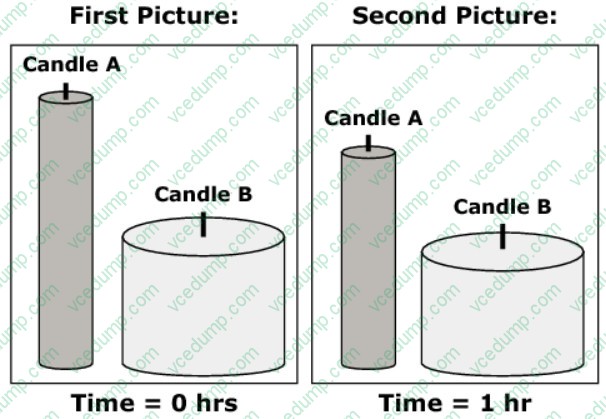
Candle Type A initial height = 20 cm
Candle Type B initial height = 10 cm
Candle Type A height after burning for 1 hour = 16 cm
Candle Type B heignt after burning for 1 hour = 9 cm
You will use this information to help Abbie think about the candles she might use for her film.
t hours after it is lit.
Now, choose either Candle A or Candle B to create an equation that will tell Abbie the height of the candle at
Determine what the numerical values for k and n should be for the candle you chose.
Using these k and n values, write an equation that tells Abbie the height h of the candle, in cm, at t hours after it is lit.
A. See explanation below -
Question 188:
Aimee plans to open a lemonade stand. She wants to determine whether to sell an 8 ounce or 10 ounce cup of lemonade. Each 8-ounce cup costs 2 cents and 10 ounce cups are 3 cents each. The lemons to make a half-gallon of lemonade cost 5 dollars and the sugar for the half-gallon costs 85 cents. She already has all the materials needed to make the stand and she can use the location at no cost. Aimee notices that about 150 people pass by the location of her stand each day and thinks that 20 percent of these people will buy a cup of lemonade. You have made the 2 accompanying graphs to help Aimee make business decisions.
Read the attached passage and consult the attached graphs. Which of these unit conversions will you need to use to calculate the costs per cup?
1.
dollars to cents
2.
gallons to ounces
3.
gallons to cups
4.
pounds to ounces
A. conversions 1 and 2
B. conversion 3 only
C. conversions 1 and 4
D. conversion 2 only -
Question 189:
FILL BLANK
Case study
Lights, Candles, Action!
Your friend Abbie is making a movie. She is filming a fancy dinner scene and she has two types of candles on the table. She wants to determine how long the candles will last.
She takes a picture, lights the candles, and then lets them burn for 1 hour. She then takes a second picture. You can assume that each candle burns at its won constant rate.
Candle Type A initial height = 20 cm
Candle Type B initial height = 10 cm Candle Type A height after burning for 1 hour = 16 cm Candle Type B height after burning for 1 hour = 9 cm
You will use this information to help Abbie think about the candles she might use for her film.
Abbie has 3 hours left to film. She lights a new Candle Type A and Candle Type B and then starts filming.
In the 3 hours she has left, will Abbie capture the moment when the candles are exactly the same height?
Explain to Abbie how you can determine the answer.
A. See explanation below -
Question 190:
Read the text and answer the question.
Blue Crabs Provide Evidence of Oil Tainting Gulf Food
Weeks ago, before engineers pumped in mud and cement to plug the gusher, scientists began finding specks of oil in crab larvae plucked from waters across the Gulf coast.
The government said last week that three-quarters of the spilled oil has been removed or naturally dissipated from the water. But the crab larvae discovery was an ominous sign that crude had already infiltrated the Gulf's vast food web – and
could affect it for years to come.
"It would suggest the oil has reached a position where it can start moving up the food chain instead of just hanging in the water," said Bob Thomas, a biologist at Loyola University in New Orleans.
"Something likely will eat those oiled larvae . . . and then that animal will be eaten by something bigger and so on."
Tiny creatures might take in such low amounts of oil that they could survive, Thomas said. But those at the top of the chain, such as dolphins and tuna, could get fatal "megadoses."
Marine biologists routinely gather shellfish for study. Since the spill began, many of the crab larvae collected have had the distinctive orange oil droplets, said Harriet Perry, a biologist with the University of Southern Mississippi's Gulf Coast
Research Laboratory.
"In my 42 years of studying crabs I've never seen this," Perry said.
She wouldn't estimate how much of the crab larvae are contaminated overall, but said about 40 percent of the area they are known to inhabit has been affected by oil from the spill.
While fish can metabolize dispersant and oil, crabs may accumulate the hydrocarbons, which could harm their ability to reproduce, Perry said in an earlier interview with Science magazine.
She told the magazine there are two encouraging signs for the wild larvae – they are alive when collected and may lose oil droplets when they molt.
Tulane University researchers are investigating whether the splotches also contain toxic chemical dispersants that were spread to break up the oil but have reached no conclusions, biologist Caz Taylor said.
If large numbers of blue crab larvae are tainted, their population is virtually certain to take a hit over the next year and perhaps longer, scientists say. The spawning season occurs between April and October, but the peak months are in July
and August.
How large the die-off would be is unclear, Perry said. An estimated 207 million gallons of oil have spewed into the Gulf since an April 20 drilling rig explosion triggered the spill, and thousands of gallons of dispersant chemicals have been
dumped.
Scientists will be focusing on crabs because they're a "keystone species" that play a crucial role in the food web as both predator and prey, Perry said.
Richard Condrey, a Louisiana State University oceanographer, said the crabs are "a living repository of information on the health of the environment."
Named for the light-blue tint of their claws, the crabs have thick shells and 10 legs, allowing them to swim and scuttle across bottomlands. As adults, they live in the Gulf's bays and estuaries amid marshes that offer protection and abundant
food, including snails, tiny shellfish, plants and even smaller crabs. In turn, they provide sustenance for a variety of wildlife, from redfish to raccoons and whooping cranes.
Adults could be harmed by direct contact with oil and from eating polluted food. But scientists are particularly worried about the vulnerable larvae.
That's because females don't lay their eggs in sheltered places, but in areas where estuaries meet the open sea. Condrey discovered several years ago that some even deposit offspring on shoals miles offshore in the Gulf.
The larvae grow as they drift with the currents back toward the estuaries for a month or longer. Many are eaten by predators and only a handful of the 3 million or so eggs from a single female live to adulthood.
But their survival could drop even lower if the larvae run into oil and dispersants.
"Crabs are very abundant. I don't think we're looking at extinction or anything close to it," said Taylor, one of the researchers who discovered the orange spots.
Still, crabs and other estuary-dependent species such as shrimp and red snapper could feel the effects of remnants of the spill for years, Perry said.
"There could be some mortality, but how much is impossible to say at this point," said Vince Guillory, biologist manager with the Louisiana Department of Wildlife and Fisheries.
Perry, Taylor and Condrey will be among scientists monitoring crabs for negative effects such as population drop-offs and damage to reproductive capabilities and growth rates.
Crabs are big business in the region. In Louisiana alone, some 33 million pounds are harvested annually, generating nearly $300 million in economic activity, Guillory said.
Blue crabs are harvested year-round, but summer and early fall are peak months for harvesting, Guillory said.
Prices for live blue crab generally have gone up, partly because of the Louisiana catch scaling back due to fishing closures, said Steve Hedlund, editor of SeafoodSource.com, a website that covers the global seafood industry.
Fishers who can make a six-figure income off crabs in a good year now are now idled – and worried about the future.
"If they'd let us go out and fish today, we'd probably catch crabs," said Glen Despaux, 37, who sets his traps in Louisiana's Barataria Bay. "But what's going to happen next year, if this water is polluted and it's killing the eggs and the larvae? I
think it's going to be a long-term problem."
Excerpt from "Blue Crabs Provide Evidence of Oil Tainting Gulf Food Web" by John Flesher. Copyright © 2010 by The Associated Press. Reprinted by permission of The Associated Press.
The following question is divided into two parts. First, answer part A. Then, answer part B.
Part B
Which sentence from the text best expresses the same central idea you choose in part A?
Note:
Part A
Q: Read this section from the text and the directions that follow.
Weeks ago, before engineers pumped in mud and cement to plug the gusher, scientists began finding specks of oil in crab larvae plucked from waters across the Gulf coast.
The government said last week that three-quarters of the spilled oil has been removed or naturally dissipated from the water. But the crab larvae discovery was an ominous sign that crude had already infiltrated the Gulf's vast food web – and could affect it for years to come.
“It would suggest the oil has reached a position where it can start moving up the food chain instead of just hanging in the water”, said Bob Thomas, a biologist at Loyola University in New Orleans. “Something likely will eat those oiled larvae… and then that animal will be eaten by something bigger and so on.”
What is the central idea of the section?
A:
Scientists fear long-term negative effects on Gulf coast organisms from contaminated blue crab larvae.
A. The government said last week that three-quarters of the spilled oil has been removed or naturally dissipated from the water.
B. "Something likely will eat those oiled larvae...and then that animal will be eaten by something bigger and so on."
C. She told the magazine there are two encouraging signs for the wild larvae ?they are alive when collected and may lose oil droplets when they molt.
D. Adults could be harmed by direct contact with oil and from eating polluted food. But scientists are particularly worried about the vulnerable larvae.
E. "But what's going to happen next year, if this water is polluted and it's killing the eggs and larvae? I think it's going to be a long-term problem."
Related Exams:
-
AACD
American Academy of Cosmetic Dentistry -
ACLS
Advanced Cardiac Life Support -
ASSET
ASSET Short Placement Tests Developed by ACT -
ASSET-TEST
ASSET Short Placement Tests Developed by ACT -
BUSINESS-ENVIRONMENT-AND-CONCEPTS
Certified Public Accountant (Business Environment amd Concepts) -
CBEST-SECTION-1
California Basic Educational Skills Test - Math -
CBEST-SECTION-2
California Basic Educational Skills Test - Reading -
CCE-CCC
Certified Cost Consultant / Cost Engineer (AACE International) -
CGFNS
Commission on Graduates of Foreign Nursing Schools -
CLEP-BUSINESS
CLEP Business: Financial Accounting, Business Law, Information Systems & Computer Applications, Management, Marketing
Tips on How to Prepare for the Exams
Nowadays, the certification exams become more and more important and required by more and more enterprises when applying for a job. But how to prepare for the exam effectively? How to prepare for the exam in a short time with less efforts? How to get a ideal result and how to find the most reliable resources? Here on Vcedump.com, you will find all the answers. Vcedump.com provide not only Test Prep exam questions, answers and explanations but also complete assistance on your exam preparation and certification application. If you are confused on your SBAC exam preparations and Test Prep certification application, do not hesitate to visit our Vcedump.com to find your solutions here.